
Cinema, Etcetera | Why Does the West Ignore Arab Comedies?
By Joseph Fahim
April 24, 2026
Over the past month, a mid-budget comedy about a group of dim-witted adult students scrambling to pass an Arabic exam has swept across Egypt and the wider Arab world. “Bershama,” the latest outing from sibling filmmakers Khaled and Sherine Diab, has grossed over $8 million worldwide, including a staggering $3 million in Egypt alone — enough to rank as the third highest-grossing Egyptian film of all time a mere month after its release.
Set largely in a rural Egyptian classroom over the course of a single day, “Bershama” is an absolute riot: a confection of situational comedy and sharply timed one-liners delivered with dexterity and precision by an eclectic cast whose comic personas perfectly complement one another.
Enlivening this colourful tapestry is a layer of social commentary on the ethical compromises normalized by economic depression, the erosion of upward mobility and the failed promises of traditional education. The Diabs’ themes are presented straightforwardly, never didactically, a directness that is emblematic of a mainstream cinema that thrives on immediacy and flirts with the boundary between wit and crudeness.

Still from the Egyptian comedy “Bershama,” which has grossed over $8 million worldwide despite having no U.S. distributor. © Orient Films
“Bershama” was released in North America on March 20. It has no American distributor and arrived in theatres with no marketing, no press and no publicity. The film relied solely on word-of-mouth among Egyptians and Arabs familiar with the recent hits of its comedy star, Hesham Maged.
The film has grossed nearly $400,000 in the U.S. — a very respectable figure for an Arab film with such an unconventional release. By comparison, “The President’s Cake,” the Cannes-winning and Oscar-shortlisted Iraqi film released by Sony Pictures Classics and backed by a robust marketing campaign, failed to reach the $300,000 mark during its entire theatrical run.
So why hasn’t anyone picked up “Bershama” for proper distribution? And more broadly, why do Arab comedies remain largely invisible to Western festivals and markets? The answers expose the deeply flawed and questionable programming and distribution practices surrounding Arab cinema outside the region.
“Arab cinema continues to be pigeonholed into a narrow strain of social realism that presents foreign audiences with a familiar, often reductive image of the region: refugees, war, patriarchy, and poverty.”
Comedies, the world over, have long been deemed the least exportable of film genres. “Comedy doesn’t translate,” distributors and curators insist; cultural specificity, local pop culture references and the rhythm and tone of humor are seen as impossible to universalize. Yet this is precisely why comedies are arguably the most authentic expression of their cultures.
Comedies are made first and foremost for local audiences. Wordplay, puns and double meanings are intrinsic to their verbal texture and often difficult to convey in subtitles. In that sense, comedies do not court foreign audiences. They do not over-explain themselves or cloak their ambitions for international recognition in hollow artifice.
There have, of course, been exceptions that have managed to slip through the cracks. Palestinian filmmaker Elia Suleiman — the greatest living Arab filmmaker — introduced a distinct strain of comedy to Arab cinema, characterized by the deadpan humour, symmetrical compositions, restrained performances and recurring visual motifs in such masterworks as “Divine Intervention” (2002) and “The Time That Remains” (2009). Suleiman’s work draws from the postwar Japanese family dramas of Yasujirō Ozu, the postmodern comedies of Jacques Tati, the spiritual rigor of Robert Bresson and the expressive physicality of Buster Keaton’s silent films.
The visual language of Suleiman’s films, widely adopted in Arab advertising, found resonance both regionally and internationally. Their brilliance lies in the way politics and comedy are fused within an aesthetic that is universally legible while remaining rooted in distinctly Palestinian iconography. Though his films have never been commercially successful, his influence has been profound and far-reaching.
Suleiman has had a handful of acolytes. Both Omar El Zohairy, the Egyptian director of the Cannes-winning “Feathers” (2021), and Moroccan filmmaker Alaa Eddine Aljem, director of the Cannes-nominated “The Unknown Saint” (2019), explore similarly stylized comedic terrain.
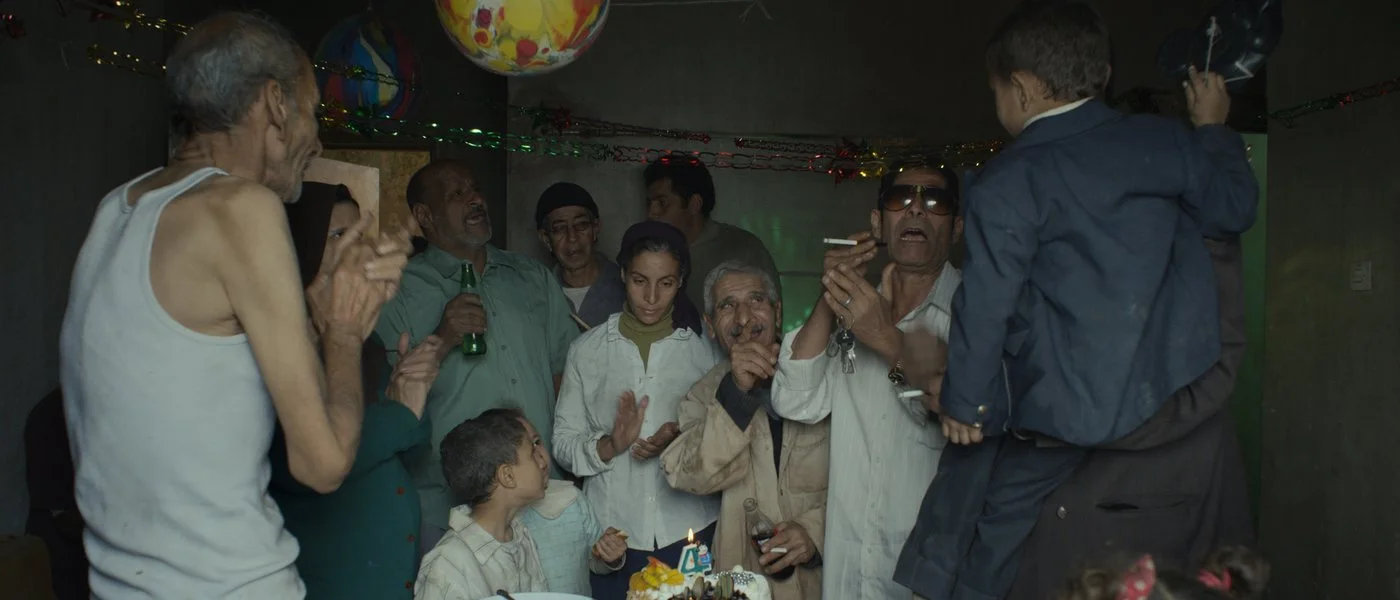
Still from “Feathers,” directed by Omar El Zohairy. © Semaine de la Critique
Not all comedies carry a winning formula. Egyptian audiences found “Feathers” — a fantastical dark comedy in which a domineering father is accidentally turned into a chicken — too alienating. Some dismissed its depiction of a grim, dystopian Cairo as bourgeois in sensibility. “The Unknown Saint,” a high-concept tale about a thief who buries his stolen money in a desert spot that later becomes a shrine to an unnamed saint, fared better. The film successfully blends subtle political commentary on the commodification of religion and Morroccans’ perpetual search for collective purpose with uproarious situational comedy rooted in the North African country’s desert culture.
Outside France, both films struggled to secure meaningful distribution, despite their successful festival runs. During the making of “The Unknown Saint,” Aljem reportedly encountered scepticism from European producers and distributors who doubted the international viability of an Arab comedy.
These two films, along with Suleiman’s “It Must Be Heaven” (2019), are among the very few Arab comedies to achieve even modest global visibility over the past decade. More mainstream comedies like “Bershama,” on the other hand, are often dismissed as artistically inferior and deemed unworthy of prestigious festival slots.
Foreign distributors, meanwhile, still struggle to market Arab films in general, let alone comedies. And Arab cinema continues to be pigeonholed into a narrow strain of social realism that presents foreign audiences with a familiar, often reductive image of the region: refugees, war, patriarchy, and poverty.
“...[U]nderstanding the socio-political conditions of any culture requires engaging with its popular cinema. In the Arab world, comedy has always been central to that landscape.”
Comedy operates in a different register, employing distinct cinematic and thematic codes. It does not necessarily stand in opposition to social realism but rather complements it, adding a vital and often more incisive dimension.
Both social realism and comedy share a certain directness. But where the schematic storytelling and minimalist rhythms of social realism can feel monotonous, comedy offers dynamism, even in its more formulaic, mainstream incarnations that are bound by classical narrative structures.
At the beginning of my career, I was quick to dismiss mainstream comedies, carelessly labelling them as mediocre filmmaking and failing to see what lay beneath, or even what their surface might reveal. Over time, I came to realize that understanding the socio-political conditions of any culture requires engaging with its popular cinema. In the Arab world, comedy has always been central to that landscape.
Some of this century’s most successful comedies that were made outside the U.S. have been deeply rooted in culturally specific humour, the very quality often cited as a barrier for Arab comedies. Notable examples include France’s “The Intouchables” (2011), Argentina’s “Wild Tales” (2014), Sweden’s “Force Majeure” (2014) and Germany’s “Toni Erdmann” (2016), to name a few.
Not everything in cinema needs to translate seamlessly across all audiences, and comedy is no exception. The real lesson of “Bershama”’s unexpected success is that Arab and Middle Eastern audiences — across diverse age groups and demographics — constitute a powerful and underserved market.
As I have argued before in this column, niche marketing that targets underrepresented communities is the future of global film distribution. Most mainstream comedies in any country may not be exportable, but the exceptional ones have the potential to travel. Unless programmers and distributors begin to recognize this, the exhausting and outdated image of Arabs as perpetual victims will continue to dominate global screens.
***
Joseph Fahim is a film critic, curator and lecturer. Currently Al-Bustan’s film curator, he has curated for and lectured at film festivals, universities and art institutions in the Middle East, Europe and North America. He also works as a script consultant for various film funds and production companies; has co-authored several books on Arab cinema; and has contributed to news outlets, including Middle East Eye, Middle East Institute, Al-Monitor and Al Jazeera. In addition, his writing can be found on such platforms and publications as MUBI’s Notebook, Sight & Sound, The Criterion Collection, British Film Institute and BBC Culture. His writings have been translated into eight different languages.

Al-Bustan News is made possible by the People’s Media Fund.