
Amid Federal Cuts, Philadelphia Immigrant Aid Groups Fight to Survive New Era of ‘Lawlessness’
By Lauren Abunassar
September 18, 2025
By June 30th, HIAS PA had laid off 35 of its staff members— nearly half its team. The loss was staggering for the remaining staff at the Philadelphia-based immigrant and refugee support organization, but the writing was on the wall. The layoffs were, after all, yet another casualty of the Trump administration’s war on immigration, a war which will see HIAS PA’s annual budget drop from $11 million to $5 million by the end of October. Today, funding cuts like these continue to reshape the advocacy landscape for aid organizations across the city.
“What worries me most — and what is going to take the most time to recover from — is the effort it will take to restore trust in our laws when they’ve been absolutely torn down and stomped on,” said Cathryn Miller-Wilson, the Executive Director of HIAS PA. “It's going to take an enormous amount of time and effort to recover from this cruelty, and from the lawlessness.”
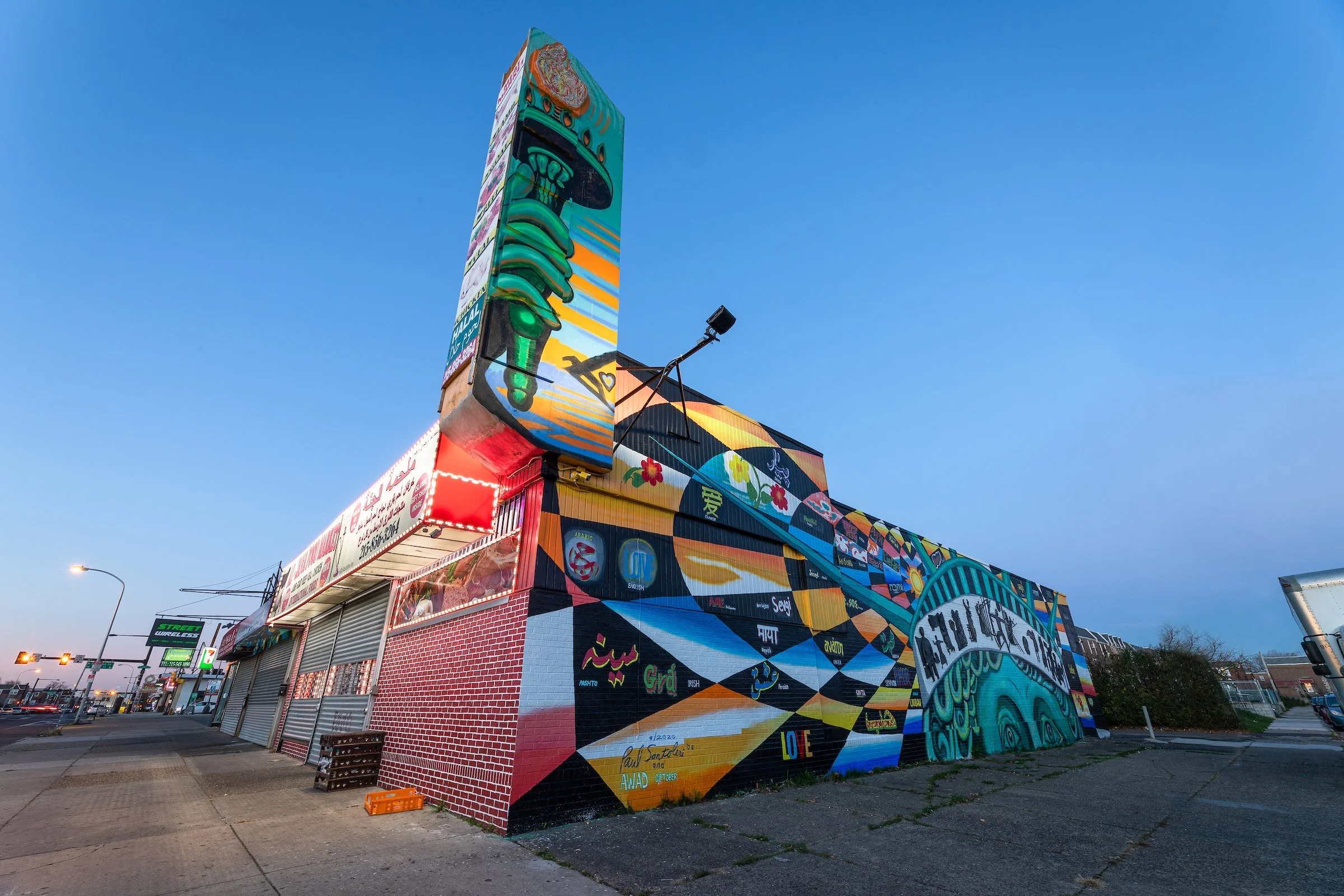
“Light of the Northeast,” a project by Mural Arts located at 6826 Bustleton Avenue. © 2020 City of Philadelphia Mural Arts Program / Abdul Karim Awad & Paul Santoleri. Photo by Steve Weinik
In January, the Trump administration halted new refugee admissions and subsequently cut off funding for agencies like HIAS PA. Meanwhile, the passage of bills like H.R. 1 in early July, a bill which saw huge increases in funding for ICE and massive cuts to Medicaid, SNAP and other social safety-net programs that cater widely to immigrant and mixed-status families, continues to undermine immigrant support organizations.
These seismic fiscal changes have left immigrant community members in Philadelphia feeling all the more fearful and powerless. According to local advocates like Miller-Wilson, while resources shrink and fear grows, the broader implications of policy changes like these are both clear and mind-boggling. “I mean, we fought a Revolutionary War in order to establish a democracy, and in seven months, democracy has been ripped apart,” she said. “This administration has made it very clear that they really just don’t care.”
Miller-Wilson has worked with HIAS PA since 2014, and watching her team shrink has been both a professional and emotional gut-punch. In the wake of their restructuring, HIAS PA has had to pivot in the same ways as many other immigrant organizations: questioning how to consolidate their efforts, and where to redirect their attention. In HIAS PA’s case, this has meant bolstering their legal aid program. It also means that many of the agency’s social support resources have disappeared, leaving clients without assistance they desperately need.
Those resources constituted a patchwork of refugee resettlement initiatives, health and wellness programs, employment support, and individualized case management and mentorship. When reflecting on the implications of this resource-drain for current and future clients, Miller-Wilson cannot help but think of past ones.
“Years ago, we resettled a refugee who, at her very first doctor’s appointment in the U.S., was diagnosed with stage-four breast cancer,” Miller-Wilson recalled. “She thought she was coming to start a new life and instead had to plan for her death and what would happen to her kids. She was a candidate for our health and wellness program.” Today, that programming is gone.
“...How do you strike the balance of helping people without exposing them? And how do you provide structural support when the support structures themselves are under attack? ”
As a licensed attorney, Miller-Wilson remembers the relentless focus on precedent in her early law school days, a lesson that got at the heart of what it means to be a country of laws. And while overturning precedent is both possible and even sometimes needed, ultimately, Miller-Wilson describes it as a kind of litmus for the legal health of a democratic system. "As a general rule, for the system to work and not result in total and complete chaos and violence, people have to be able to rely on what is the expected outcome," said Miller-Wilson. "And now we can't. We literally can't.”
Just recently, one of Miller-Wilson’s own colleagues traveled to Guinea for her mother’s funeral. When she came back, she was detained for three hours at the airport. The near-constant state of fear and uncertainty fueled by experiences like these is corrosive. “We're in a situation where, every day, Americans can't really rely on what they think the law says because it's not being enforced,” said Miller-Wilson.
Dr. Kate Firestone, Membership Director of the Pennsylvania Immigrant Coalition (PIC), has similarly had to wade through the gulf of fear ushered in by this era of loss. While PIC does not receive federal funding, many of the 50 organizations that are part of its member coalition do. The impact of funding loss on the legal side of immigrant aid has been sobering and far-reaching. “Funding for removal defense for immigrants and juveniles, legal orientation programs that offered detained immigrants information about immigration court procedures and their legal rights— all that’s gone away,” Firestone said.
At the same time, immigrants’ access to relief has drastically narrowed. Prosecutorial discretion, once a critical safeguard, has been rolled back. Even immigrants with pending green card applications are being told they’re not safe. Too many sweeping detainments and deportations have undermined any sense of safety in due process.
For immigrants and refugees, the fear has filtered into everyday life. Firestone has heard stories about families choosing not to send their children to school. Others have been too afraid to go to the grocery store. Many have foregone important doctors’ appointments, all because they don’t feel safe. Other times, PIC has fielded questions from clients about whether or not they should fill out government-supplied paperwork that would document their location and status. They are warned that not doing so would have disastrous consequences. But what does one do when completing the paperwork feels equally dangerous?
PIC refers these clients to legal experts. “These feel like impossible choices to make,” Firestone said. “But people have to make them.”
Miller-Wilson sees the same hesitation at HIAS PA: clients reach out to ask about legal options, then retreat. No one quite knows who to trust or how much to trust them. And at an operational level, people like Firestone and Miller-Wilson must ask, how do you strike the balance of helping people without exposing them? And how do you provide structural support when the support structures themselves are under attack?
Firestone can’t help but consider these attacks on a personal level. She herself was adopted from Korea as a three-month-old, and the privilege of navigating the immigration system with two U.S. citizens for parents is not lost on her. “And I was a baby. So I didn’t have what our system would call cultural baggage,” she said. “But the secondhand trauma of it all is definitely real.”
“The pendulum is going to swing back. I don’t know when… I don’t know if it will resolve in my lifetime. But history has a long arc. And it will resolve. We know this from history. ”
Still, neither Firestone nor Miller-Wilson express total hopelessness. If this is an era of destruction, it’s also an age of adaptation as organizations like HIAS PA and PIC shift their approaches to embrace collaboration and local advocacy. “We could not do this work without our partners,” Miller-Wilson said. “We’re meeting with them regularly to say, okay, we’ll do the legal support if you could pick up the social support… We can both shrink and be stronger at the same time.”
PIC, meanwhile, is leaning into local action. Its members have voted to prioritize pushing schools and townships to more publicly share welcoming policies and affirm their commitment to ensuring all students and families—regardless of background or immigration status—feel protected.
PIC is also raising funds for immigrant bail, researching pro– and anti–immigrant bills at a local level to hold local and federal representatives accountable. “I think there is space for positive change,” Firestone said. “Hopelessness is a given. But we are seeing so many people—including non-immigrants—coming out and being part of rapid response networks. They are putting their bodies on the line for their immigrant neighbors or immigrant families they don’t know because they’re capable of basic human empathy—and that gives me hope personally.”
Miller-Wilson reaches back to history to steady herself and her colleagues. HIAS PA has been around for 143 years. When she joined the team in 2014, they were a staff of 25 who built a reputation as ‘the little engine that could.’ Today, they may be reckoning with grave loss, but they’re still more of a ‘medium engine that could,’ Miller-Wilson says. And they will continue picking up the pieces for immigrant community members because they have to.
“The United States is experiencing the Dark Ages. Europe experienced it before. We experienced it in the 1920s. And I’m confident [we] will see the other side. The pendulum is going to swing back. I don’t know when… I don’t know if it will resolve in my lifetime. But history has a long arc. And it will resolve. We know this from history.”
And just as her work is about helping people, people are also where Miller-Wilson finds hope. She is moved by the stories of everyday community members doing things that signify how crises can birth innovation and human compassion.
“There have been so many evils in humanity’s history. And yet, there’s been these triumphs of good,” Miller-Wilson said. “I think about the philosopher Hobbes who said ‘life and mankind are nasty, brutish, and short.’ That is certainly something you could say today. But not of everyone. And it really gives you something to hang on to: that humanity is not all one thing.”
***
Lauren Abunassar is a Palestinian-American writer, poet and journalist. Lauren holds an MFA from the Iowa Writers’ Workshop and an MA in journalism from NYU. Her first book, Coriolis, was published in 2023 as winner of the Etel Adnan Poetry Prize. She has been nominated for a National Magazine Award and is a 2025 NEA creative writing fellow.

Al-Bustan News is made possible by Independence Public Media Foundation.