
Cinema, Etcetera | Kamal Aljafari’s ‘With Hasan in Gaza’ and the Challenges of Experimental Arab Film
By Joseph Fahim
September 12, 2025
The Locarno International Film Festival in Switzerland is an atypical event. A major film fair located in the small Italian-speaking canton of Ticino, its program is always varied: classics, genre films, popular entertainments and envelope-pushing cinema from around the globe that challenges the stifling conventions and narrow parameters of contemporary mainstream movies. The Locarno community has always embraced the ideas, politics and aesthetics of the festival’s art films, debunking the misconception that only movies with straightforward narratives can attract a large audience.
The standout Middle Eastern film at this year’s festival was “With Hasan in Gaza,” the latest conceptual documentary by award-winning Palestinian filmmaker and artist, Kamal Aljafari. Aljafari is one of the most daring and rigorous Arab filmmakers working today, whose body of work can be summed up as a grand excavation of personal and public archives related to the Palestinian people’s perpetually endangered existence in the Holy Land.
The larger part of Aljafari’s filmography is focused on his hometown of Jaffa. Collectively, “The Roof” (2006), “Balconies” (2007), “Port of Memory” (2010)” and “Recollection” (2015) resemble a collage of the ghosts of departed Palestinians, a treatise on the transient existence of families forever stranded in the shadow of the past. With “Recollection” and “A Fidai Film” (2024), Aljafari assumed a more active position, reclaiming Palestinian imagery from the colonizers.
Aljafari’s films echo one another in their themes, forms and purpose, and “With Hasan in Gaza” is both an extension of and a departure from his previous features. The documentary is comprised of three MiniDV tapes Aljafari re-discovered, detailing his two-day road trip in Gaza in November 2001, a year after the eruption of the Second Intifada.

Still from “With Hasan in Gaza,” 2025. ©Kamal AlJafari Productions
Everything and nothing happens in Aljafari’s sixth feature. Gazans eat, talk, pass time in coffee shops, swim in the Mediterranean Sea, pose playfully in front of Aljafari’s camera. Unbeknownst to him, the filmmaker is capturing a world in its fullness, and it is the mundanity of these everyday moments that makes the film so precious—a stark contrast to the barrage of violence and bloodshed that has been unfolding in front of the world over the past two years. As the genocide continues, one feels compelled to clutch onto these fleeting ordinary moments, to freeze time, to halt the wave of destruction and hold back every Gazan from marching toward their unknown fate.
Music plays a major role in augmenting the film’s deliberately amateurish aesthetics, making it immediate, unpolished and raw. In one scene, the pop tunes of Amr Diab can be heard in the background of a fast-food stall. At the end of the film, Nagat El-Saghira’s classic romantic anthem “Ah law teeraf (If Only You Knew),” composed by the great Mohammed Abdel Wahab, adds an indelible layer of heartbreak with the lyrics: “Saving some of this love that my heart can’t take in for tomorrow.” Nagat’s reassuring voice serves as the haunting sound of a bygone era, a memento mori of an out–of–the–ordinary place populated by a people so human in their ordinariness.
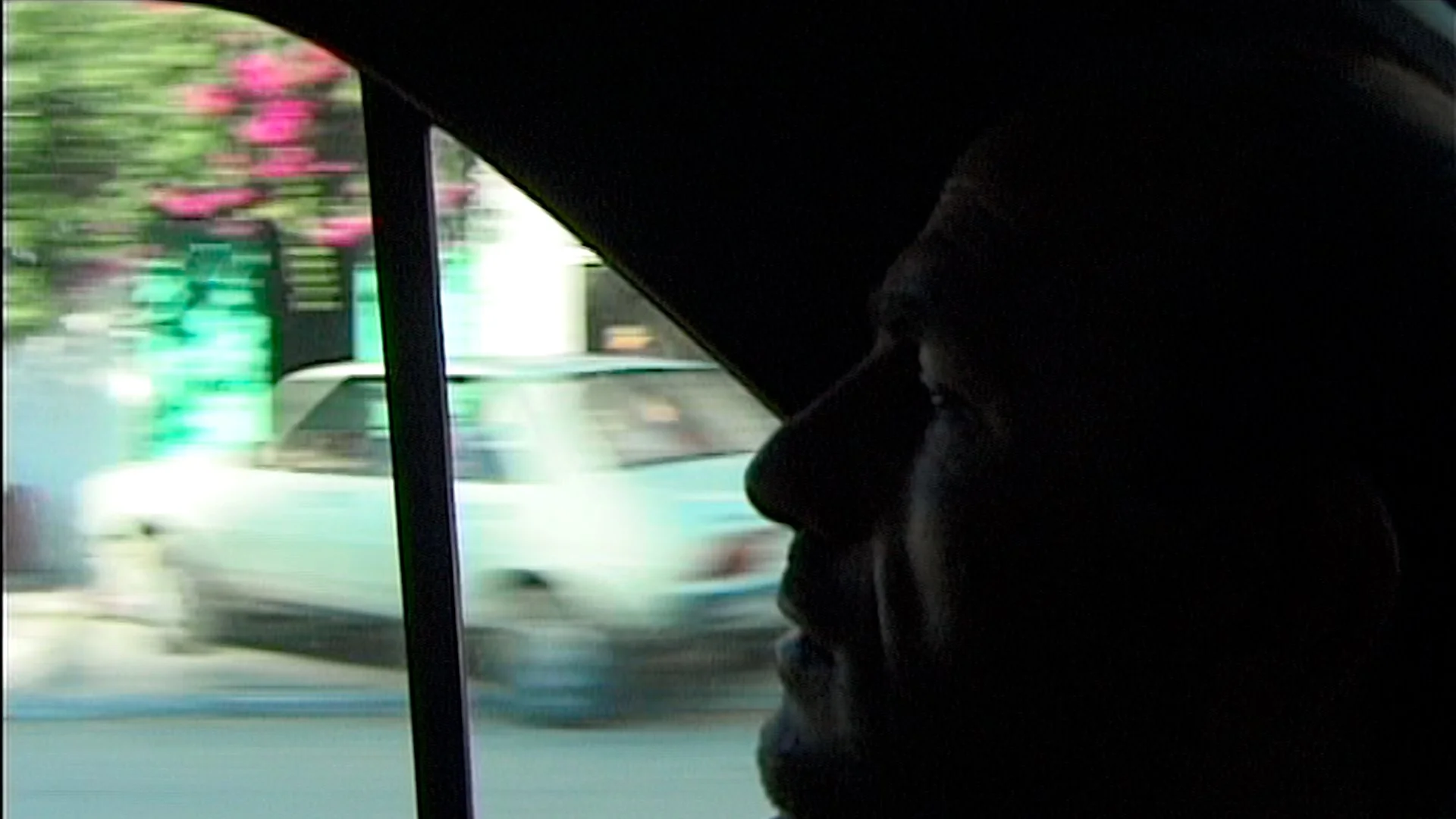
Still from “With Hasan in Gaza,” 2025. ©Kamal AlJafari Productions
In that sense, “With Hasan in Gaza” might be the most vital—and subtle—film about Gaza released this year. Since its Locarno premiere in August, the picture has already been shown at numerous other film festivals and is the only Arab feature showing at the upcoming New York Film Festival that opens on September 25.
And yet, like Aljafari’s previous work, it is unlikely that the film will be picked up for distribution in the U.S. Although audiences may find “With Hasan in Gaza” more accessible than the director’s previous work, it remains a challenging piece of cinema given its repetition, its lack of discernible dramatic structure and intervals where seemingly little happens. Technically, the film is conceptual through and through, and most independent distributors regard conceptual Arab films as unworthy of theatrical distribution in the U.S.
Gaza has boosted interest in Palestinian cinema, with titles such as the Oscar-winning “No Other Land” (2024), “From Ground Zero” (2024) and “The Encampments” (2025) outperforming expectations at the U.S. box office. The success of the Iraqi feature “The President’s Cake” (2025) at this year’s Cannes Film Festival and its subsequent acquisition by Sony Picture Classics—also the distributor of Nadine Labaki’s 2018 Oscar nominee “Capernaum”—suggests a growing interest in new Arab voices.
Festivals aside, though, the market remains closed-off for arthouse Arab films, which usually struggle to secure streaming deals in North America. The American market has never been hospitable to experimental Arab cinema. As streaming services continue to dominate movie watching, distributors have become exceedingly cautious, refraining from taking on films that deviate from the more straightforward Arab stories released in the U.S.

Still from “With Hasan in Gaza,” 2025. ©Kamal AlJafari Productions
But the success of “With Hasan in Gaza” in Locarno, where it was seen by thousands of people, has proven that there is a sizeable audience for films like Aljafari’s: an artistically and intellectually uncompromised cinema that rejects a digestible, ready-made message.
The progressive ethos of Greta Gerwig’s “Barbie” (2023) failed to convert Trump’s America, and the popularity of Netflix’s “Mo,” did not win over those who remain skeptical of the Palestinian cause. Most viewers gravitate towards stories that match their political inclinations, and viewers of Arab stories are no different.
In contrast, the films of Aljafari and other brilliant Arab artists have the potential to offer their viewers new ideas, new sensations, new sentiments. They possess the power to challenge and invigorate audiences in a fashion few mainstream films can.
These films must be allowed to reach audiences that are uninterested in didactic mainstream offerings. The future of Arab cinema lies in drawing and nurturing these film communities, and inventive, defiant, experimental movies deserve to be part of this ambitious endeavor.
***
Joseph Fahim is a film critic, curator and lecturer. Currently Al-Bustan’s film curator, he has curated for and lectured at film festivals, universities and art institutions in the Middle East, Europe and North America. He also works as a script consultant for various film funds and production companies; has co-authored several books on Arab cinema; and has contributed to news outlets, including Middle East Eye, Middle East Institute, Al-Monitor and Al Jazeera. In addition, his writing can be found on such platforms and publications as MUBI’s Notebook, Sight & Sound, The Criterion Collection, British Film Institute and BBC Culture. His writings have been translated into eight different languages.

Al-Bustan News is made possible by a grant from Independence Public Media Foundation.