
Art as Resistance | National Book Award Nominee Fargo Tbakhi on Writing Poetry in a Time of Genocide
By Lauren Abunassar
October 2, 2025
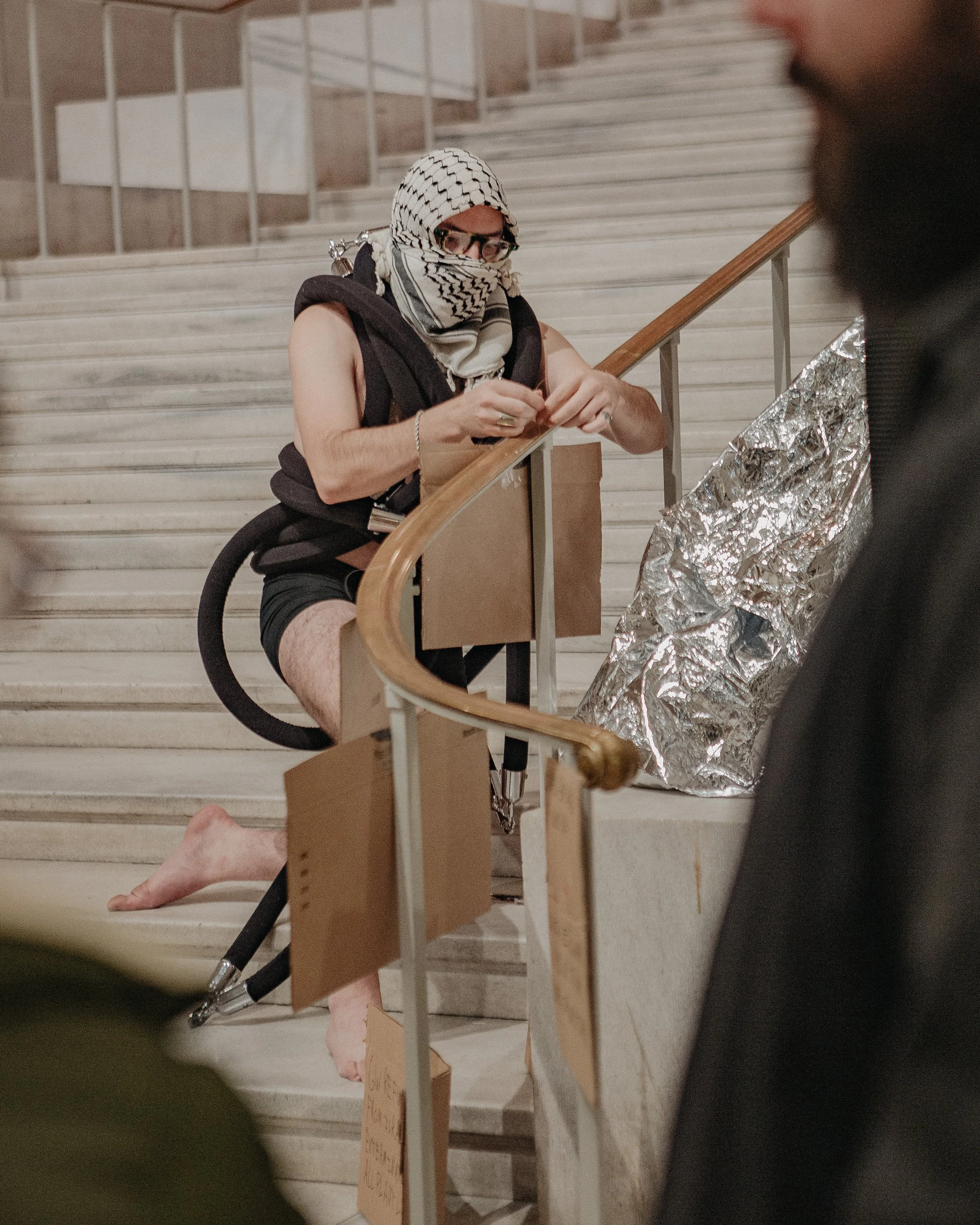
Fargo Nissim Tbakhi. Photo: Senna Ahmad
Palestinian performance artist and author Fargo Nissim Tbakhi never really wanted to write a poetry collection. “That form of book was never exciting to me,” he admits. And yet, his debut poetry collection, “TERROR COUNTER,” is currently longlisted for a 2025 National Book Award and is being heralded as an important testament to Palestinian identity, survival and imagination.
Replete with hybrid poetic forms Tbakhi invented, sequences that imagine the future of Palestine, and emotionally wrought considerations of inheritance and life in the diaspora, “TERROR COUNTER” is also an invitation to consider how one writes in a time of catastrophe and genocide. What work can poetry do, if any work at all?
In September, Tbakhi participated in a reading in Philadelphia alongside Ahmad Almallah, the Palestinian-American poet, scholar and author of the 2025 poetry collection “Wrong Wind.” The reading, titled ‘Poetry as Resistance,’ was an opportunity for the writers to consider what role poetry may play in resisting erasure. And if poetry may be considered a tool, what are its limitations? Al-Bustan News spoke with Tbakhi about this very question, as well as the complicated notion of liberation, the importance of silence, expectations of Palestinian identity and poetry, and more.
This interview has been edited for length and clarity.
“A lot of people want to believe that there’s something magical about poetry and that it’s always on the side of the oppressed, or that it gives us some kind of liberatory space just in and of itself. I don’t think that’s true. ”
Lauren Abunassar (LA): You recently participated in a reading in Philadelphia titled ‘Poetry as Resistance.’ And while I know poetry has never been an apolitical act, it feels like lately it has played an even bigger part in collapsing any kind of false illusion of distance from the genocide in Gaza. Can you speak a bit about why you think poetry plays such a special role in resistance, or how it can bring us closer to the urgency of witness?
Fargo Tbakhi (FT): Personally, I don’t really know that it does. I feel the phrase ‘poetry as resistance’ makes me a little uncomfortable, specifically in the context of the United States. Because it is very easy, and in a lot of ways seductive, to believe that if poetry is what we do, and we believe in resistance, then our poetry is resistance, right? But to me, I want to be more critical and insist on a more material understanding and analysis of what it means to think about resistance and to question whether poetry does that.
I cannot genuinely say I believe that my writing and publishing a book with a small press based in the U.S. is an act of resistance. For me, it tends to get into these questions about rhetoric, or about public opinion, or about changing people's minds or hearts through our writing. But I don't know that I would call that resistance. Because to me, that is a word that means real and particular things. It means Palestinians laying their bodies and lives on the line to materially resist genocide and occupation and expropriation of land and material resources. Or it means people in the West who have similarly laid their bodies and their material comfort on the line in order to be in solidarity.
So I guess what is potentially more interesting to me, and some of what's in your question, is I don't know that I believe in poetry as resistance, or I think that it's too often an easy way out for a lot of people. But I do think there are moments in this country's history where poetry was more connected to real resistance and revolutionary movements, and those things feed each other. Poetry might offer a way of galvanizing us towards action, or clarifying for us some of the feelings we have around action. But I think sometimes it's actually almost paralyzing to believe that poetry is the only form of resistance we have access to.
LA: There is something that feels very active about the poems in “TERROR COUNTER.” There is so much movement embedded into them. Even just thinking about some of the “Gazan Tunnel” poems in the book, or some of the poems working with hybrid structures or alternative forms that move across the page. Can you walk us through your procedural thinking and how you arrived at structuring some of these poems on the page in the way you did?
FT: Well, I think part of it is that I didn't ever study poetry in any formal educational space. I didn’t have a sense of established poetic forms or general ideas of what a poem is supposed to look like. Writing was a lot more of an experimental space for me. So with the “Tunnel” poems, I was thinking: what if there was a poetic form where the requirements were not literary, but ideological? They were political requirements. The basic idea of cutting or carving through or tunneling through some fucked–up imperialist text with my own words was the starting point. And then, the actual way that it ended up looking on the page was a lot of experimentation and seeing how I could try and honor what, to me, is one of the most miraculous forms of Palestinian resistance and survival: the act of creating and forcing a livable economy using tunnels.
LA: In comparison, can you walk us through the difference between your relationship to the page versus your relationship to the stage as a performer?
FT: If the basic purpose of writing a poem is to communicate something in some form, then the list of tools that I have when I'm doing that on the page are limited. I have language. And I have the relationship between the language that I write and where and how it is on the page. When I perform, I have the tone and quality of my voice. I have what my body is doing. I have my relationship to other physical bodies in the space… So sometimes, when I have an idea for a project or something I'd like to work on, it's a little unclear what form it needs to take until I run out of tools.
If I'm writing a poem and it's just not working, maybe it is something that doesn't want to only live on the page. And then, when I discover more things in the performance, I can return to the poem and try and figure out if I can replicate in some form what I did when I performed. I ask what are some strategies I can try and use to break or push or bend the language and to capture that feeling.
LA: For one of your performances, “My Father, My Martyr, and Me,” you mention facing this question of what it means to be an identity of any kind. Do you feel that writing this book has brought you closer to any new questions, or even questions you want readers to ask after reading “TERROR COUNTER”?
FT: When I think about the poems in this book, a lot of the questions I had were less about what does it mean to be a Palestinian, to be a man, to be someone who was born in the U.S. It's less about trying to figure out the answers to those questions, or even asking those questions, and more about what does it mean to publish a poem that mentions the word Palestine in a United States literary ecosystem that is deeply entangled with the forces that are killing Palestinians? What does it mean to perform in a room for people who all pay their taxes and those taxes are killing my family? I want to ask those questions in ways that aren't end points, that aren't rhetorical, that actually matter to me and that are considered not very nice to ask in poetry readings or communities.
A lot of people want to believe that there's something magical about poetry and that it's always on the side of the oppressed, or that it gives us some kind of liberatory space just in and of itself. I don't think that's true. So for me, a lot of it was letting go of these surface level questions and wanting to talk with the people that I'm connected to, and say, here are the harder questions that I find myself asking. And I want to think about those things together. Like, what's the next step after we all figure it out? ‘Palestinian’ doesn't really mean any one thing. It's a lot of things. And what is most important, especially in this moment, is what are we doing? I think I've moved a lot towards thinking about identity as something we construct through action, rather than anything stable or received or inherited.
“Poetry is not just constant misery or constant revolutionary fervor. It’s all of these things that are in between that make us people that live in the world.””
LA: The titular poem “Terror Counter” is one of my favorite poems in the collection, partly for the way you're enacting this very painful and eerie sensation of simultaneity, where images of the genocide unfold alongside moments in the diaspora. How did you negotiate exploring these personal, vulnerable moments you mentioned, or these intimate moments that are maybe more focused on the granular, in a book that's also very interested in bearing witness to collective struggle?
FT: This book was a lot of building space to hold and articulate my own ugly feelings… As much as I spend a lot of time in an intellectual space thinking about legacies and practices of Palestinian revolution and resistance and survival, my own personal experience of the world is filled with shame and despair and fear and loneliness. So I think sometimes there are the spaces of intellectual and political commitment and of personal, vulnerable experience, and we have to choose one over the other. It's not good. It's not good organizing rhetoric to say, ‘I don't know if we will win. I don't feel it day to day.’
On the other hand, it's not useful to just sink into these feelings of despair and shame. So to me, it's a little bit about how one thing poetry can do is be a space where we can articulate all these things that we feel while we are also doing the other thing. Poetry is not just constant misery or constant revolutionary fervor. It's all of these things that are in between that make us people that live in the world. And so finding the space for that was important to me.
I think in general, especially in literary spaces, if anyone publishes Palestinians they want certain things from us. And it is, often, going to pressure our speech and our writing to sacrifice certain political commitments, or sacrifice acknowledging that we have feelings that aren't pretty and aren't easily digestible into a specific framework.
LA: You mentioned loneliness and shame; but there are also huge notes of love in this book. And imagination. And the possibility that's accommodated by imagination. Has poetry or writing this book shaped your understanding at all of the role of imagination and its powers and failures?
FT: I think that the section of the book that is maybe most related to this question is my ‘Futurism’ series, which, in a lot of ways, was an attempt for me to understand or to go deeper into the space that we sometimes get into when we think liberation is inevitable. I think this is an important statement and an important way of feeling and moving. But it also holds a lot of question marks. What do we mean by liberation? And if it’s inevitable, what does that mean? What does it require of us to do? I have spent a lot of time in my writing and reading career thinking about speculative fiction and sci-fi, and this act of imagining a future that emerges from the conditions of the present and the past.
In the futurism section of “TERROR COUNTER,” I really wanted to say, okay, if I were to spend some time in the idea of a liberated future, how far can I push that definition? How far can I push my understanding of what that means and what it necessitates of me right now? It's … almost impossible to imagine a world where there is no United States, there is no system of global extractive capitalism. And when we are in the present, it's easy to get lost in those things so that we can't do the small things. But it's also, to me, equally unrealistic to say anywhere will be liberated until those things are true. So it's this balance of space where I say, let's get as big as we can possibly get in thinking about what this feels like. It was very much me wanting to explore insistence and ecstasy or joy and what that feels like on the page.
LA: Do you think poetry has any role to play in ushering the end of unjust systems or starting over?
FT: That’s a question that feels difficult because I dislike most of the existing answers. And I feel myself spending a lot of time and energy pushing back against the existing answers, which doesn't leave as much room for what I actually think. But there's a Mahmoud Darwish quote from near the end of his life that says something like: ‘I used to think that poetry could change the world and that it could change social structure, but now I think that poetry only changes the poet.’ And I don't always believe that. And it's actually been very important to me to try and think about writing as a real tool.
But it's hard for me these days to separate poetry from publishing or all of the structures and forms in which we experience and encounter poetry. And so it makes it fuzzier for me to figure out or understand what it does and what its relationship is to struggle. I think it's been obfuscated by so many cultural and political forces, especially in the United States, that are defanging what poetry is or could be. I have a mentor who’s a poet who does believe that poetry can be a dangerous thing. And I just can’t get there. But I think of it also as a challenge to myself, to be curious about.
“The world is the way that the world is as much as we want to change it. And it is filled with compromises that we can choose to make or not make. I think that’s a constant form of negotiation as we move through the world and try to figure out not just how to survive, but how to survive with our souls intact.”
LA: We've been talking a lot about moments of witness. And there are so many gestures of archiving and record–keeping throughout this book. Do you have any thoughts on the role that silence or refusal might have to play in poetry?
FT: I do think a lot about silence or refusal. I think about silence in terms of letting go of explaining for a particular market or a particular audience. I don't want to have to start every poem with, ‘in 1948…’ It's really boring to me, and it’s not what I want to hear or talk about or write about or think about. And so, there's a way in which refusing that act of context-giving assumes an audience that already knows and is able to engage with deeper ideas.
In terms of silence right now… there’s a kind of enforced publicness and consumption of Palestinian figures, like all sorts of other marginalized and brutalized communities. They're made public because of their suffering or because of their resistance, and it comes with all of these expectations of ‘you're supposed to be performing a particular thing and talking in a particular way’. In this book, when I was writing especially about someone like my father, I wanted to just give him some silence. I wanted to give him some anonymity back… I think about that a lot in terms of writing about the dead, who can't consent to being in my poem. And so I find myself thinking about a lot of necessary silence.
Because as much as we talk about the silence of the world in response to genocide, in response to brutality, there's also always constant discourse about those things. But that discourse is actively killing us. And so silence and refusal are also about saying, ‘I don't want to talk to people or in ways that won't do anything except further brutalize me and the people that I care about.’ The world is the way that the world is as much as we want to change it. And it is filled with compromises that we can choose to make or not make. I think that's a constant form of negotiation as we move through the world and try to figure out not just how to survive, but how to survive with our souls intact.
***
Lauren Abunassar is a Palestinian-American writer, poet and journalist. Lauren holds an MFA from the Iowa Writers’ Workshop and an MA in journalism from NYU. Her first book, Coriolis, was published in 2023 as winner of the Etel Adnan Poetry Prize. She has been nominated for a National Magazine Award and is a 2025 NEA creative writing fellow.

Al-Bustan News is made possible by Independence Public Media Foundation.