Art as Resistance | Lara Bedewi Is Telling One Arab Story at a Time — and That’s the Point
By Lauren Abunassar
January 2, 2026
If you ask Philadelphia–based multimedia artist and filmmaker Lara Bedewi if she always knew she would become an artist, it is an Arabic word that comes to her first: مكتوب. maktoub, or “it is written.” In other words, her career felt somewhat fated and heavily foreshadowed in childhood. Her teta still regales others with details about the very first art project Bedewi made as a kid — a homemade guitar. From there, the crafting only continued. Then came a passion for photography. And then, for film, perhaps Bedewi’s most prolific medium.
“Everyone in my family is a storyteller,” Bedewi says. Her mother studied architecture and had an interior design trade showroom. Her jiddo was the go–to reciter of Arabic poetry at family weddings and parties. Her father often talks about how, if he weren’t a mechanical engineer, he would have been a painter. All around her were artists telling stories in different ways and different mediums.
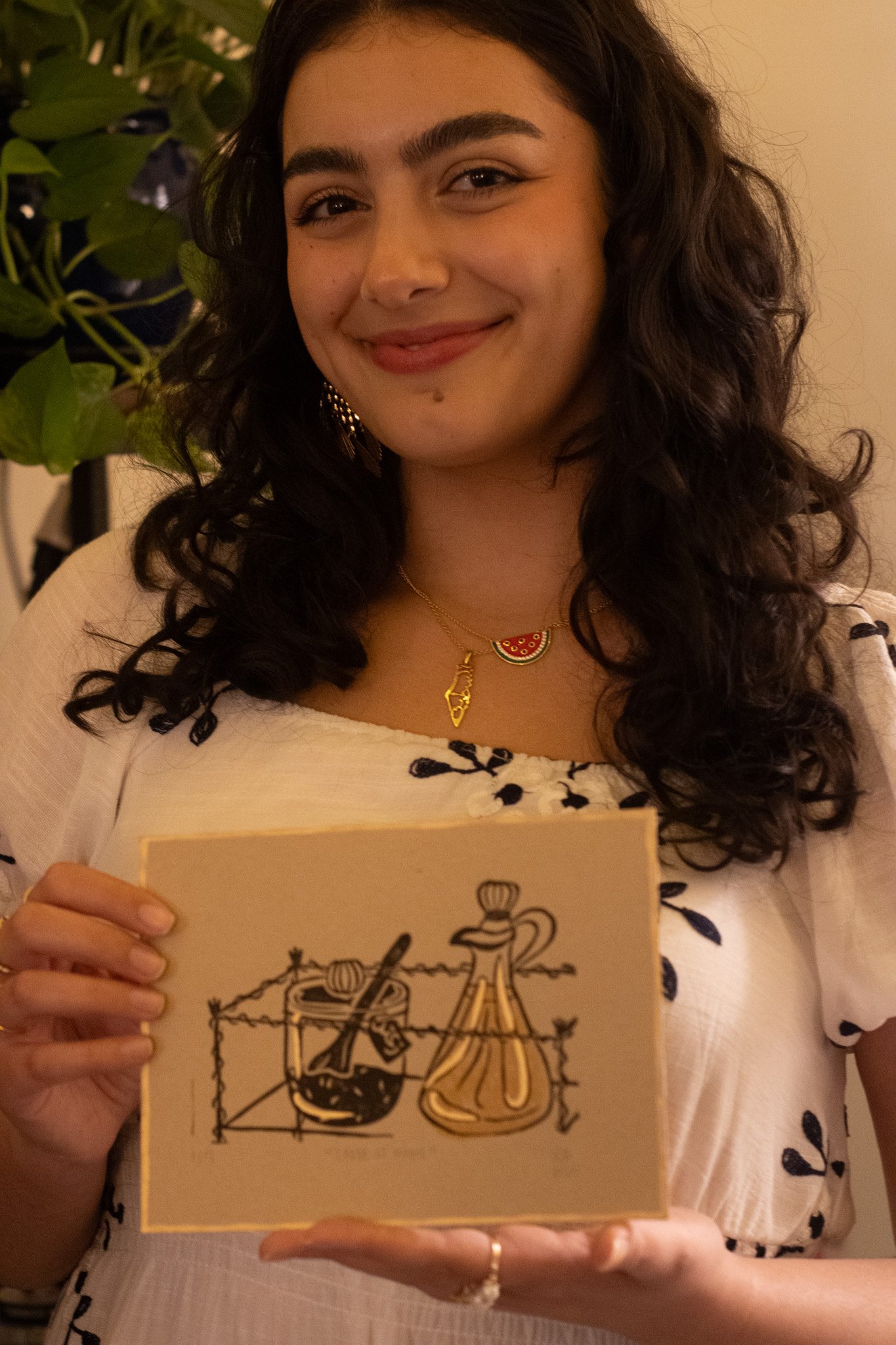
Lara Bedewi holds one of her prints, titled “Taste of Home.” Photo: Lauren Abunassar
By the time she reached high school, Bedewi knew she would also be a storyteller, making films about what it meant, and how it felt, to be an Arab American girl. “It always just felt so innate to me that these were the only kinds of stories I could tell,” she says.
One of Bedewi’s earliest films was a short documentary, “Hidden Treasures of Egypt,” which she made in high school while visiting her father’s family in Egypt. It is a strikingly vibrant and nuanced portrait of a camel handler, a bread maker, a former café owner who lost his savings during the 2011 Egyptian Revolution and other local characters. It is hard to imagine the documentary, equal parts intimate and unafraid to confront the post-Revolution political fallout and unrest, being stitched together by a high schooler. At the same time, one of Bedewi’s authorial signatures is clear even this early in her practice: an ability to allow Arab characters to simply exist without being used solely as political arguments
She takes the same approach to storytelling in her 2023 short film, “To’oborni,” an Arabic idiom that translates roughly to “may you put my casket in the ground.” An official selection for the 2023 Arab Film and Media Institute’s Arab Film Festival, “To'oborni” follows protagonist “Salma” as she helps her mother and her teta prepare for a family dinner. As Salma refines her technique rolling grape leaves with her Teta, or struggles with her mother’s expectation that she wear a dress to dinner, the film becomes a tender study on how all three women are navigating their relationship to tradition and selfhood. It is a slice–of–life style film that hearkens back to Bedewi’s desire to tell stories about Arab American girlhood while also exploring belonging on a multigenerational scale.
“When I’m making films, I don’t go out of my way to show off the culture or educate about the culture,” says Bedewi. “I don’t think my filmmaking has ever been about educating people or trying to change peoples’ minds about something. It’s always been about capturing a feeling.”
Perhaps this is why her films feel so personal: they stem from her vigilantly guarded love for her culture. Bedewi’s home is dotted with watermelon napkins and Palestinian cola, swatches of tatreez on the wall (she recently joined a tatreez circle herself), Palestine–shaped necklaces on the jewelry holder, a copy of Mohammed el-Kurd’s “Perfect Victims: And the Politics of Appeal,” on her bedside table. Not long ago she hosted a teach–in on the history of Palestine with her partner, walking friends and community members through a curriculum they designed together. And she has regularly sold hand–crafted prints of za'atar and olive oil bottles, and birds cloaked in ‘Free Palestine’ banners, to fundraise for Gaza.
Bedewi grew up understanding the far reach of history and loss, and their impact on her family. Most of her mother’s family in Lebanon fled from Palestine in the 1940s and ‘50s. Her mother grew up in Beirut but left for Greece during the Civil War. “She and her family thought they would be able to return back home and this was just temporary,” Bedewi says. “So they left all of their belongings behind for the most part.” When it became clear they could not go home, they settled in Virginia. Today there is a scarcity of family photos from her mother’s childhood, and every time Bedewi unearths one, the weight of that treasure’s meaning is not lost on her.
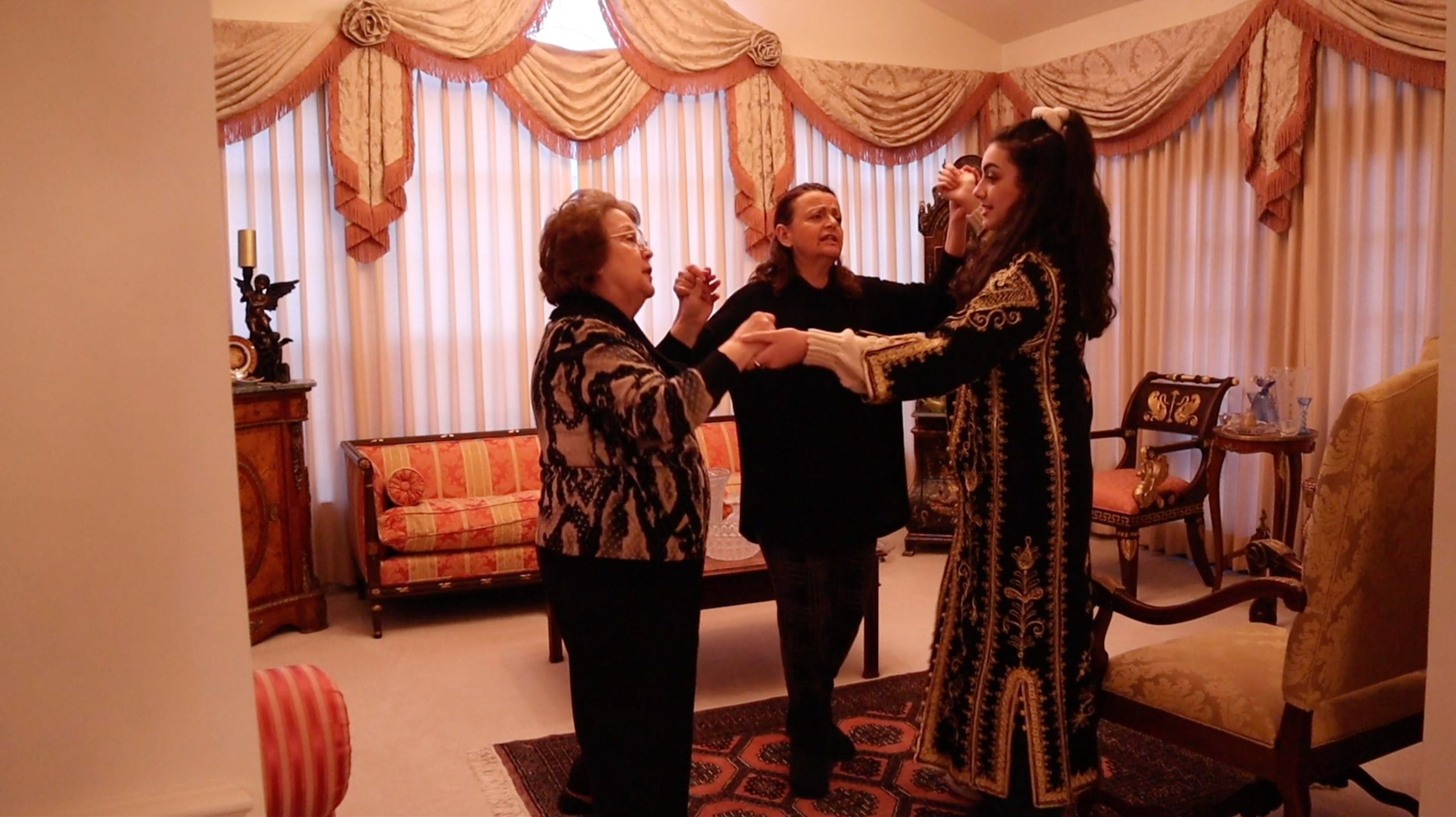
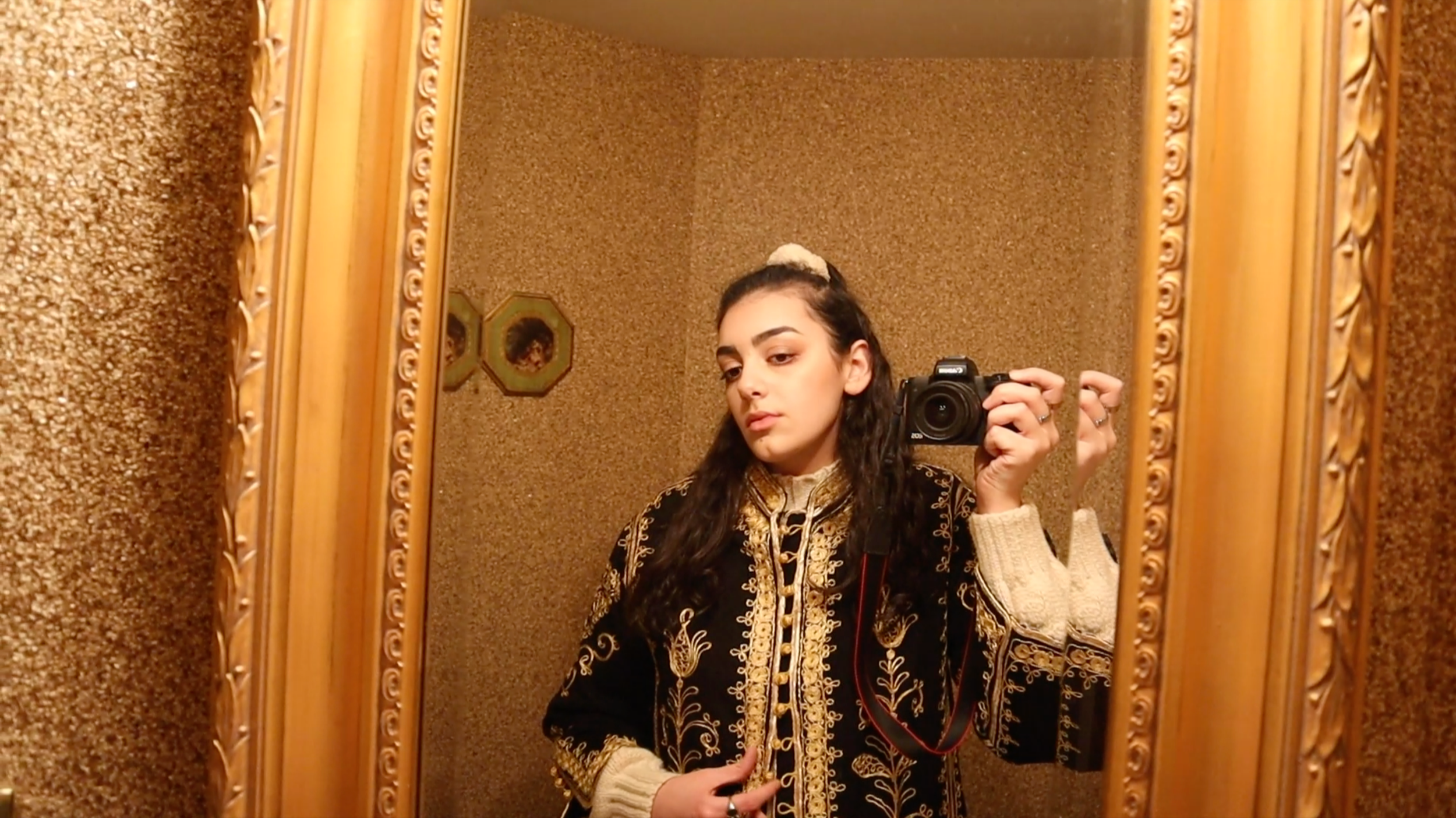
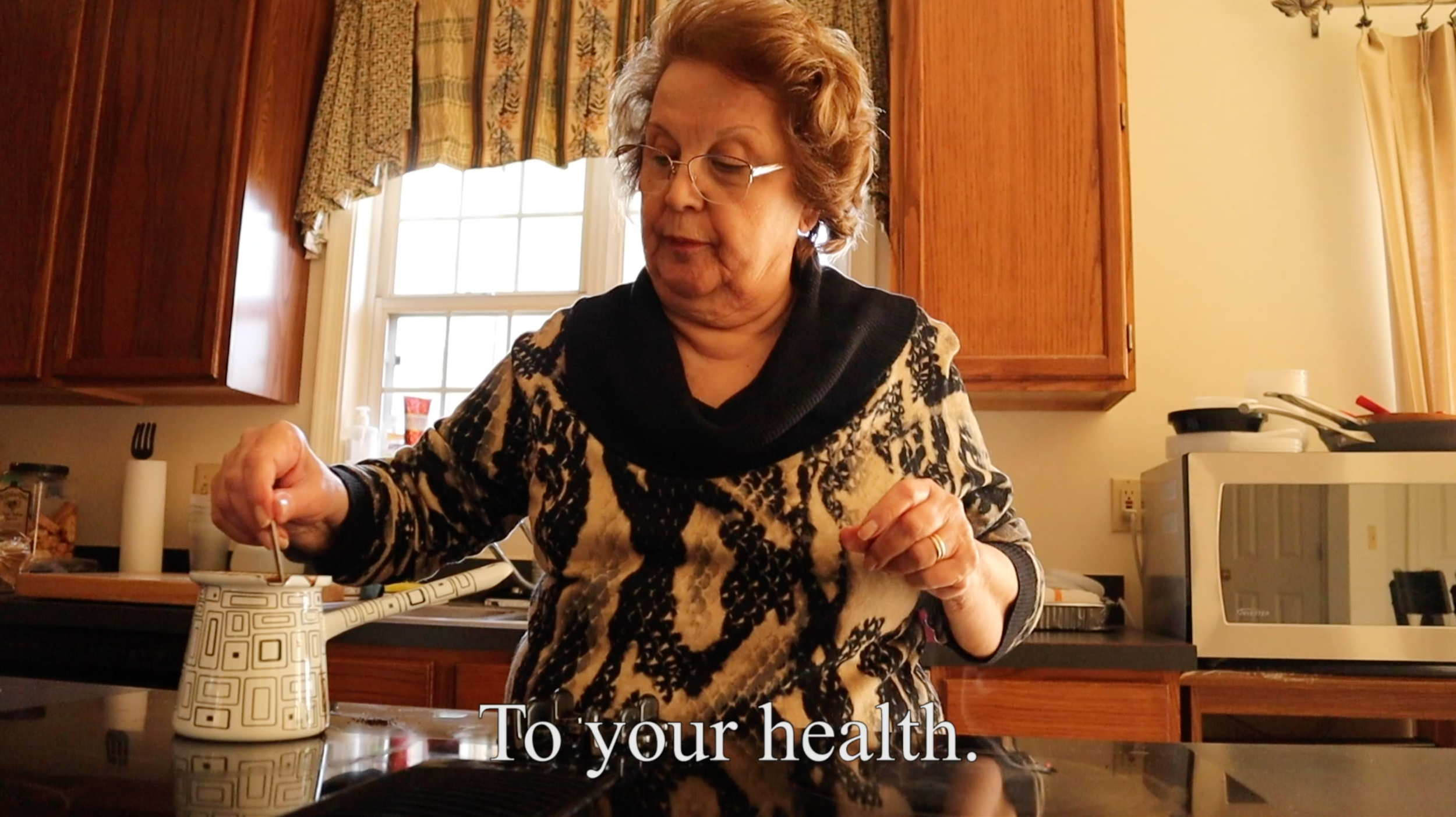
Stills from “Confessions of the Family Torchbearer,” Bedewi’s Covid–era documentary featuring footage and photographs of her teta, her mother and herself. Images courtesy of Lara Bedewi
Some of these photos are on display in a Covid–era documentary Bedewi shot, entitled “Confessions of the Family Torchbearer.” A sort of nonfiction sister piece to “To’oborni,” it similarly focuses on Bedewi, her mother and her teta. There are scenes of Bedewi rolling grape leaves and trying on a traditional thobe. Bedewi is a diligent cultural steward, and the film is replete with ancestral pride.
Still, she has had to grapple with the complications of identity, those moments when she feels too American to be Arab enough and too Arab to be American enough. Recently discovering the term “third–culture kid” felt like a revelation — a way to describe the liminal space between presence and absence that many in the diaspora contend with daily.
“I remember when I got my first period and I was traveling back from Egypt with tampons and pads in my suitcase,” Bedewi says. “I was already so insecure about that, but TSA was just opening my suitcase in front of everyone, searching it.” It was an early lesson in how surveillance can attach itself to Arab bodies, and how that scrutiny often collides with the private vulnerabilities of girlhood. Moments like this, when identity and vulnerability overlap, echo through Bedewi’s films, where coming of age is rarely separate from being watched or asked to explain oneself.
“Not to be ‘woe–is–me,’ but it’s these little things that make you feel like you just don’t quite belong,” Bedewi says. “I never want to claim the struggles of being born and raised in the region as my own. Because I’ve grown up with an extremely privileged life… But if you're going to enjoy the food and the music and all of these beautiful things, you also have to acknowledge so much of the pain”
Recently, she has been getting ready to start production on her most personal film yet, enabling Bedewi to get even closer to utilizing filmmaking as a cultural and familial bridge. “Daughters of the Fig” follows Naila, a Palestinian American, as she journeys through dreamscapes and family histories to come to terms with what homeland and Palestinian identity mean to her. “I wander aimlessly as I search for you in every familiar place, desperately hoping to find you…” says Naila in one early scene, reading from old Arabic notes in her family archive.
Bedewi admits the project is based on her relationship with her own jiddo, who passed away a few years ago. “When I lost him, I felt like I lost so much of my core identity,” says Bedewi. “I started remembering all of these stories that he had told me growing up, even down to songs his character sings in the film.” The film is a deep investment in the belief that storytelling can both reclaim and memorialize the people and places we have lost.
Bedewi was inspired to take on the project after discussing it with a producer from Safad, the same Palestinian village where her family originated. She met the producer at Watermelon Pictures, a Chicago–based film production and distribution company dedicated to uplifting Palestinian and Arab voices. Bedewi started working for the company in 2024 and now serves as a digital content producer. Watermelon is currently distributing “To’oborni” on their streaming platform, Watermelon+.
“There’s this stigma with Arab films, with Palestinian films, that characters have to be suffering in some capacity or … be the perfect victims,” Bedewi says. “But being at Watermelon has shown me that we can and should make films about anything and everything. We can make horror films. We can make documentary. Surrealism. Whatever. And there are people out there who believe in these stories.”
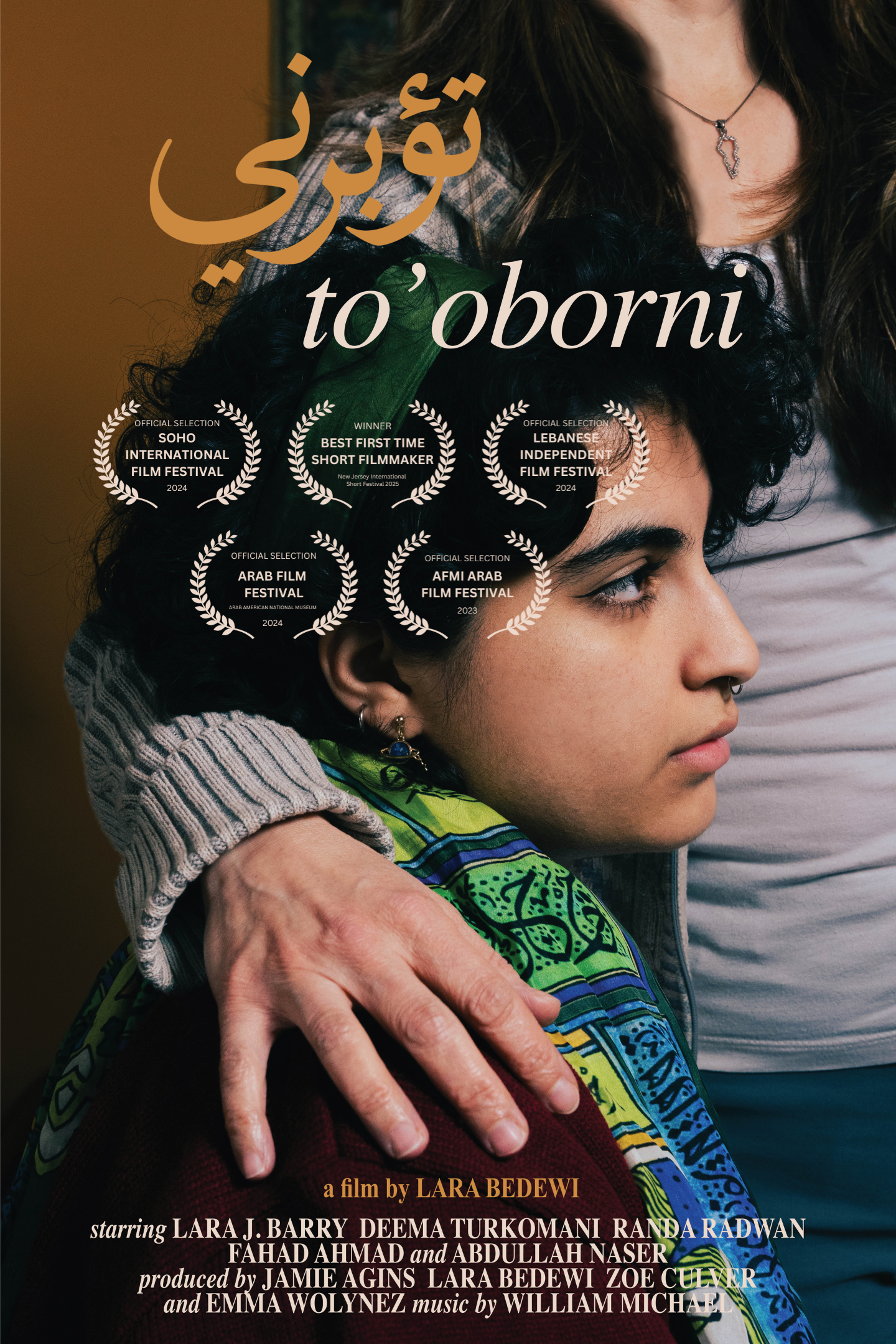
Bedewi’s short film, “To’oborni,” was her senior thesis at Drexel University and was screened at the 2024 Arab Film Festival. Image courtesy of Lara Bedewi
While Bedewi has often worried that her films will be misconstrued as representative of all Arab experience, she has increasingly felt permitted to tell ‘one’ Arab story, not ‘the’ Arab story. That shift has been liberating and has inspired her to found her own production company, Albi Productions, which will produce “Daughters of the Fig.” It has also inspired her to embrace storytelling as a force that can bring you closer to culture, while also preserving it. “I’ve realized that though I’ve never been to Palestine, I feel so intertwined with my Palestinian identity and culture that I sometimes feel I have memories of Palestine,” she says.
This emotional resonance — hopeful, bittersweet and full of yearning — pulsates through much of Bedewi’s work. It suggests that memory is not just experiential: it is passed through the family archive, through oral histories and photos, both missing or recovered, and through the ancestors who have served as crucial guides.
In this sense, Bedewi’s career today could be more accurately described by the meaning behind “To’oborni.” While its rough translation is “may you put my casket in the ground,” its true meaning rests in implication: may I never have to live a single day without you. It’s a phrase rooted in devotion and a fierce refusal of separation — from a person, a place, a homeland. In Bedewi’s hands, it becomes both a personal inheritance and proof that storytelling can be an act of keeping something alive.
***
Lauren Abunassar is a Palestinian-American writer, poet and journalist. Lauren holds an MFA from the Iowa Writers’ Workshop and an MA in journalism from NYU. Her first book, Coriolis, was published in 2023 as winner of the Etel Adnan Poetry Prize. She has been nominated for a National Magazine Award and is a 2025 NEA creative writing fellow.
Al-Bustan News is made possible by Independence Public Media Foundation.