
As the U.S.–Israel War with Iran Engulfs Lebanon, Diasporic Lebanese Feel the Limits of Resilience
By Lauren Abunassar
April 16, 2026
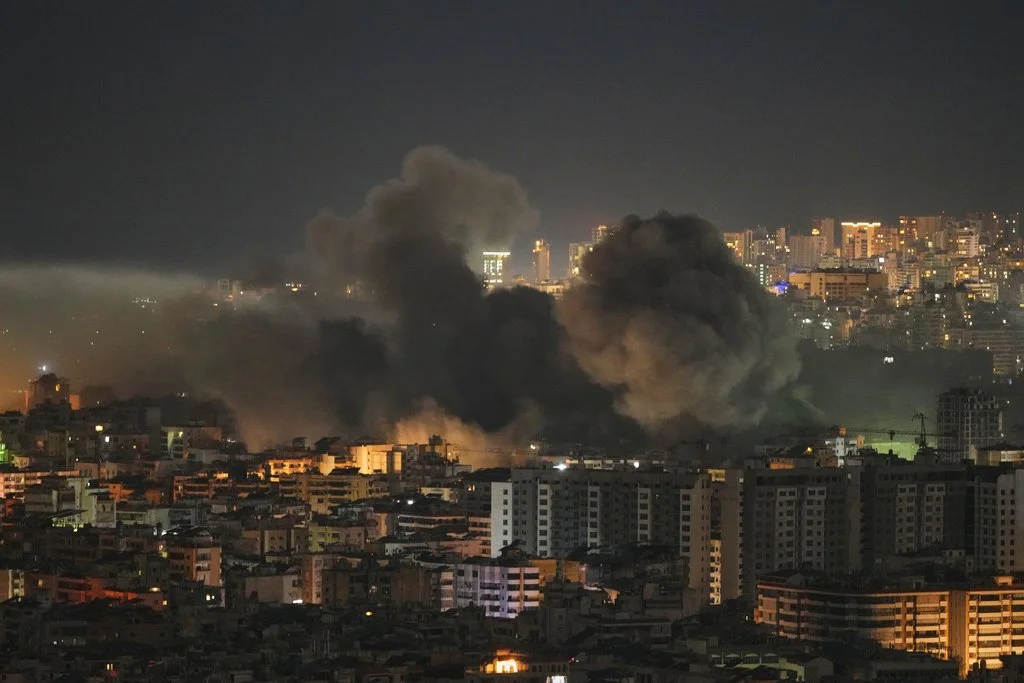
Israeli airstrikes on the Dahiyeh neighborhood of Beirut in March, 2026. (AP Photo/Hassan Ammar)
Temple University senior Ali Srour cannot remember the last time he spoke with his family in Lebanon about something other than war.
A first-generation American, Srour’s parents moved to the U.S. from Beirut and Southern Lebanon in the 90s. Today, his grandparents, aunts and cousins remain in Beirut. The mental toll of Israel’s ongoing strikes is impossible to ignore when he calls to check on them. After all, for diasporic Lebanese like Srour, the war is not just a distant crisis — it is a constant, intimate presence shaping how they grieve, connect and understand Lebanese identity.
“I think the people of Lebanon, like my family, are tired of acting like things are okay,” Srour says. “There’s not a single member of my family I can call without hearing, ‘oh, there’s a missile dropping,’ before you actually hear the missile. Alhamdulillah, nothing has happened to them. But [there’s a sense that] it could have been one of them. And you just know, even if it’s not your family, it’s still a family. You grieve in that sense.”
“Sometimes it’s a bit unbearable. And you get a little mad, like, ‘Why do we have to constantly worry about our people?’ ”
Srour’s memories of Lebanon are warm, domestic, ordinary. Eating kibbeh nayyeh on special occasions. Staying up until 5 a.m. to talk with his aunts and cousins. Going for kazdoura, the Lebanese term for a stroll with no destination, with his grandfather. And visiting Jnoub — the south of Lebanon — where the sunsets held a magic you cannot really find anywhere else. “It’s just so so beautiful,” Srour says.
On those visits, he treasured seeing his entire family in a single day, a luxury that Lebanese in the diaspora do not often have. And though Srour admits, “obviously there are bad memories,” it is the beautiful ones that carry the most weight for him.
Now, however, the Lebanon of Srour’s youth has all but vanished. As the U.S.–Israel war in Iran escalates, Lebanon has been dragged into a proxy war. More than one million Lebanese have been displaced — roughly one fifth of the country’s population. The humanitarian crisis continues to worsen.
Srour has not visited Lebanon since 2021, but his mother and sister visited last summer, and their experience was a sobering reminder of the new reality. “They saw the missiles flying over them from all sides,” Srour says. “And there were drones everywhere just whizzing behind them and all around them. I don’t think they even stepped out of the apartment they were in. They didn’t even go out on the balcony. They were scared of being surveilled. They’re not going to do anything wrong. We’re not bad people. But the thought that these drones are watching you… who knows what will happen?”
On April 8, a two-week ceasefire was declared in the U.S.-Israel war with Iran. The same day, Israeli forces launched a devastating bombardment in Lebanon — the deadliest day of attacks to date, with more than 300 fatalities and over 1,000 injured. Local Beirut hospitals are now facing a drastic depletion of resources that has physicians worrying about their ability to continue treating trauma patients.
Watching the crisis unfold has left Srour and his family feeling devastated and helpless. “When we heard that Lebanon was getting involved in the Palestine-Israel war, we were all on edge,” he says. “Now, I’ve watched my mother go from relatively happy …to just watching nothing but the news. She doesn’t talk about anything but this. For two years. Sometimes it’s a bit unbearable. And you get a little mad, like, ‘Why do we have to constantly worry about our people?”
There Is More to Lebanon than Resilience
Natalia Rabahi, a Ph.D. student at Temple University specializing in media, communication and the Lebanese diaspora, is often frustrated by widespread insistence on Lebanon’s ability to endure crises.
“The narrative of resilience is almost like a myth of Lebanon as the Phoenix rising from the ashes just to make people accept it,” Rabahi says. “This generation of millennials, they grew up in 2006 with a horrible summer war. Then in 2019, we had the thawrah [the October Revolution protests], you had hope, you had expectations. And then 2020, the [Port of Beirut] explosion.”
Rabahi was in Lebanon at the time. Exhausted by her feelings of helplessness, she began commuting from the coastal town of Batroun to Beirut’s Karantina neighborhood almost every day to contribute to efforts to rebuild. Carrying cement bags and bricks, surveying the devastation, she couldn’t help but wonder: “How long can Lebanese people keep doing this?”
Though Rabahi grew up in Brazil, she lived in Northern Lebanon for four years. Her parents’ family are from Akkar in northern Lebanon and her mother’s sisters now live in Metn, just east of Beirut. Their proximity to strike zones and the fallout has left Rabahi in a space of terrible limbo. Like Ali Srour, she grapples with the grief and fear from a distance.
“For us who are abroad, there’s not much to do,” Rabahi says. “You have a conversation with your family in the morning, and in the afternoon you go and hang out with your friends. Life is normal. But within you, it’s not. You feel so sad, but you don’t know where to put that sadness.”
“Rabahi tries to remember a Kahlil Gibran quote that has stuck with her since the very early days of the conflict: ‘You have your Lebanon with her problems, I have my Lebanon with her beauty’.”
In September 2024, Rabahi was left reeling when Israel launched a carefully coordinated attack, exploding thousands of handheld pagers and walkie-talkies in Lebanon and Syria. UN experts denounced the attack as a violation of international law. Israel framed the operation as an assault on Hezbollah, a divisive Lebanese political party with an active paramilitary wing backed by Iran. In reality, however, the attack injured over 4,000 civilians and killed at least 12 civilians.
For Rabahi’s family, the operation was shocking not just for its devastation but for the reminder that a period of respite was ending. It had been years since attacks like these had reached Lebanon. Rabahi recognized a familiar fear for her family’s livelihood and for the future of the country. “You don’t even really have time to grieve because you also have to think about the future,” Rabahi says. “[Family there] has to think about if you’re in an area of danger. If you have to evacuate…”
Rabahi and her husband felt compelled to visit as soon as they could, recognizing the possibility that worsening conditions would make it difficult, if not impossible, later. They bought plane tickets just before the November 2024 ceasefire was announced, and they traveled with their young daughter to Lebanon for Christmas. Rabahi describes the trip as a “moment of hope.” Locals celebrated, and the three were able to see family, even visit the brewery where Rabahi and her husband had met at a Halloween party years ago. “Every time I tell this story, everyone is so shocked that Lebanon had a Halloween party,” she laughs, considering the Lebanon that people in the West seem to imagine.
While Rabahi is grateful for the experience, it is hard to ignore how distant that place, that moment, now seems. The turmoil caused by attacks is not confined to regional borders, either. As a scholar, Rabahi’s research focuses largely on the Lebanese diaspora. In part, she examines how they relate to their identity during conflict.
For Ali Srour, the war has sharpened his dedication to his culture. “You realize your Lebanese identity isn’t just your songs and Fairuz,” he says. “It’s also a little bit of grit, resistance, maturity, open-mindedness and the yearning for more knowledge to understand what’s happening and to make change.”
And while this heightened devotion is something Rabahi has observed in her research, she has also noticed how the sectarian views that have long divided Lebanon become all the more prominent in times of conflict. Suddenly, Lebanese pride gives way to a bitter and desperate need to cast blame.
“You always see the headlines: ‘[Israel targets] the Hezbollah stronghold neighborhoods of Dahiyeh’,” she says. “But for Christians from the North, that is so far removed from them, [they think], ‘That’s not Lebanon. It’s Dahiyeh’. The sense of ‘we are all Lebanese’… completely crumbles in times of war because we are not a united country.”
Still, for all the despair these divisions dredge up, Rabahi tries to remember a Khalil Gibran quote that has stuck with her since the very early days of the conflict: “You have your Lebanon with her problems, I have my Lebanon with her beauty.” It is a reminder that while the country is currently besieged and indiscriminately bombarded, there is another Lebanon, filled with life.
A Fragile and Temporary Hope
On April 9, Vice Mayor of Easton, Pa. Frank J. Pintabone hosted a Lebanese cedar tree planting. The event was meant to honor both the prominent local Lebanese presence in Easton and the spirit of the broader Lebanese community. Easton, which sits around 50 miles north of Philadelphia, is one of three sister cities of Kfarsghab, Lebanon. And on the tree–planting day, many local Lebanese came to watch the treasured symbol of Lebanon take root.
“It’s [an event] that is important to everybody — Lebanese and their neighbors. Every group deserves recognition,” Pintabone said. Half Lebanese, half Italian, Pintabone has family in Northern Lebanon, and it is not lost on him that many of his Easton neighbors also have relatives abroad who are suffering. He describes waiting to hear from family as being on pins and needles. Though they have been relatively safe in the north, the grief still reaches them.
“It’s unfortunate this is something that isn’t new,” Pintabone said. “It’s devastating and you never get used to it… In a time of sadness, [this tree planting] is meant to give us all a bit of hope and something to celebrate. No matter how briefly.”
One local attendee, who did not share her name, noted how meaningful it was to her to see children coming out to take part in the tree planting. It was important to remember the younger generation who would carry Lebanon’s legacy forward past these periods of devastation.
Lebanese immigrant Bassam Samaan, owner of Trees of Joy in Bethlehem, Pa., donated the cedar tree sapling, which could grow up to 150 feet. He also noted the important symbolism. The sapling’s mother came directly from Lebanon in 1960 and was planted in Washington D.C. Samaan collected cones from that tree and planted them four years ago, producing the sapling that will reside in Easton.
For many in the diaspora, gestures like this are among the few ways to hold on to some hope for Lebanon, especially as U.S. immigration crackdowns and surveillance of anti-Israel protests leave many feeling limited in the ways they can safely express solidarity. The hope may feel fragile and temporary, but it is no less meaningful for immigrants who are far from home, desperate to access a piece of the Lebanon they remember.
Natalia Rabahi also thinks about ways to prioritize community. She remembers one particular scene following the Port of Beirut explosion. “When I would volunteer carrying those bags of cement, what really helped me heal — what helped all of us heal — is that [you could see] the people of Lebanon coming to aid one another in spite of ideologies or political identities,” she says.
At a painful distance, she turns to these scenes for some comfort. “I really hope the same thing is happening [in Lebanon] now.”
***
Lauren Abunassar is a Palestinian-American writer, poet and journalist. Lauren holds an MFA from the Iowa Writers’ Workshop and an MA in journalism from NYU. Her first book, Coriolis, was published in 2023 as winner of the Etel Adnan Poetry Prize. She has been nominated for a National Magazine Award and is a 2025 NEA creative writing fellow.

Al-Bustan News is made possible by Independence Public Media Foundation.