
By Sawyer Taylor–Arnold
November 9, 2026
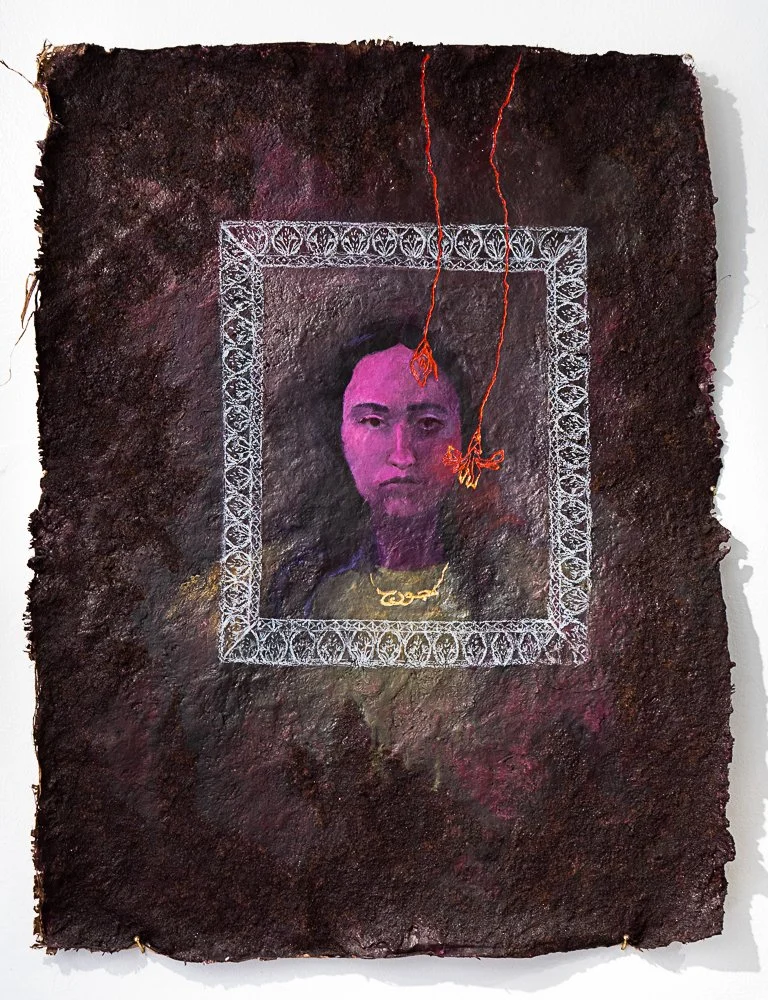
Self-Portrait (2026) by Alyssa Khalifa. Photo courtesy of the artist
Walking into Nyctinastic Cycle, artist Alyssa Khalifa’s first solo exhibition now on view at Crane Arts, one is greeted by a body, sprawled across a white plinth, that seems to be both disintegrating and regenerating. Fingers unfurl from the figure’s arms and dissolve into wispy tendrils of papyrus, while thick stalks with coiled roots emerge from the figure’s back, its papery skin blushing and speckled under a paste of sumac. The stalks bear droopy red lotuses, a motif inspired by Khalifa's grandmother who gifted her a tray adorned with the Egyptian flower three years ago.
“The lotus took on a significant symbol for me,” Khalifa says, “and as I grew into that symbol, it started to become a symbol of rebirth. Not just with my sexuality, but also learning more about myself as a person, getting more in touch with my roots, and becoming closer with family members.”
The papier–mâché figure, entitled “Maturing Lotus” (2026), is a physical manifestation of this symbolic transformation, one that carries with it the weight of pain, love, and loss.
“Maturing Lotus” is one of a plethora of hauntingly beautiful, spectral, and surrealist pieces in the exhibition, displayed through November 15 in Crane Arts’ Icebox Project Space. Part of Collective Futures — a six-week, citywide project engaging artist-led spaces and collectives — Nyctinastic Cycle debuted in partnership with Batikh Batikh, a pop-up cinema and gallery that seeks to amplify the work of queer and female SWANA artists. Khalifa has been a member of Batikh Batikh for about a year.
Originally from Michigan, she relocated to Philadelphia in 2020 to pursue her MFA in painting, sculpture, and queer studies at the Pennsylvania Academy of the Fine Arts. The move was, in some ways, a homecoming, as Khalifa’s family first lived in Germantown upon immigrating from Egypt, and the artist has maintained familial ties to the city. Today she teaches mixed-media art to seventh through twelfth graders in Philadelphia.
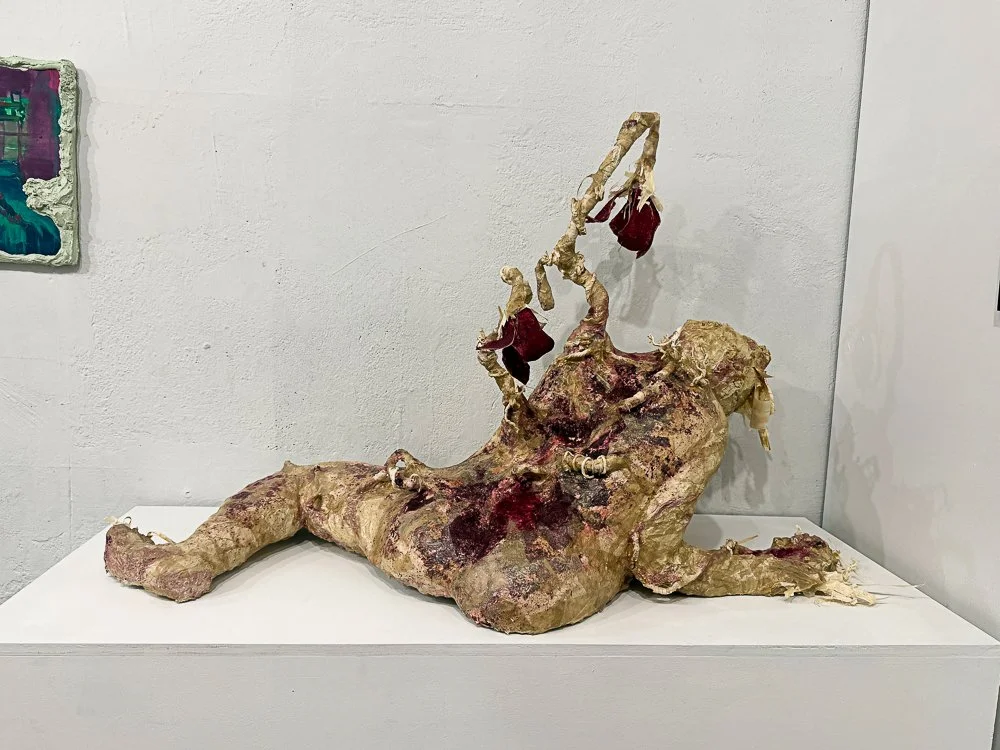
Alyssa Khalifa’s papier-mâché sculpture “Maturing Lotus” (2026) reflects on themes related to the artist’s identity, including queerness, heritage, and chronic illness. Photo courtesy of the artist
Like many of the works in Nyctinastic Cycle, the fragility of the papyrus–and–flax–paper skin of “Maturing Lotus” belies the depth and weight of questions the artist engages with. Khalifa’s autobiographical practice often draws from reflections on different facets of her own identity: her queerness, her Egyptian-Lebanese heritage, and her experience living in a body with chronic illness. The exhibit, much like her practice, is primarily figural, and the bodies that populate it are often reflections of her own.
“It’s a very vulnerable, kind of bizarre experience,” Khalifa says, reflecting on both the practice of being her own muse and the intimacy of the figures’ portrayal of her experiences. Despite this intimacy, many of the figures in Nyctinastic Cycle are faceless, either turned away from the viewer or obscured entirely. “I intentionally didn’t render the face in some of them because I really wanted to focus on the physical manifestation of grief, and these feelings in the body and how we hold [them],” she says.
This quest appears prominently throughout the exhibit but particularly in a mini-series of works on papyrus displayed on one wall of the gallery. “Suspended II” (2026) features a body that hinges uncomfortably at the hip, its discolored arm hanging limply at its side, appearing to leak nerves and veins from within. In “Begin” (2026), another body buckles under the weight of a lotus flower emerging from its back.
The figures in Khalifa’s works grapple with pain, both physical and emotional, that seems to worm its way through their limbs, reflecting events in the artist’s own life: contending with the loss of family members—and with this, the threat of losing ties to one's culture—in addition to chronic pain. Khalifa has endometriosis, a medical condition in which tissue grows outside of the uterus and can cause severe discomfort. As she worked on pieces for the show, she underwent surgery for this condition, a procedure that in turn triggered inflammation throughout her body.
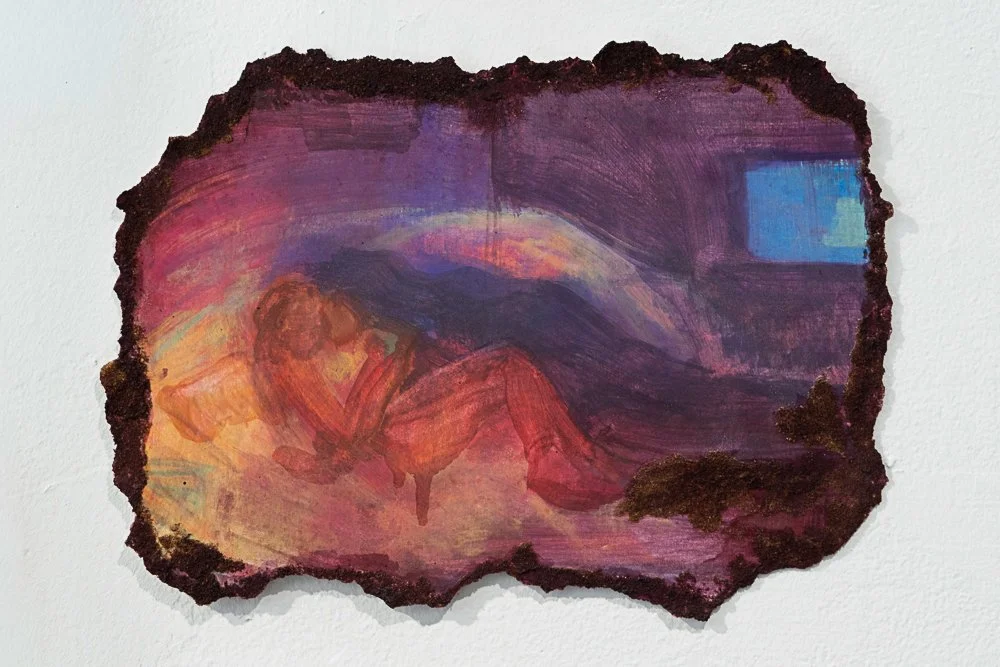
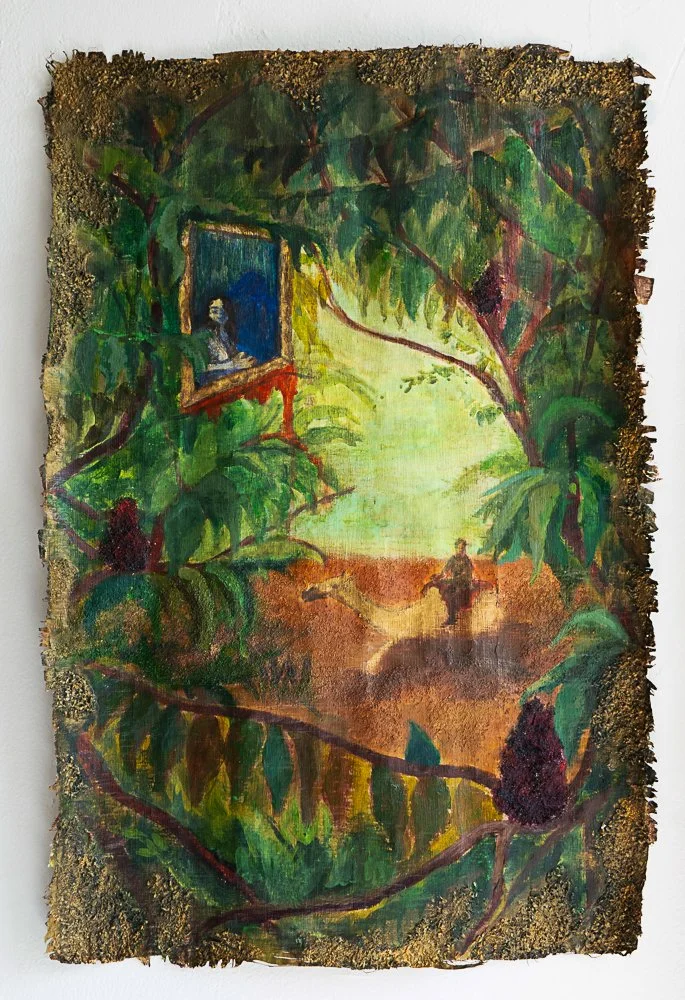
Above: “Me and You” (2026) Below: “Sumac in Detroit” (2026), by Alyssa Khalifa. Photos courtesy of the artist
This reckoning with her own embodiment was accompanied by a reckoning with the bodily impermanence of those she loved. After watching three family members cycle in and out of the hospital in recent years, the inevitability of loss began to take up greater space in Khalifa’s life and practice.
“I’m not just losing loved ones,” she says, “I’m also losing a piece of myself and my culture.” The experience not only pushed her to forge deeper connections with family members, but to think more seriously about cultural preservation. In Khalifa’s life, this intention manifested as a renewed interest in cooking; in her practice, a new approach to materiality.
Many of the works in Nyctinastic Cycle feature surfaces heavily textured with sumac and za’atar. The idea to experiment artistically with these spices occurred to Khalifa while visiting family in Michigan: not only did the spices evoke fond memories of her teta’s kitchen, sumac in particular was similar in texture to the coffee grounds that had previously been her mixed-media material of choice. The mini-series of paintings was born out of this process of experimentation, as Khalifa sought different methods to adhere the spices to papyrus and prevent mold from forming.
The addition of za’atar and sumac lends depth and texture to otherwise flat renderings of natural landscapes. In “Unconscious” (2026), sumac mixed with acrylic paint is transformed into a silty purple soil that looks as if it has sprouted directly from its papyrus backing. In “Sumac in Detroit” (2026), a gold-hued paste of za’atar frames the scene’s jungle foliage, decadently peeking through green leaves and branches.
These spices appear in domestic scenes as well. Sumac is used in “Me and You” (2026) to encase a rendering of Khalifa and her partner in an earthy, moss-like frame, one that seems to grow according to its own logic and envelops the intimate embrace below. In these works, Khalifa’s choice to incorporate culturally significant, organic mediums gestures beautifully at the artist’s preoccupation with notions of cyclicality, ancestry, and renewal in both their material and placement.
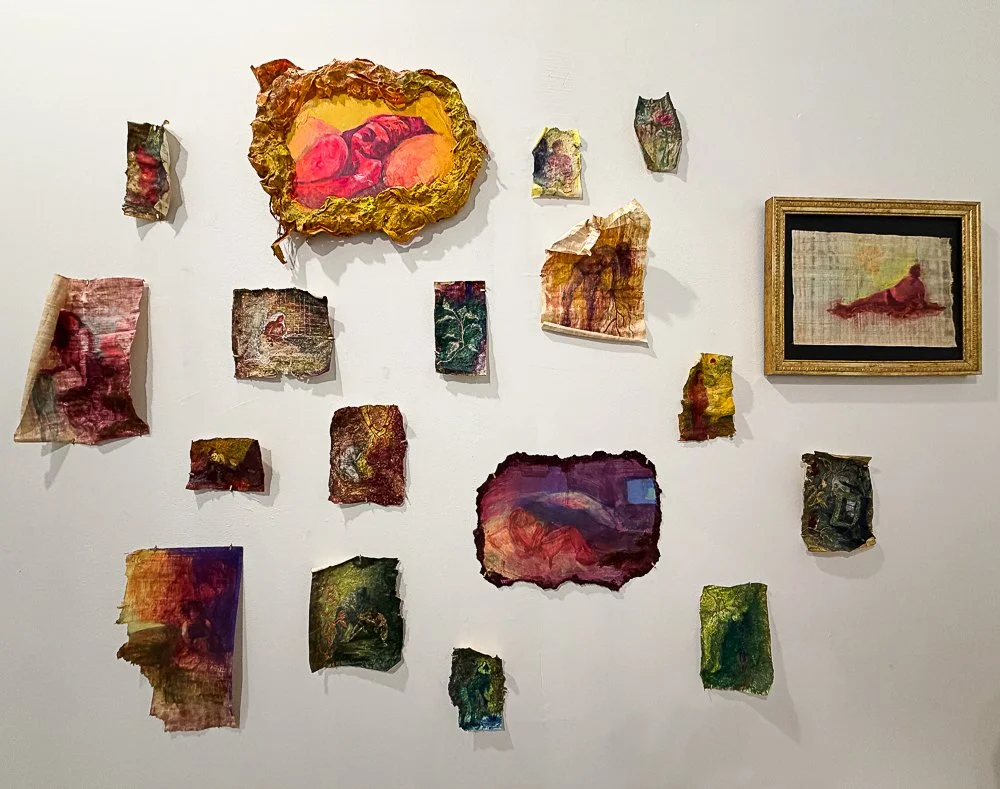
An installation view of works in Alyssa Khalifa’s solo exhibition at Crane Arts, Nyctinastic Cycle. Photo courtesy of the artist
Nyctinastic Cycle is principally about the cycles that create a person — love and loss, life and death, sickness and health, becoming and unbecoming — and the body that carries them. Though autobiographical, this show makes clear that Khalifa’s practice is far from singular. Rather, it reflects the body of a collective, a familial line, a coalescence of relationships and experiences and lives.
Few pieces in the show illustrate this better than the artist’s self-portrait hung by the gallery’s entrance, a formidable midwife to the works inside. In “Self Portrait” (2026), Khalifa’s face, encased in a delicately drawn silver frame, stares directly out at the viewer. Her skin is rendered a bright fuchsia in an ode to the rich stain of sumac. Red lotus flowers dangle in front of her face, a gesture to ancestry in both the near and distant past. Her chest is adorned with a gold necklace that bears the name “George” in Arabic — an uncle, Khalifa says, “who was like a father to me, and so I always think of him as a guardian angel.” In the show’s only unobscured self-portrait, it is not only Khalifa’s face the viewer finally sees, but an amalgamation of the legacies that have preceded her and the love that endures.
***
Sawyer Taylor–Arnold is a Philadelphia-based researcher, writer, and arts practitioner. She holds a BA from Harvard College and an MA in Art History from the University of Pennsylvania with a focus on Egyptian modern art. Originally from Western North Carolina, her work explores hidden histories of gender, sexuality, and power in art and material culture from Appalachia and North Africa.

This story was made possible by the People’s Media Fund.