
These Philly–Area Performers Are Committed to Preserving the Cultural Authenticity of Belly Dance
By Gawhara Abou-eid
November 14, 2025
For four decades, the sounds of the oud and tabla filled the Middle East Restaurant, a Lebanese family-owned landmark that once stood as a cultural hub in Philadelphia’s Old City. Amid the music and movement, a young Michele “Meesha” Tayoun found her life’s calling.
“I was first drawn to belly dance by watching family and community members dance at gatherings… It was part of the joy and connection I grew up with,” Tayoun says. “But what truly grabbed me was the music.”
The restaurant was owned by her relatives and featured live Arabic bands and traditional performances, creating an atmosphere that she remembers as “warm, inviting… and soulful.” Those experiences impressed upon her that the dance is “not just performance, but a deep cultural and emotional expression.”
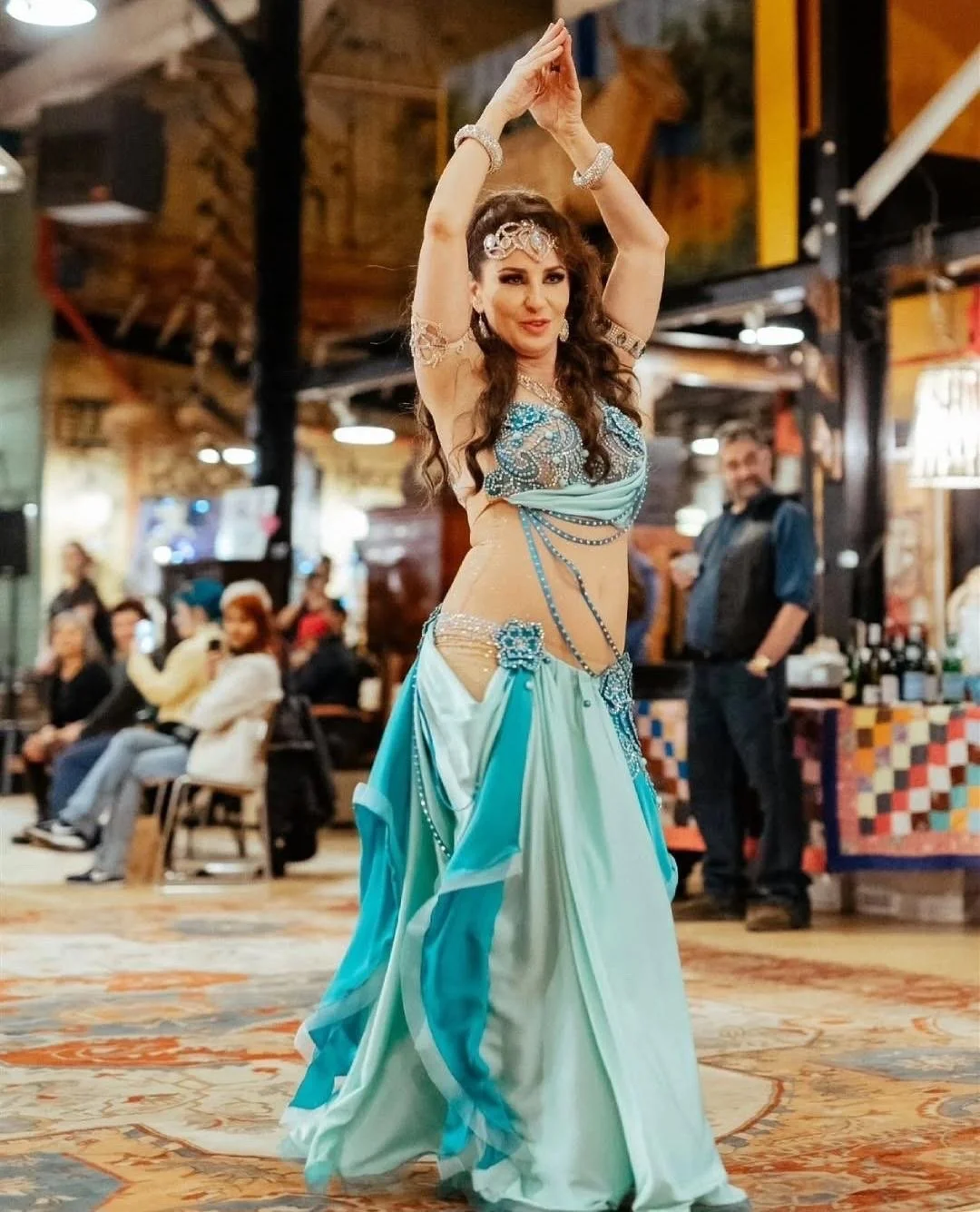
Michele Tayoun, of Meesha Belly Dance, performs at Material Culture in Philadelphia to help raise money for a charity in 2023. Photo courtesy of Michele Tayoun
The Arabic term for belly dance, or “raqs sharqi,” translates to ‘Eastern dance’ and is believed to have emerged in Egypt between 1910 and 1930 to describe a professional stage form that evolved from older communal and folkloric dances such as “raqs baladi,” or country dance. During the late 19th and early 20th centuries, Egypt’s urban entertainment venues, shaped by colonial influences and modernity, reimagined women’s social dances as theatrical solo and ensemble performances. Meanwhile, the Western label ‘belly dance’, which entered English use by the early 20th century, is believed to be derived from the French “danse du ventre,” or dance of the belly.
Tayoun, who runs Meesha Belly Dance, prefers the terms raqs sharqi or orientale — which was derived from French and historically used in parts of the dance community — when teaching or performing in cultural contexts. She calls belly dance a simplified label that lacks nuance. But she uses the term in her social media handles, she says, because it’s the term most people recognize. Her Lebanese heritage, combined with her upbringing in the United States, guides her approach to performance and teaching, giving her an emotional and bodily connection to the art. She describes the gestures, phrasing and rhythms as a “language my body already knew.”
Living in the U.S., however, has made Tayoun aware of how easily the dance can be misrepresented or reduced to a stereotype, so she is intentional in how she presents it to new audiences. Her performances aim to balance authenticity with emotional storytelling, grounding creativity in cultural respect while educating audiences about the art form’s roots.
When Tayoun performs traditional raqs sharqi, particularly to live music, observers often tell her they feel something “soulful, alluring and familiar.” She interprets that response as evidence that the dance can speak across cultures when presented with integrity. Over time, she has seen curiosity and respect replace misconceptions, an evolution she calls a “very positive shift.”
For Tayoun, raqs sharqi is a living embodiment of heritage and identity that goes beyond entertainment. It holds a complex place in SWANA (Southwest Asian and North African) societies, she says, celebrated for its artistry yet sometimes stigmatized for its femininity. SWANA audiences may feel pride when international pop stars like Shakira use belly dance elements but shame women in their own families for pursuing the dance professionally.
“The power of female sensuality still makes many people uncomfortable,” she says, describing the dance as “a celebration of the feminine and the cycles of creation and emotion that connect us all.” Within American culture, Tayoun views raqs sharqi as a bridge for dialogue about identity, gender and respect for cultural roots.
“When performed with authenticity, it becomes a form of empowerment, an act of reclaiming the beauty and strength of the feminine and honoring the deep humanity that this dance expresses,” she says.
Tayoun is emphatic that she does not seek to reinvent the form but to deepen her relationship with it. For dancers who do not share SWANA heritage, she says, “intention is key.” When such artists study the music and cultural context with genuine care, she believes they can become “respectful ambassadors.”
“You have to see it first and foremost as an ethnic dance.”
Tayoun’s work situates her among a small group of artists in Philadelphia who have shaped locals’ understanding of the dance through decades of performance, education and cultural exchange. Habiba (Barbara Siegel) and Najia are both American-born dancers who, despite not being of SWANA heritage, have built their practice on immersion, research and firsthand learning abroad.
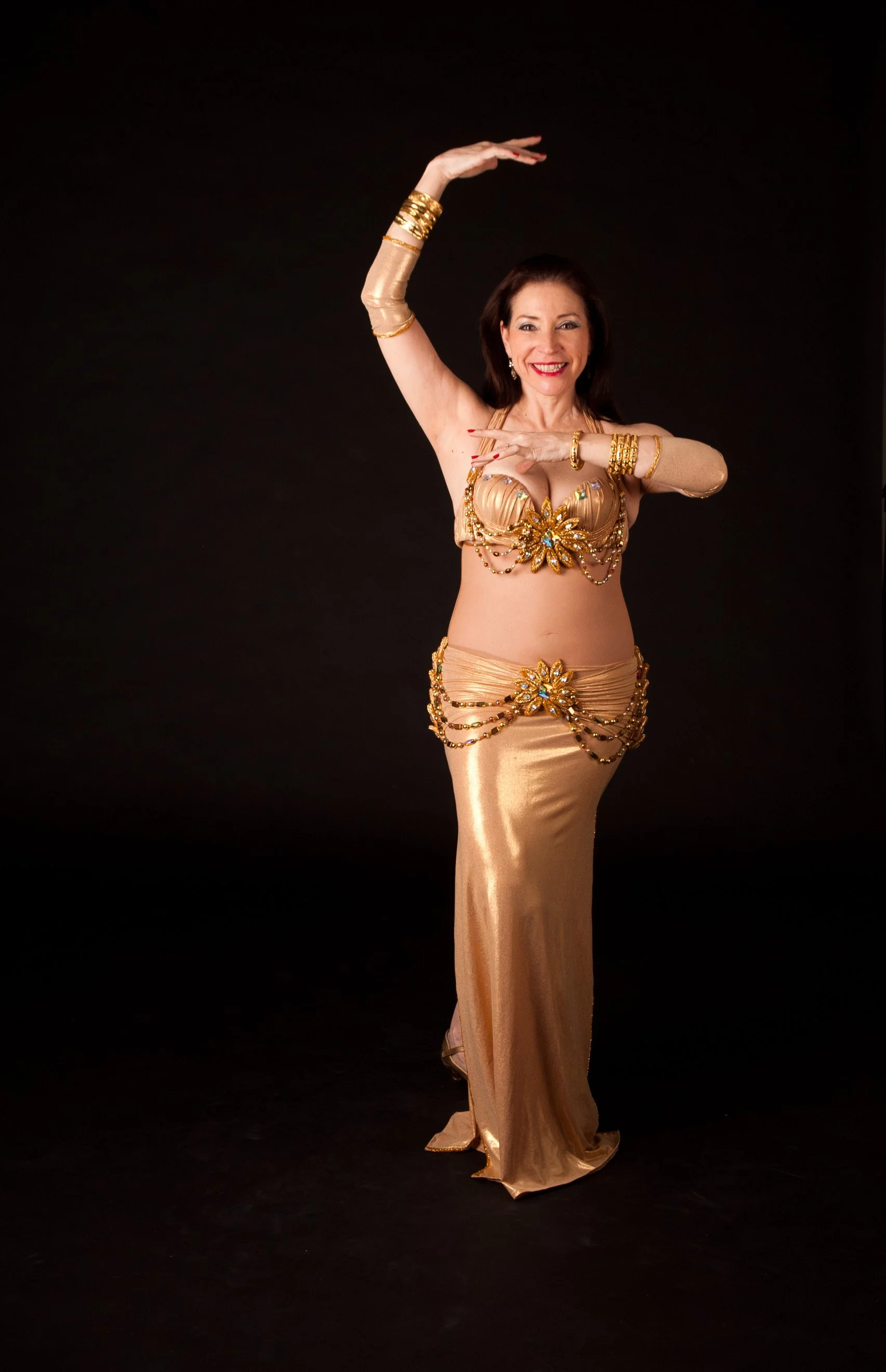
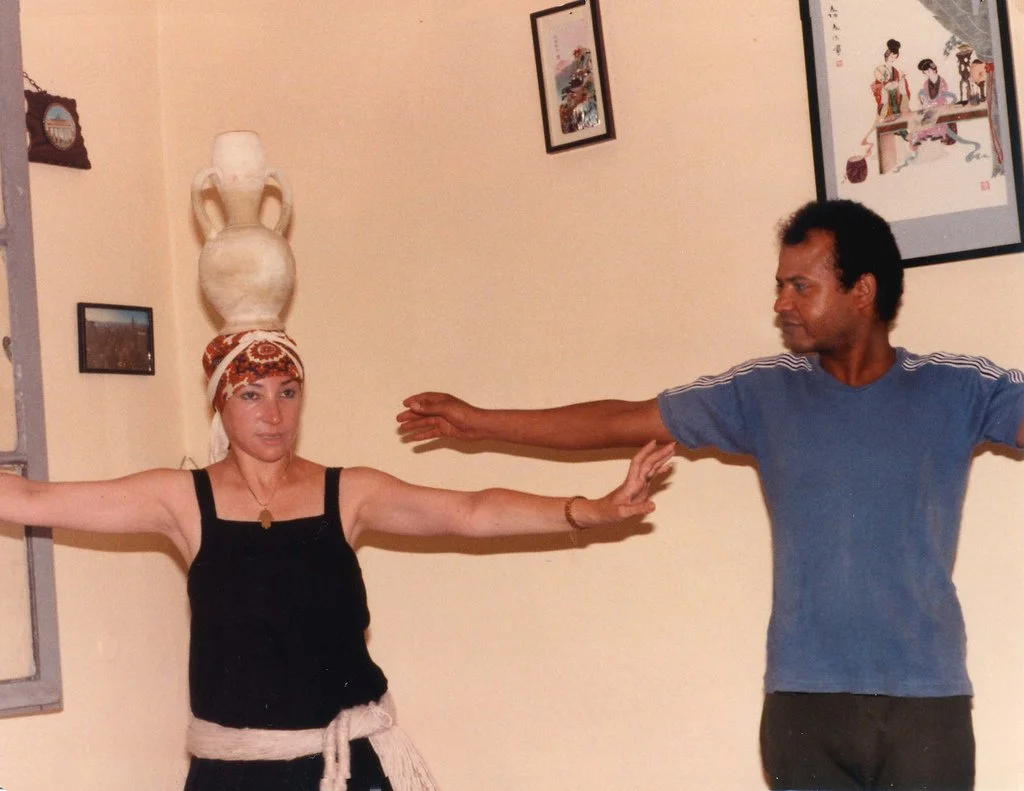
Above: Habiba (Barbara Siegel) began dancing in the late 1960s, a time when belly dance flourished in American nightclubs. Photo by Lloyd David. Below: Siegel learns Tunisian dance during one of many visits to North Africa. Photo courtesy of Barbara Siegel
Siegel, owner of The Habiba Studio, began dancing while in college in New York City during the late 1960s to 1970 — a time, she says, when belly dance flourished in American nightclubs. She was initially looking for a way to exercise when she saw her first performance on Eighth Avenue and was immediately captivated.
“The minute the dancers started performing, I thought, ‘I want to do this forever,’” she says.
After moving to Philadelphia in 1971 to study library science, she continued taking lessons and soon found herself teaching. Her growing commitment led her to Egypt and Tunisia, and she visited both countries many times to study the dance in its native settings.
“You have to see it first and foremost as an ethnic dance,” she says.
As a teacher, Siegel has long worked to facilitate cultural understanding. She recalls that in Philadelphia, some nightclub belly dancers leaned toward burlesque or theatricalized interpretations. But, as she tells her students, while the dance can be sensual, “it doesn’t need any help by being burlesque.”
Siegel distinguishes between Western interpretations that highlight spectacle and SWANA contexts in which the dance is part of community celebration, such as weddings, where the atmosphere is familial and children often join the dancer onstage.
In the 1950s, the Egyptian Reda Troupe, founded by Mahmoud Reda, revolutionized Egyptian dance by bringing folkloric traditions to the theatrical stage. As Egypt’s first official state dance company, they performed worldwide and inspired generations of dancers. Their innovative approach helped shape the modern form of raqs sharqi, blending its folk origins with formal artistry.
Siegel’s acquaintance with one of the troupe’s leading figures sharpened her appreciation for Egyptian dance traditions that continue to influence performers today. She also credits her mentor, the late Ibrahim Farrah, a Lebanese-American teacher who played a significant role in the dance’s popularization in the U.S., with shaping her understanding of the cultural dimension behind movement. His advice? “You’ve got to sit and string peppers with the women.”
To Siegel, the phrase symbolizes the importance of immersing oneself in everyday life, not just formal training.
Siegel’s teaching continues to attract both American and SWANA students, including many, she says, who “maybe never had time to learn it, or their families didn’t dance.” She takes pride in one of her students, Shahrzad, who began lessons with her at the age of 14 and now performs professionally in Cairo.
When it comes to terminology, Siegel uses “belly dance” and “raqs sharqi” interchangeably. She often introduces the Arabic term once she has her audience’s attention, noting that while ‘belly dance’ is widely recognized, its Arabic name better reflects the dance’s origin and meaning.
“The goal is for people to know what you’re talking about,” she says.

Najia, who runs Be a Living Goddess Studio, started feeling the pull of SWANA music as a child. Image courtesy of Najia
Be a Living Goddess Studio owner and teacher Najia, who prefers to be known by her performance name, uses both terms but urges her students to recognize the deeper meaning behind the original.
For Najia, the pull of SWANA music began in her childhood. Born in West Philadelphia and raised in Delaware County, she recalls hearing melodies from her Armenian neighbors’ home and feeling instantly “enchanted.”
Inspired by films, television shows like “I Dream of Jeannie” and the ornate rugs and lamps she saw in her neighbors’ house, she would dress up and dance at home. By age five, she was choreographing neighborhood performances with a friend, selling tickets and creating costumes from household fabrics. Her Italian-American mother also exposed her to many cultures by hosting international friends and introducing global foods through community clubs.
When Najia’s mother later took a night-school belly dance class, Najia, still too young to enroll, attended as an observer. The teacher, noticing her interest, demonstrated some basic hip circles and small pelvic movements for her, which Najia continued to practice on her own. She began taking formal classes as an adult and traveled extensively to study the dance firsthand, visiting Egypt, Jordan, Turkey and Morocco, sometimes staying for months and living with local families. She describes her travels as both artistic and anthropological, involving observation of dances performed in homes that foreigners rarely see.
Najia says her experiences taught her to understand the distinction between public and private dance in SWANA societies. She says she saw many dancers perform primarily in family or community settings rather than on professional stages. When teaching her American students, she emphasizes these nuances.
Similarly, she is frustrated by the fact that many Americans still associate the term belly dance with “erotic entertainment.” So she has focused on combating these misconceptions and raising standards in both her performance and her instruction.
Today, Najia teaches mostly private sessions and online classes to students who demonstrate “genuine respect for the culture.” She describes herself as both a dancer and psychic medium, speaking about movement as a kind of dialogue between body and energy. While some are drawn to that spiritual dimension, she says her foundation remains rooted in the traditional music, feeling and storytelling of SWANA dance.
Some students, she says, approach the dance as a path to healing, community and empowerment; others pursue it superficially. She has become selective about who she teaches, aiming to preserve what she considers “a sacred, expressive form that connects women through shared emotion and movement.”
Like Tayoun and Siegel, Najia explores how the dance in the U.S. navigates authenticity and accessibility. All three dancers note the open-mindedness of Philadelphia audiences, who respond warmly when a performance emphasizes musicality, storytelling and cultural respect.
For Tayoun, the sense of cultural connection and musical storytelling she experienced at her family’s restaurant continues to shape every performance. Her family’s former restaurant may be gone, but the spirit it fostered remains.
“Audiences are curious and captivated by the culture and music,” she says. “When presented with integrity, this dance speaks across cultures.”
***
Gawhara Abou-eid is an Egyptian-American researcher and journalist from Lewisburg, PA and an Al-Bustan News media fellow. They hold a BA in International Relations from The George Washington University, with a concentration in International Security Policy. Gawhara has published research for the League of Arab States in Cairo, and their journalism has appeared in The Standard Journal and The News-Item.

Al-Bustan News is made possible by a grant from Independence Public Media Foundation.