
Interactive | Mapping SWANA Philly
By Ben Bennett
November 13, 2025
For the first time since 2000, residents will have a new racial category to identify themselves on the next U.S. census: MENA. The identification, Middle Eastern or North African, will appear on the 2030 census.
This is a welcome development for many. Formal consideration of the new census category started ten years ago, based on engagement with Middle Eastern and North African communities that showed a demand for this new category. According to the U.S. Census Bureau, the updated demographic data will inform health research and policy decision-making related to these communities.
The push to include a MENA category in the census has been a multi-decade process. In 2010, the Arab American Institute founded the MENA Advocacy Network to conduct research and create a category for the racially, ethnically and culturally diverse group. The effort to include the designation on the 2020 census did not succeed, but in March 2024, the Office of Management and Budget, charged with determining racial categories on the census, announced that MENA would be added to the 2030 census.
Counting Philadelphia’s SWANA Population
The updated census data will undoubtedly provide insight into often undercounted and underrepresented populations in census counts. During the 2020 census, Al-Bustan Seeds of Culture partnered with Philly Counts to encourage SWANA residents to participate in the survey. However, without an option to represent their ethnicity on the census, most of these community members were grouped with the broader racial category of ‘white.’
The Pew Research Center has tackled the task of breaking down which Philadelphia neighborhoods are home to sizable populations of different SWANA groups. In 2024, Pew published a study that explored immigrants’ origins and where in the city they have tended to settle. The data visualization shown below, for example, that while North African immigrants can be found across the city, the largest concentration is located in the northeast.
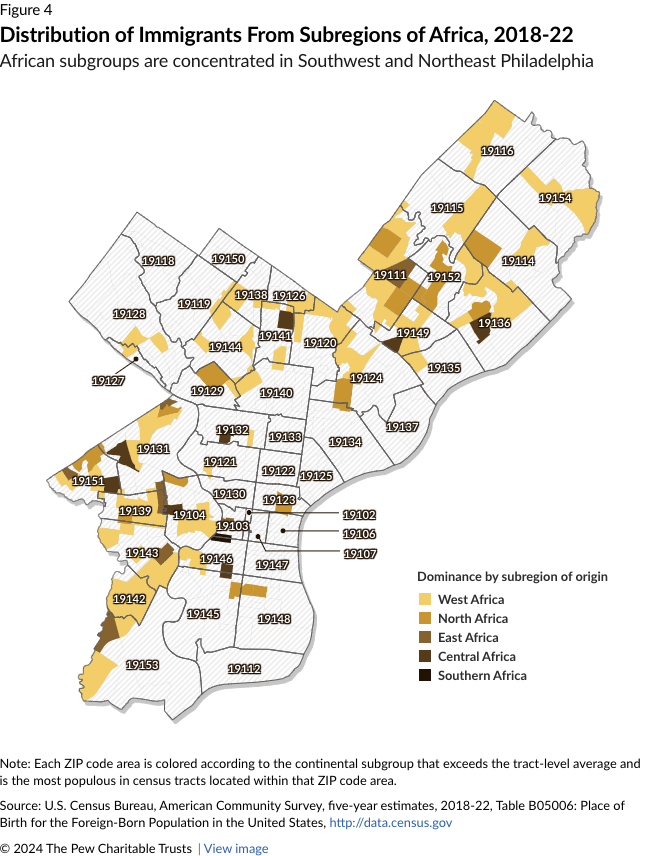
Source: Pew.org
Where Are Philly’s SWANA Communities?
While the Pew study covered immigration from Europe, Asia, Africa, and the Americas, there is no data specifically on the SWANA communities in Philadelphia. To locate these communities, I looked at census data from the American Community Survey 5-Year Data, from 2009 to 2023. Although there are no racial categories in the survey, it is possible to sort demographics by ancestry. The SWANA groups included are Afghan, Egyptian, Jordanian, Lebanese, Moroccan, Palestinian, Syrian, Armenian, and Turkish.
Using this data, I created a chloropleth map, with the darker areas representing the highest concentration of a given ethnic group and the lighter shades the lowest. For example, you can see that the highest concentration of Philadelphians with Syrian heritage is in Center City, while the largest Turkish community is in West Philly.
While this data does not offer a complete picture of the SWANA populations in Philadelphia, in part because the census relies on residents self-reporting, it does provide an overview of the city’s zip codes. You can explore the interactive maps below by hovering over the green areas.
***
Ben Bennett is a Chinese-American visual journalist based in Philadelphia and an Al-Bustan Media Fellow. He is a recent graduate of American University's journalism program, where his coverage focused on underserved communities and the intersection of politics and popular culture.

Al-Bustan News is made possible by a grant from Independence Public Media Foundation.