
Cinema, Etcetera | The Oscars and Berlinale Show the Limits on Political Speeches at Awards Ceremonies
By Joseph Fahim
March 27, 2026
The past month in film was dominated by two different yet related events: the Oscars and the Berlin Film Festival, or Berlinale. A common thread in both was the intensity of the filmmakers’ political speeches, and the stark contrast in the reactions to those speeches in their respective countries.
Judging by the commentary surrounding both events, the public wants and expects such speeches, while the media and politicians largely condemn them. This disconnect exposes the erosion of freedom of expression at a time when career security and capital have become the dominant forces in cinema.
The Berlinale has long been regarded as the most political film festival in Europe. Founded in 1951 at the height of the Cold War, Germany’s foremost film event has consistently worn its liberal politics on its sleeve, championing causes ranging from queer rights, environmental justice and the war in Ukraine, to the plight of the Iranian opposition and anti-Trump sentiment in the U.S.
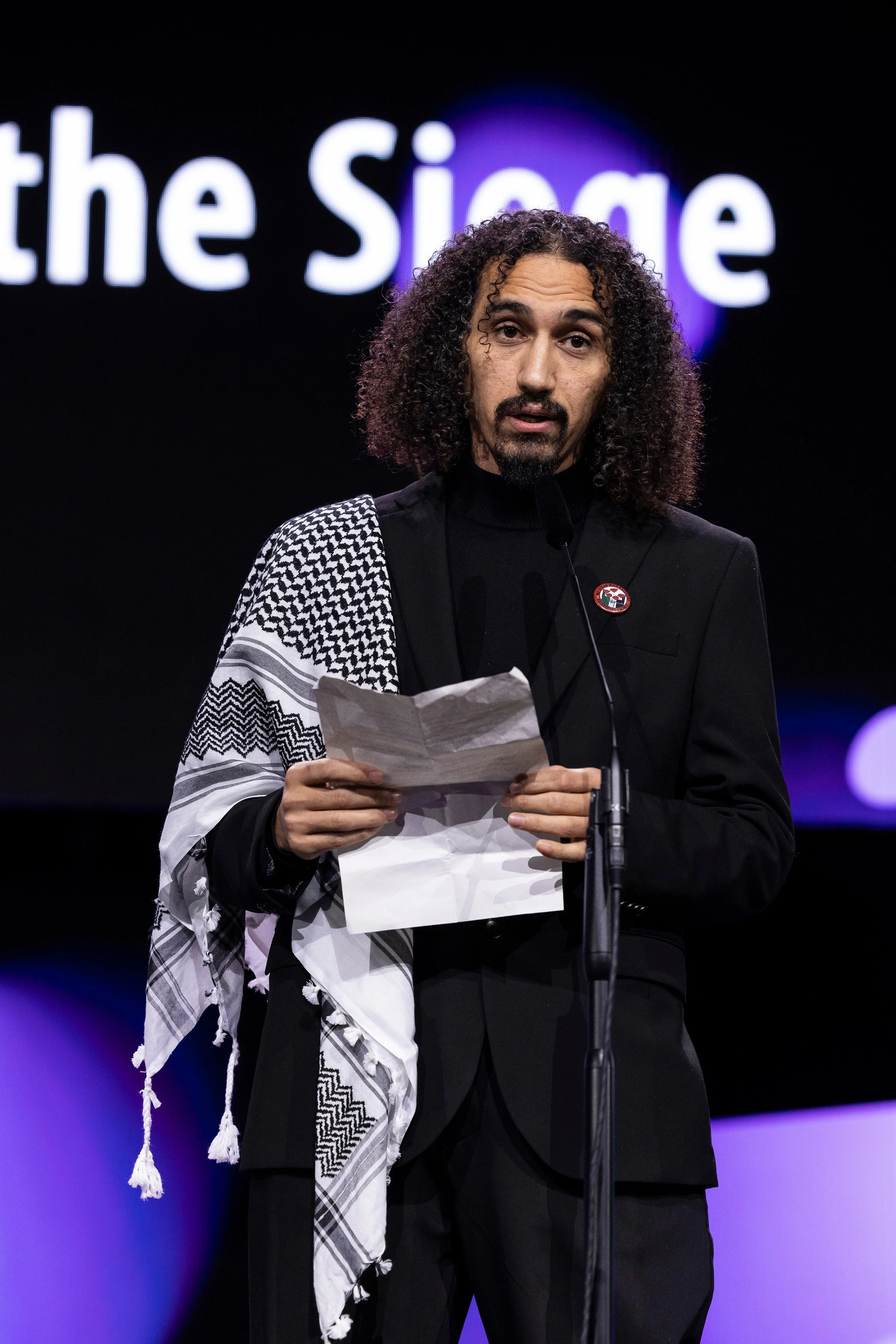
Abdallah Al-Khatib faced backlash for his speech at the 2026 Berlinale condemning the German government’s complicity in the genocide in Gaza. © Richard Hübner / Berlinale 2026
But the genocide in Gaza laid bare the limits of Berlin’s liberalism. The fierce backlash against the Oscar-winning documentary “No Other Land,” which premiered at the festival in 2024 alongside several filmmakers expressing solidarity with the Palestinian cause, revealed the boundaries imposed by an unabashedly pro-Zionist political establishment and a media landscape that is highly selective in the free speech it chooses to endorse.
More than two years after October 7, neither the German mainstream media nor the political establishment appears to have shifted its staunch pro-Israel stance. Upon receiving the Best First Feature award at last month’s closing ceremony, Palestinian-Syrian filmmaker Abdallah Al-Khatib delivered a blistering rebuke of Germany’s much-criticized foreign policy.
“Some people told me, maybe you have to be careful before you say what I want to say now, because you are a refugee in Germany,” he said. “There are so many red lines, but I don’t care. I care about my people, about Palestine. So I will say my final word to the German government: you are partners in the genocide in Gaza by Israel.”
Al-Khatib’s speech prompted the German Minister of Environment to walk out of the ceremony. Two days later, a host of politicians and media outlets pounced on Al-Khatib in the same fashion as the earlier attacks on “No Other Land.”
“For all their political undertones, none of the evening’s speeches matched the directness of Michael Moore’s 2003 condemnation of the Iraq War or Jonathan Glazer’s 2024 critique of the Israeli occupation of Palestine. ”
A month later, the American media reacted with markedly less hostility toward the political speeches at the Academy Awards on March 15 — and there were quite a few.
The directors of the Best Documentary Feature winner, “Mr. Nobody Against Putin,” took aim at ICE while addressing the growing influence of right-wing moguls over American media. “We act complicit when a government murders people on the streets of our major cities,” co-director David Borenstein said. “When we don’t speak up as oligarchs take over the media and control how we produce and consume it.”
Norwegian filmmaker Joachim Trier, winner of the Best International Film award, struck a more universal note, saying, “All adults are responsible for all children. Let’s not vote for politicians who fail to take this responsibility seriously.”
And there were other topical remarks: The team behind Netflix’s Best Documentary Short winner “All the Empty Rooms” addressed school shootings while criticizing dysfunctional gun laws. Actor Will Arnett warned of the growing threat of AI in cinema. And Jimmy Kimmel predictably took aim at Melania Trump and CBS. But the loudest applause of the night was for the briefest political statement. Before presenting the Best International Film award, Javier Bardem simply declared: “No to war, and free Palestine.”
Yet perhaps the most revealing political dimension of the ceremony was what went unsaid. Paul Thomas Anderson, who won Best Director for “One Battle After Another” — one of the most overtly political Hollywood films in recent years — chose a more oblique approach.
“I wrote this movie for my kids, to say sorry for the mess we’re leaving them, but also to encourage them to be the generation that brings back some common sense and decency,” he said.
Despite the film’s clear parallels to contemporary America, from the rise of white supremacy to ICE raids and the failures of the left, Anderson avoided directly naming the current administration throughout the awards season, which speaks volumes about the current state of filmmaking in Hollywood. With the looming merger of Warner Bros. and Paramount, partly owned by Trump ally Larry Ellison, few filmmakers appear willing to antagonize what may soon become Hollywood’s most powerful conglomerate.
Equally conspicuous was the absence of any explicit reference to the Iran war, a silence likely informed by the same pressures. For all their political undertones, none of the evening’s speeches matched the directness of Michael Moore’s 2003 condemnation of the Iraq War or Jonathan Glazer’s 2024 critique of the Israeli occupation of Palestine. Moore’s speech was roundly booed and was widely attacked by conservative media. Meanwhile Glazer, who is Jewish, was accused of antisemitism and denounced by a multitude of filmmakers, producers and actors.
The worlds of the Oscars and the Berlinale could hardly be more different. With the exception of the International Film category, the Academy Awards tend to celebrate industry professionals operating within an increasingly conservative Hollywood system. European festivals like the Berlinale, by contrast, remain dominated by independent filmmakers whose politics are often inseparable from their work.
But filmmaking in the U.S. still retains a margin of freedom that allows a figure like Bardem to utter “Free Palestine” without immediate reprisal, even in today’s climate. That margin is non-existent in Germany, where criticism of Israel or of Germany’s role in the Gaza war is widely deemed unacceptable.
“A speech can be more threatening than a work of art, particularly in times of war, when cinema cannot match the speed or urgency of the spoken word.”
Film, however politically explicit, can rarely match the immediacy of a speech. Unlike cinema, which, no matter how direct, remains open to interpretation, a speech is an unambiguous articulation of an artist’s political stance, delivered in real time on a global stage. In that sense, a speech can be more threatening than a work of art, particularly in times of war, when cinema cannot match the speed or urgency of the spoken word.
Days before Al-Khatib’s remarks, Kaouther Ben Hania, the director of “The Voice of Hind Rajab,” rejected an award at the Cinema for Peace event in Berlin.
“Peace is not a perfume sprayed over violence so power can feel refined and comfortable,” she said. “If we speak about peace, we must speak about justice. And justice means accountability. I refuse to let their deaths become a backdrop for polite speeches about peace. When peace is pursued as a legal and moral obligation, rooted in accountability for genocide, then I will return and accept it with joy.”
Ben Hania did not face the same level of backlash in the German media as Al-Khatib, perhaps due to her ties to major international figures such as Joaquin Phoenix, Brad Pitt and Jonathan Glazer, all of whom are credited as executive producers on her film.
Power and privilege, then, shape both the tone and consequences of political speech. For established filmmakers like Ben Hania, such statements carry relatively little risk; if anything, they reinforce positions already articulated in their work. For Paul Thomas Anderson, the stakes may arguably be higher, making explicit political speech potentially riskier than his stature might otherwise suggest.
Al-Khatib, by contrast, had everything to lose, and it is precisely this vulnerability that lends his speech its force. The contrast between the three thus reflect a certain hierarchy in cinema, one that doesn’t necessarily translate to more freedom of speech.
In functioning democracies, artists should be free to express their views without fear of reprisal. Yet if the current political and economic climate reveals anything, it is that the West no longer embodies the freedoms it has long claimed to uphold. Nor, perhaps, does it retain the self-proclaimed authority to lecture others on them.
***
Joseph Fahim is a film critic, curator and lecturer. Currently Al-Bustan’s film curator, he has curated for and lectured at film festivals, universities and art institutions in the Middle East, Europe and North America. He also works as a script consultant for various film funds and production companies; has co-authored several books on Arab cinema; and has contributed to news outlets, including Middle East Eye, Middle East Institute, Al-Monitor and Al Jazeera. In addition, his writing can be found on such platforms and publications as MUBI’s Notebook, Sight & Sound, The Criterion Collection, British Film Institute and BBC Culture. His writings have been translated into eight different languages.

Al-Bustan News is made possible by a grant from Independence Public Media Foundation.