
Egypt's World Cup Breakthrough Unites Philadelphia Fans Across Borders
By Gawhara Abou-eid
July 10, 2026
Before Egypt's FIFA World Cup run ended in a controversial 3–2 loss to Argentina in the Round of 16 on July 7, fans packed into a Philadelphia restaurant carrying a different expectation than they had ever brought to a World Cup watch party. For many, it was a chance to celebrate a country finally receiving international recognition in sports while reconnecting with a community thousands of miles from home.
On July 3, that sentiment filled every corner of Cilantro Mediterranean Cuisine in South Philly as families, students and longtime soccer supporters crowded together to watch the Pharaohs face Australia in the Round of 32. The first African or Arab nation to compete in a FIFA World Cup when it qualified in 1934, the team had never advanced beyond the tournament's opening stage before 2026.
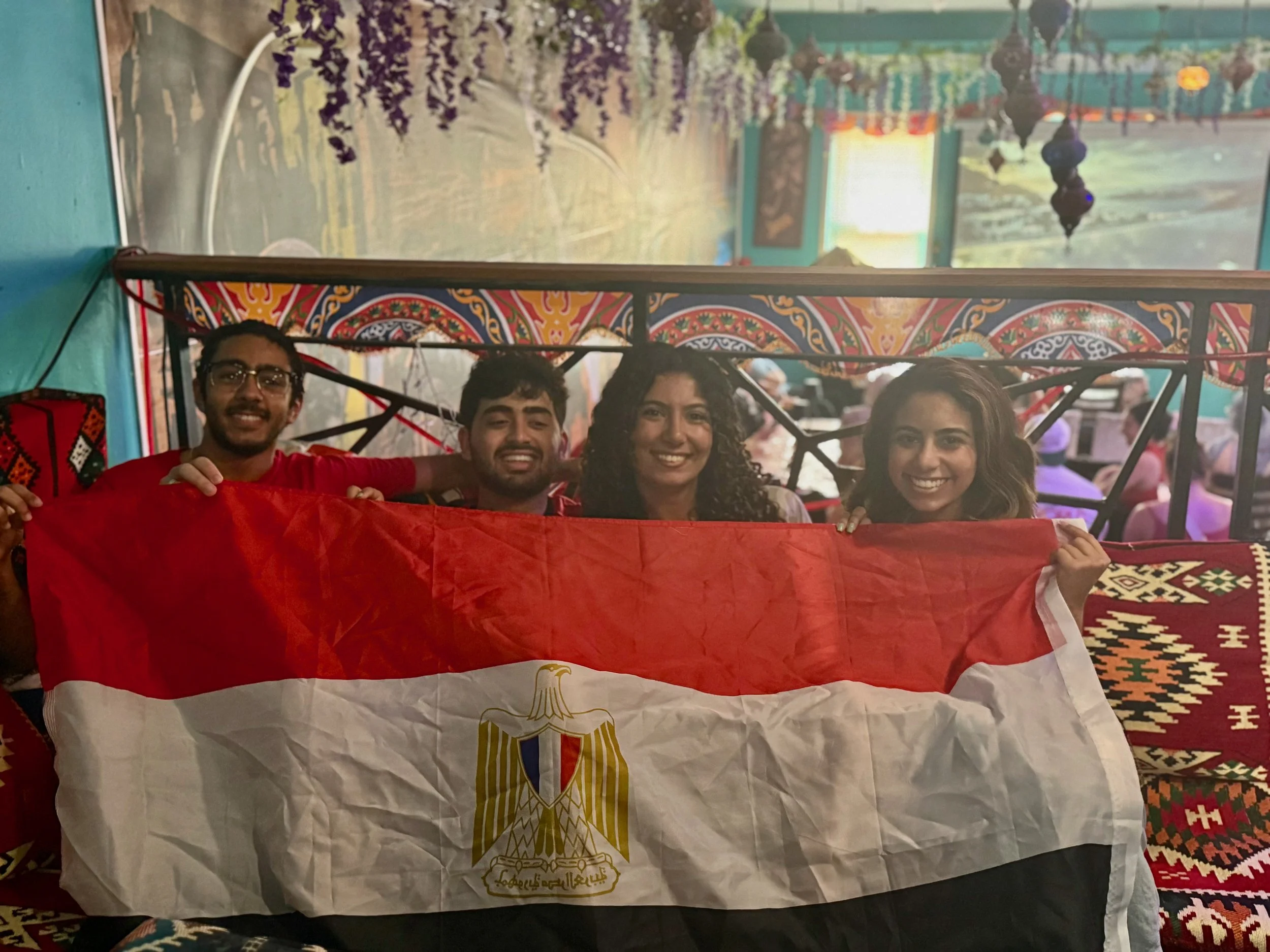
A group of friends travel from out of state to watch Egypt’s match against Australia at Cilantro Mediterranean Cuisine on July 3. All photos by Gawhara Abou-eid
Egyptian flags were draped across tables, a tabla was struck and cheers erupted with nearly every touch of the ball, creating an atmosphere owner Marwan Elazzazy said reminded many immigrants of home. For Elazzazy, whose family founded the Cilantro restaurant brand decades ago in Mohandessin, Egypt, before expanding internationally and eventually opening the Philadelphia location nearly eight years ago, the tournament became less about business and more about creating a place where Egyptians could celebrate as a community.
"I love the fact that it brings people back and brings them together, in a way people haven't seen in years,” he said. “They stop by from New Jersey and Ohio to come and watch the games with the Egyptian community just to feel like they're back home, and that's all that matters to us — to make people feel back home.”
That shared enthusiasm became one of the defining themes of the afternoon. Among those watching was Ahmed Elmiligy, who moved to Philadelphia seven years ago from Alexandria, Egypt. He grew up immersed in the sport, which his grandfather introduced him to as a child. Elmiligy later played at youth academies affiliated with Al-Ittihad Alexandria Club and Smouha Sporting Club, and he has watched every World Cup since 2006. Unlike many supporters surprised by Egypt's success, Elmiligy said advancing from the group stage felt achievable because of the draw.
"I was very proud," he said. "I one-hundred-percent expected this, because if we didn't do it this year, when can we do it?"
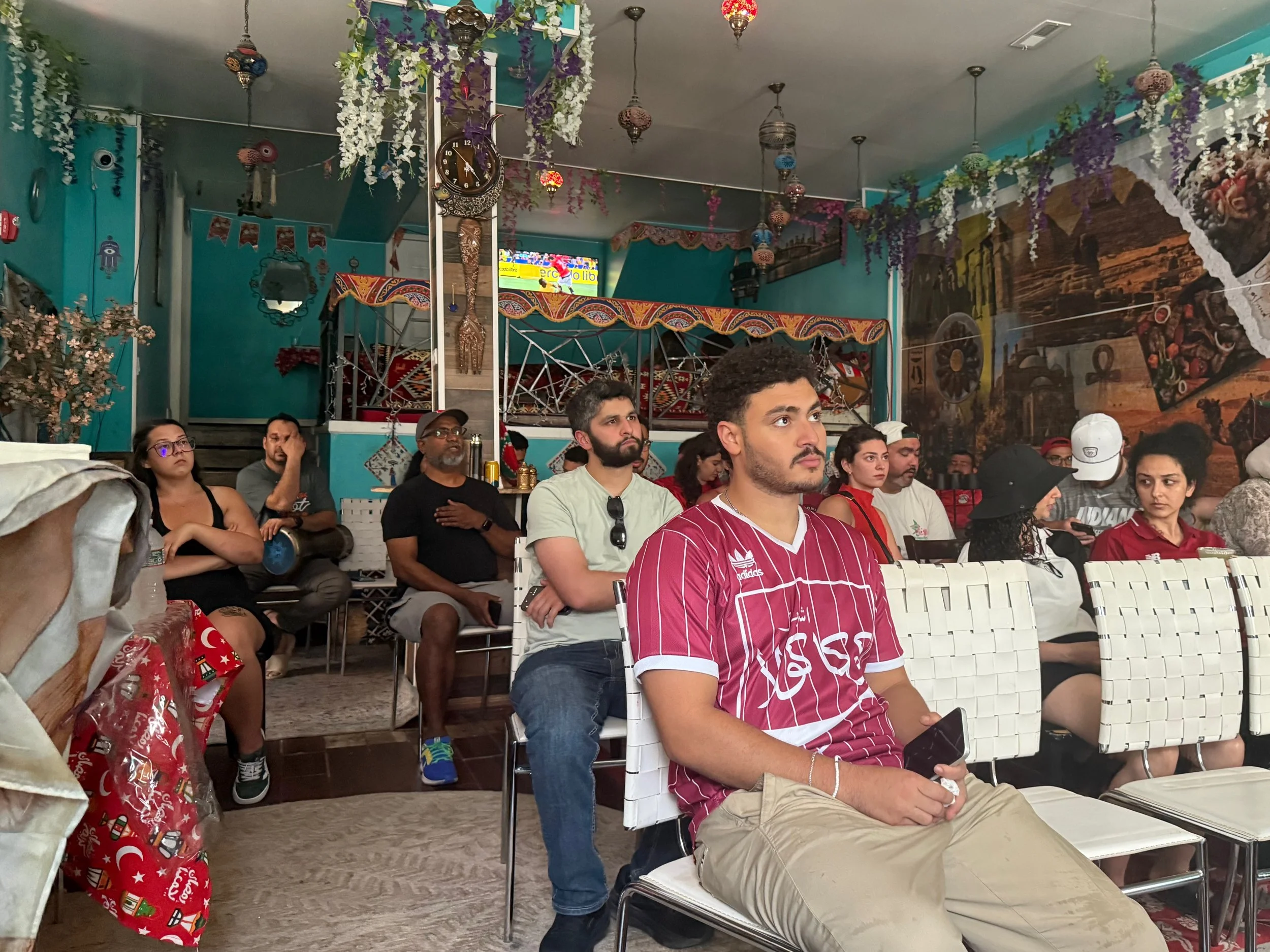
Cilantro Mediterranean Cuisine owner Marwan Elazzazy, front, watches the match with fans.
What impressed him more than the results was the team's approach. After disappointing performances in the recent Africa Cup of Nations tournaments, Egypt appeared transformed, Elmiligy said. He credited that change to a more confident mentality and new leadership. Rather than relying almost exclusively on defending and counterattacks, the squad was finally playing with belief. He argued Egypt's talent has often been underestimated compared with the celebrated generations that dominated African football between 2006 and 2010.
"I think what we lacked was personality," Elmiligy said. "We're playing with a great personality right now. All the talk about how our team is not the same as it used to be is putting a lot of pressure on the players, that they're not as good. I think we have always had a problem with the coaches that we hired. It's not the players."
Elazzazy admitted his own expectations evolved as Egypt continued climbing. At first, he said, simply qualifying for the group stage felt like an accomplishment. Then came the team’s first victory in World Cup history. Instead of edging out a narrow win against New Zealand in the group stage, Egypt won 3-1, fueling celebrations that stretched around the globe. Relatives contacted Elazzazy from Egypt, and friends living in Kuwait sent videos of celebrating crowds.
"It was a crazy feeling," he said. "It was different. You could tell the people were really happy, like you could just look at somebody's face and you understand what they're going through.”
As the match unfolded, chants for Egypt came not only from Egyptians but from fans whose own teams had been eliminated. For Drexel University students Sulaf Ghanim, who is Palestinian, and Filza Zuberi, who is Pakistani, supporting Egypt felt natural despite neither having grown up following the Egyptian national team closely.
Ghanim said she has long supported Arab nations in international tournaments and followed Egypt during the Africa Cup of Nations. Seeing the Pharaohs reach the World Cup knockout stage represented a milestone she never expected to witness. With Egypt and Palestine sharing a border, many Palestinians view Egypt as a second home, said Ghanim, who has family members currently living there. "We love Egypt," she said. "We think that it is ‘um el donia,’ or ‘mother of the planet.’"
For Zuberi, a lifelong cricket fan, following Egypt throughout the tournament transformed her into a soccer supporter. “[The] Pakistan team has never been … in FIFA ever,” she said. “But as a Muslim, I wanted to support all my Muslim friends." She admitted she had not expected Egypt's run when the tournament began, but after watching the team, she quickly became captivated by its style of play. "They give us goosebumps every time they hit the goal," she said.
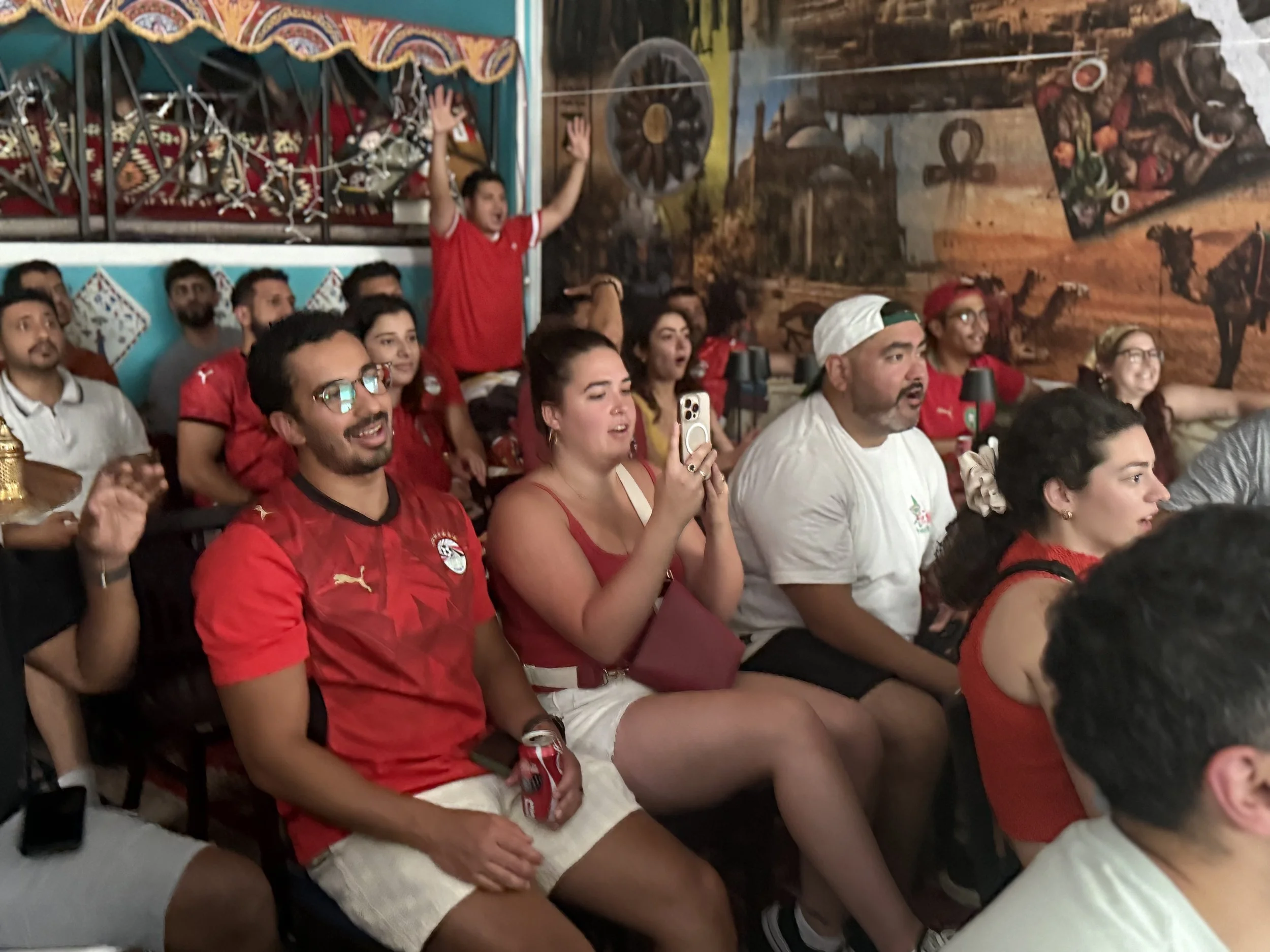
Lifelong soccer fan Ahmed Elmiligy (front left) watches the match surrounded by Egypt supporters.
Earlier Friday, a video circulated on social media showing Egypt’s head coach Hossam Hassan and team director Ibrahim Hassan — the coach's twin brother — in an altercation with a Dallas police officer at the team's hotel before the Round of 32 match. Dallas police said officers were responding to a report of an individual without event credentials attempting to access the hotel, while Egypt's team said the dispute arose as players greeted supporters. Both sides later stated that the matter had been resolved. Elazzazy, who referred to Ibrahim Hassan as a longtime family friend, said he spoke with the team director after the incident and that his attention remained on Egypt's match against Australia.
Online, fans raised concerns over reports of issues with visas and accommodations affecting several visiting SWANA teams during the tournament. Elazzazy said he believes host nations have a responsibility to ensure all teams are treated respectfully. "We do face racism anyway. That's nothing new. We've been living in this forever," Elazzazy said. "[But] the fact that you're having the FIFA World Cup here and you're asking people to come over, you have to respect that."
Those concerns are part of a broader hope that Egypt's World Cup run will create a deeper understanding of the country, its culture and the region beyond the headlines. For Amy Mehany, an Egyptian American who traveled from South Jersey for the watch party, the tournament offered an opportunity to challenge stereotypes about her heritage. Her family immigrated from Egypt when she was an infant, and she has observed that many Americans still associate Egypt almost exclusively with ancient history. "We're more than just the pyramids and the pharaohs," she said. "We have a lot of spirit, we're a fun group of people, and it's good to get to know us.”
Elmiligy would love for newcomers to discover another point of cultural pride: the food. “I think Egyptian food is top, and it's not getting as much credit as it should be." That sentiment resonated with Elazzazy, who said introducing visitors to Egyptian culture extends beyond the meals. Having hosted Egyptian heritage celebrations in the past, he hopes the World Cup encourages people to learn about modern Egypt.
“Egyptian culture is big. It's something that people also could learn about, how good and kind the people are,” he said. “It's important that we keep gathering.”
***
Gawhara Abou-eid is an Egyptian-American researcher and journalist from Lewisburg, PA and an Al-Bustan News media fellow. They hold a BA in International Relations from The George Washington University, with a concentration in International Security Policy. Gawhara has published research for the League of Arab States in Cairo, and their journalism has appeared in The Standard Journal and The News-Item.

Al-Bustan News is made possible by the People’s Media Fund.