
Art as Resistance | The Risograph Book Offering a Glimpse of Palestinian Survival
By Lauren Abunassar
May 26, 2026
When Rami George (they/them) first had the idea to curate an art book featuring commissioned works from seven Palestinian artists, Israel’s latest genocidal campaign in Gaza had not yet begun. It was 2022 and George, a Lebanese-American artist based in Philadelphia, was absorbed by an interest in “The Xerox Book,” a landmark conceptual art exhibition curated by Seth Sigelaub in 1968. Sigelaub’s project explored how a book can offer a certain permanence to an art piece, a permanence more difficult to find in conventional exhibition formats. What if this construct was mapped onto a Palestinian project?
George began reaching out to artists with a very open prompt. The book would look like a watermelon — pink pages, green cover — and that was what George initially titled it: Watermelon Book. Artists could respond to the symbol however they wanted, a symbol Palestinians have historically embraced as a way to counter Israel’s ban on public displays of the Palestinian flag in occupied territories.
“[I told people] we want to hold the space for you and however you want to create work in this moment,” George said. Then October 7 happened, and the project became something else entirely.
“Most people had finished their contributions either right before or right as the genocide started in Gaza,” George said. “And then we were in this really hard space of invitation to the artists, asking: do you want to amend your work in any way?”
For some of the artists, the answer was yes. And they needed years to consider how to create work alongside an active genocide, maybe even about an active genocide. The work they eventually submitted was published in 2025 as “Jadu’i Book” — jadu’i referring to a melon native to Jenin that was brought back from extinction thanks to Palestinian agriculturalist Vivien Sansour.
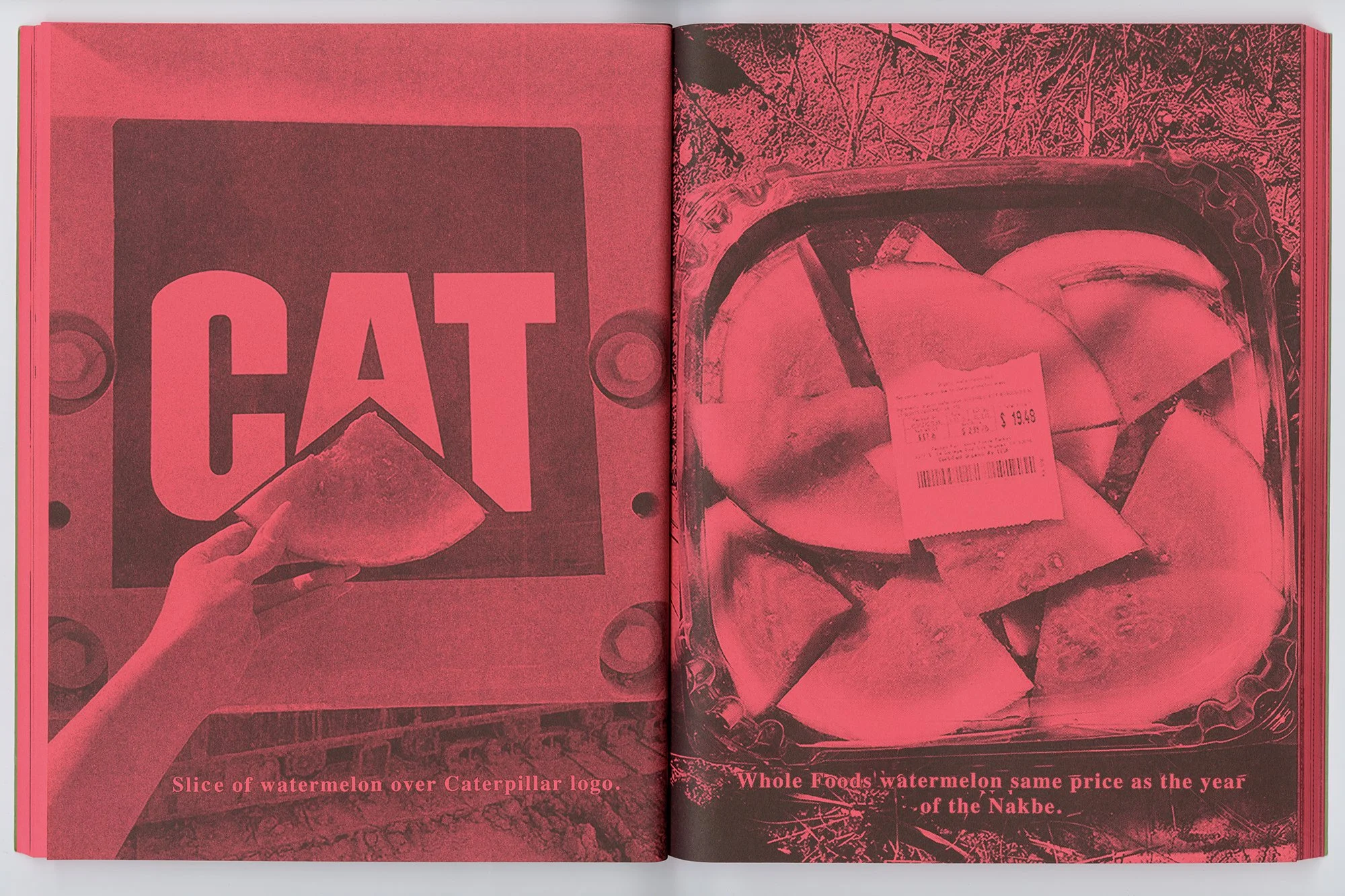
“Jadu’i Book” is a nuanced archive of Palestinian diaspora, advocacy, resistance and grief. The book showcases formal variety: photographs, columns of text, video stills, outlines of maps. It is printed using the Risograph technique — a Japanese duplicator machine whose ink, made of pigment suspended in soybean oil, never fully dries.
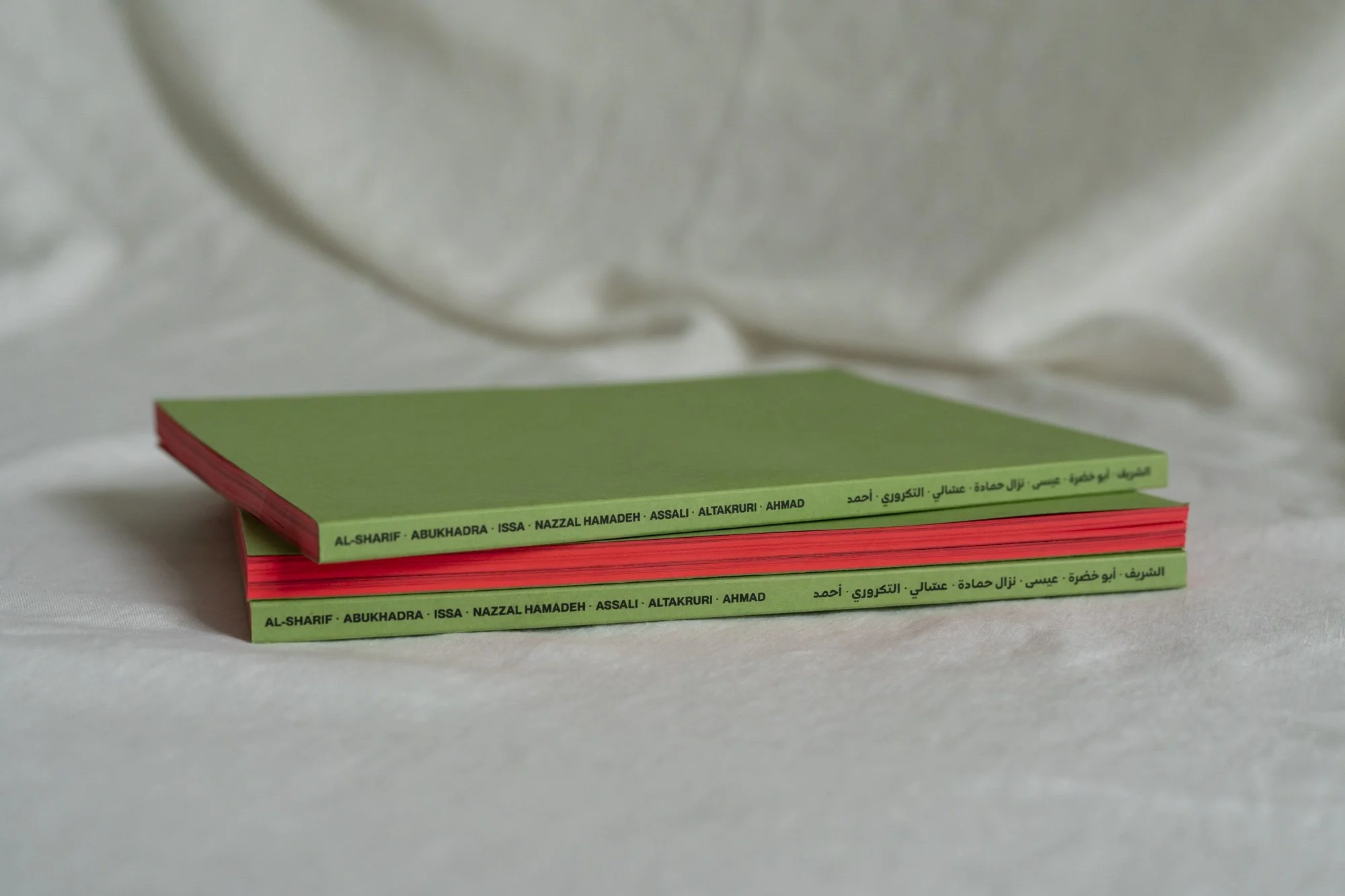
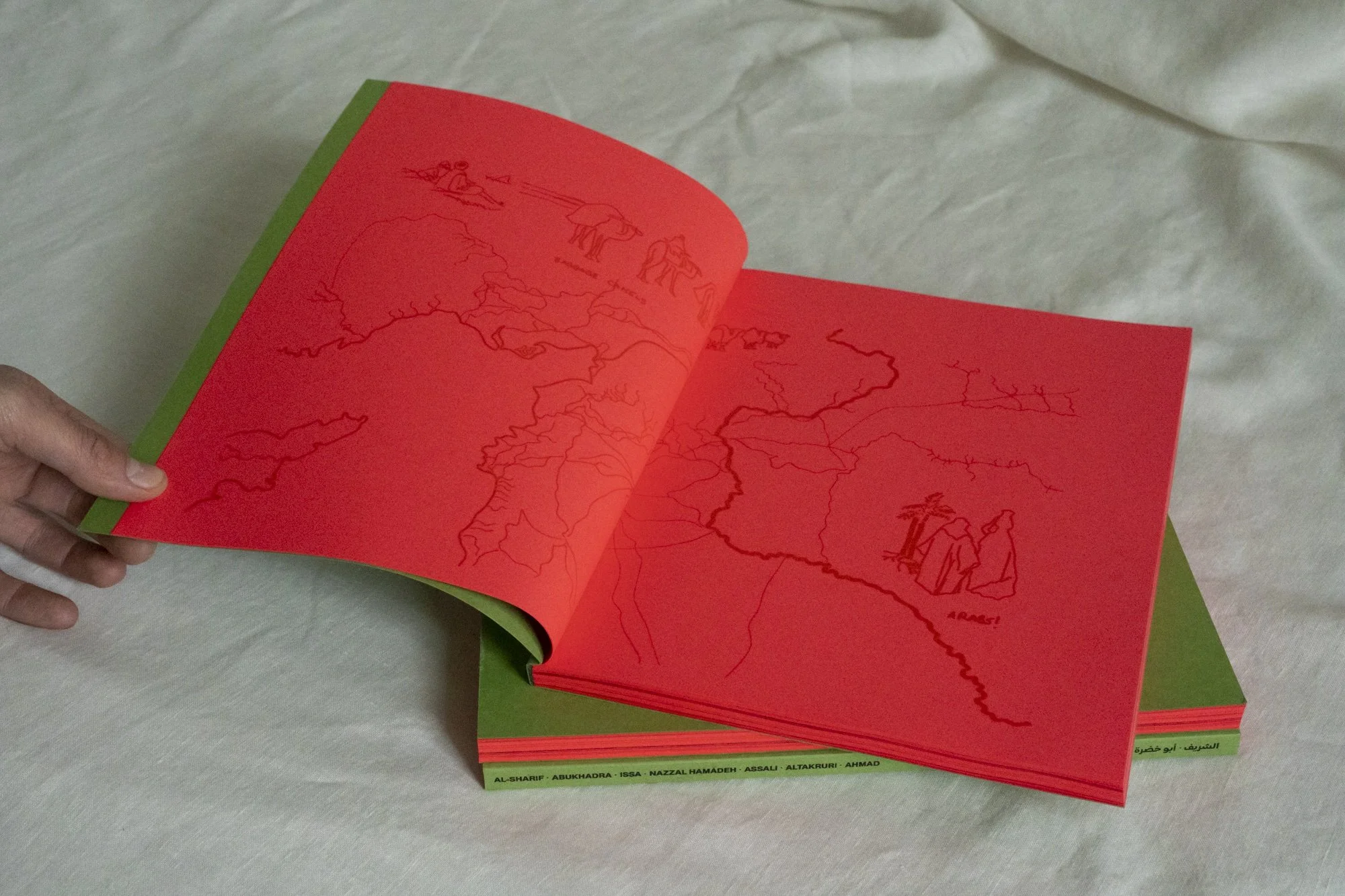
“Jadu’i Book” (2025), a Risograph book curated by Philadelphia-based artist Rami George. All photos courtesy of Rami George
"There is potential for layering to continue," said Connie Yu of Many Folds Press, the Philadelphia-based Risograph studio that published the book. It is a fitting technology for a project that refuses to be finished and insists on recognizing both history past and history that is continuously unfolding. And while some of the contributions to the book grapple directly with the watermelon as an emblem of Palestinian identity, other pieces welcome symbolism and abstraction, offering a portrait of life in the Palestinian diaspora in the face of erasure.
Interdisciplinary artist and designer Qais Assali (they/them) came across the inspiration for their own contribution to the book while living near Little Palestine in Chicago’s southwest suburbs, the largest Palestinian enclave in the country. Born in Palestine and raised in the UAE, Assali moved to the U.S. 10 years ago. While wandering through Little Palestine, they found a brand of chips called Misli, an Arab knockoff of the Israeli chip brand Bissli. They were shocked, recalling the sighting with near-giddy wonder.
"I got really interested in the production and branding and de-branding, but also this diasporic product and what it's doing here,” Assali said. “On the cover of the chips, the languages are Hebrew and Arabic. There is no English. So I was also fascinated by the idea of seeing these two languages in the landscape of the United States.”
In Palestinian dialect, ‘misli’ also means gay. Assali was transfixed by all of these symbolic textures overlapping: the counterfeit branding, the two languages pressed together on American soil, the queer subtext embedded in a snack food found in a Chicago suburb far from actual Palestine. Inspired, Assali built a project around the chips, considering queer history, color theory, the “hijacking” of a brand. They even researched official Kuwaiti Ministry of Commerce teaching guidelines meant to help citizens distinguish a six-colored “regular” rainbow from a seven-colored LGBTQ+ rainbow.
Assali was amazed by the implication of color-counting as a kind of identity surveillance. The Palestinian flag ban and the resulting politicization of the watermelon, the bag of chips and the rainbows all collapsed into the same question. Who gets to decide what a color means, and what happens to the people whose identity — Palestinian, queer or both — is often so symbolically linked to color?
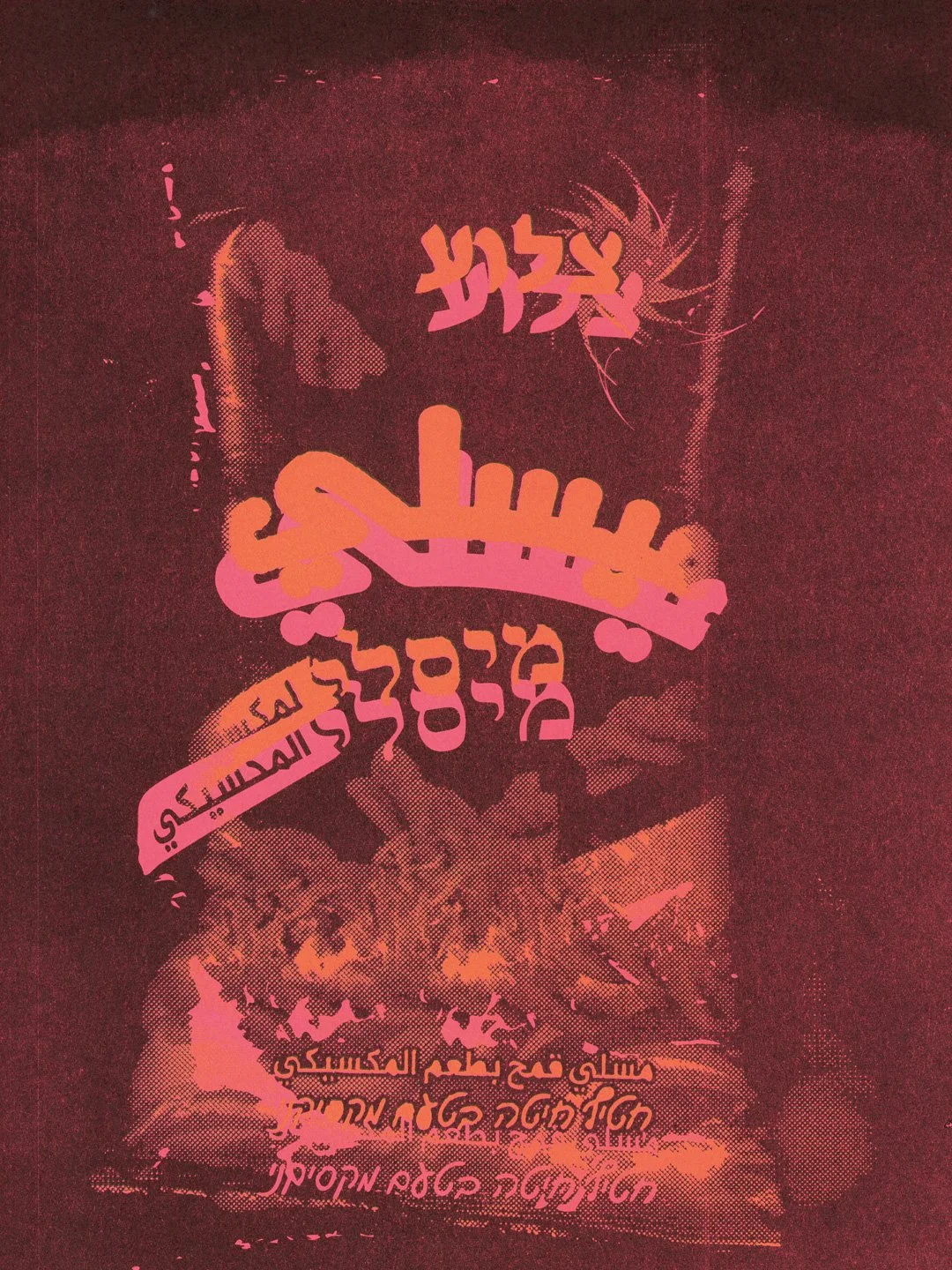
Contributor Qais Assali considered the layers of symbolism in a bag of Misli chips, which they found in Little Palestine, just outside Chicago.
For their contribution to the “Jadu’i Book,” Assali scanned the chips bag repeatedly until the images swelled and distorted with each new rendering. Thinking about “The Xerox Book,” Assali considered what it might mean to exhaust an image but also assert some record of its symbolic power. A bag of chips is not just a bag of chips, after all, just as a watermelon is not just a watermelon.
For Assali, the chips bag also became a way to reflect on something more personal: the experience of being a Palestinian artist in the diaspora, where it is impossible to detangle your art from politics. "Whatever work I was doing in Palestine was not political art, because I was in Palestine,” he said. “But the moment I came to the U.S. I fell into this trap of ‘political artist.’ So if I just hold up a bottle of water, it is political.”
Assali is quick to affirm they are proud of being in this trap, insisting that Palestinian art is not just symbolism and aesthetics. Rather, it has to be considered as something with purpose and context. “[It’s] uncomfortable to me to think of Palestinian content as ideal artistic material,” Assali said. “I don't want to produce the image of Palestinian victimhood.”
Beyond the Watermelon
Since October 7, Palestinian identity and narrative have only continued to face the looming threat of erasure, attack, oversimplification and distortion that can come with sudden global attention. For many of the artists featured in “Jadu’i Book,” these pressures can be difficult to detangle from the art itself. And as the genocide continues, it is hard to ignore the limits of what art and advocacy, even witness, can do.
“The genocide really made Palestine known to the whole globe,” said Assali. “But what did we gain from that? Everyone knows and it's still going. And it's harsher because it's in HD, and so we feel the silence even more."
The silence has heavily influenced Ottawa-based Palestinian artist Rana Nazzal Hamadeh. Her contribution to “Jadu’i Book” was a text-based piece on the Palestinian Authority’s (PA) 2021 killing of political dissident Nizar Banat. The killing sparked widespread protests against the PA and its coordination with Israel. The PA met those protesters with tear gas, clubs, stones and brutal beatings.
Though Hamadeh considered changing her piece after October 7, she ultimately chose to continue telling nuanced stories about what life in an apartheid state looks like.
“After October 7, for years really, it was impossible to think about anything other than what was happening in the moment,” she said. “So there was a kind of impulse to not talk about things that had happened in the past. And there’s always a tension when you’re talking about Palestinian Authority in the West. People fear if you speak about Palestinian Authority as a police state or as a repressive force itself, that it’s just going to complicate things.”
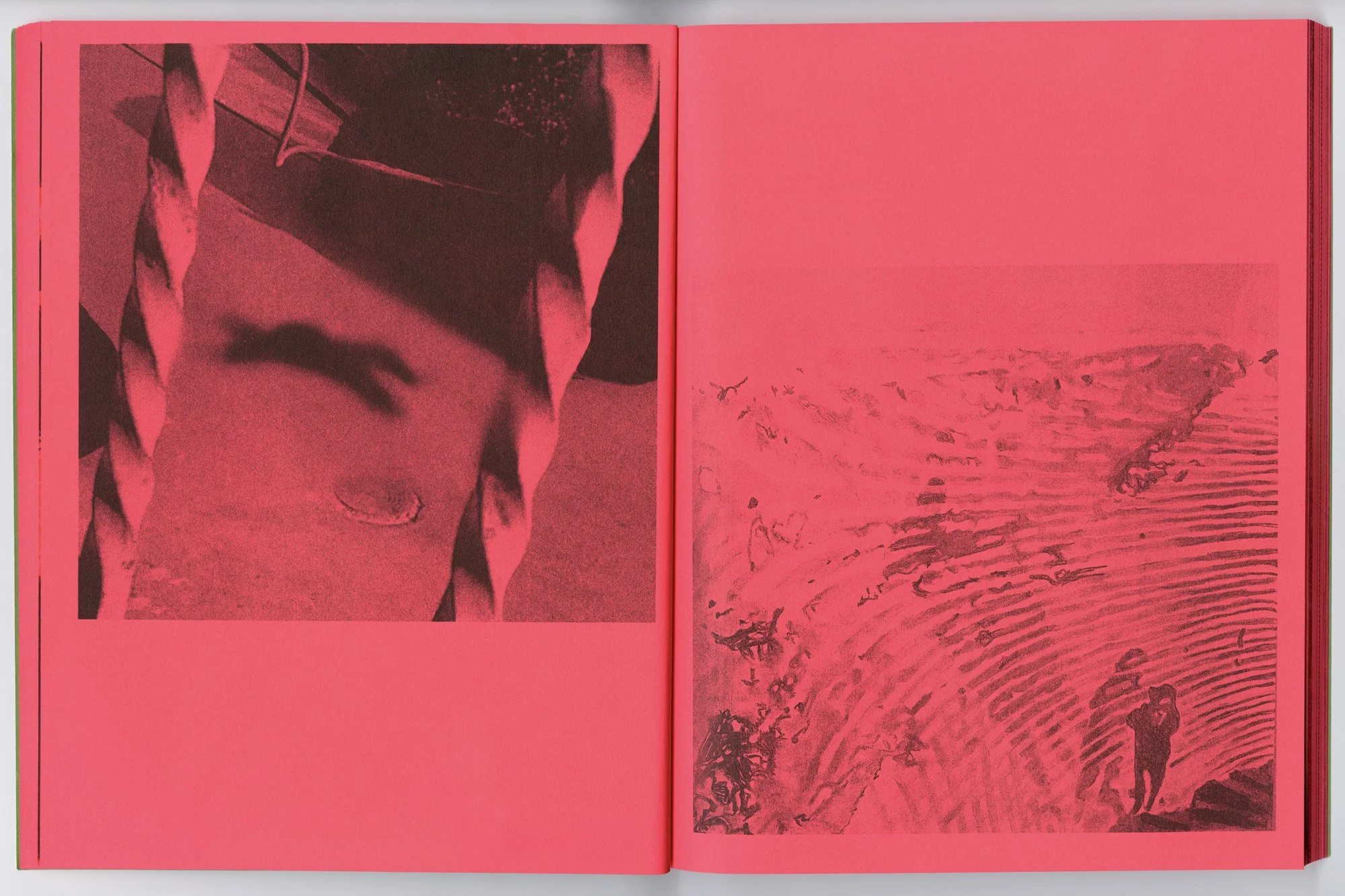
Risograph-printed artwork by Lamia Abukhadra (above) and Saj Issa (below)
Still, Hamadeh didn’t want to cater to an audience who could only process simple narratives. That’s never been her audience in the first place, she said. And the project of “Jadu’i Book” is not to simplify an understanding of Palestinian identity. It was Hamadeh who first suggested the updated title to Rami George, who had been speaking with some contributors about their increasing disillusionment with the commodification and shallow ubiquity of the watermelon as a symbol.
At a panel discussion on April 25th hosted by Philadelphia’s Asian Arts Initiative, George spoke with contributing artist Amanny Asell Ahmad about the way the watermelon had lost much of its political meaning in its overuse. “Amanny even said, I will not be in a publication named Watermelon Book,” George remembered. “It is an easy symbol. We can wear it as earrings and a purse and a fanny pack, but it doesn't necessarily mean we support the work of liberation.”
Rana Nazzal Hamadeh has been unable to approach her practice the way she once did. “I think my impetus for creating art before was to find new ways of getting people to look at things they're already seeing,” she said. “And when genocide is unfolding in front of us, it felt really unnecessary to ask people to do anything other than to look at the surface of what's happening in that moment."
As she reconsidered how art and advocacy overlap, Hamadeh began to ask harder questions about whether awareness, long treated as a form of political power in the West, actually functions that way at all. "If you look at the battle of propaganda, you can see that Israel is failing,” she said. “But the next question is: does it matter? Does awareness lead to power? I don't place as much hope in awareness as I did before."
As a practicing artist in addition to being a curator, Rami George has also orbited around this question. “What does it mean to create art right now?” they ask. “Do I have that capacity?" Working on “Jadu’i Book” became not so much a distraction from this question but a way to turn to art to advance a project that had some larger purpose in preserving a piece of Palestinian narrative and culture.
The book has had a tangible impact as well. All proceeds from sales are going directly to The Sameer Project, a rapid-response initiative dedicated to sourcing and distributing aid to displaced families across Gaza. George has also been distributing the book to cultural archives, finding hope in the longevity that publication makes possible. More editions can be sold. The book exists and will continue to exist as a record.
When “Jadu’i Book” book was finished, George wanted to bring attention to the importance of the archive. “Completed October 2025, during an ongoing Nakba and genocide of the Palestinian people,” they wrote in the book’s colophon.
"I wanted to make clear that this work marks a moment that is current, ongoing and also a moment that began long ago,” they said. “And there is a future to it. I think about a post-genocide. It will come. And people in a free Palestine will be able to read this too."
***
Lauren Abunassar is a Palestinian-American writer, poet and journalist. Lauren holds an MFA from the Iowa Writers’ Workshop and an MA in journalism from NYU. Her first book, Coriolis, was published in 2023 as winner of the Etel Adnan Poetry Prize. She has been nominated for a National Magazine Award and is a 2025 NEA creative writing fellow.

Al-Bustan News is made possible by the People’s Media Fund.