
From Protest Politics to Party Insider: A Conversation with Marwan Kreidie
By Gawhara Abou-eid
May 14, 2026
For Marwan Kreidie, politics began long before party meetings, endorsements or Pennsylvania committee races. It began with war.
Born in New York City and raised in Beirut during part of the Lebanese Civil War, Kreidie said his early political consciousness was shaped by displacement, Palestinian refugee camps and what he viewed as the unequal treatment of Arabs in American politics. Decades later, the longtime Philadelphia activist, former city commissioner candidate and political organizer is running for a local committeeperson position in Philadelphia — a smaller race than the citywide office he sought in 2019, but one he sees as part of a broader strategy to shift the Democratic Party from within.
Over four decades, Kreidie has occupied multiple roles: protest organizer, Palestine activist, Democratic insider, housing advocate and, at times, a controversial figure within Philadelphia’s Arab American community. Some critics accused him of becoming too close to Democratic leadership, particularly Pennsylvania Gov. Josh Shapiro, after Kreidie publicly argued that Arab American leaders should maintain relationships with elected officials despite disagreements over Gaza, anti-war protests and U.S. policy toward Israel.
In an interview conducted during Arab American Heritage Month in April, Kreidie discussed his political evolution, his belief in working “inside” institutions rather than outside them, the backlash he has received, and why he believes Arab American political influence has entered a new era.
The following conversation has been edited for length and clarity.
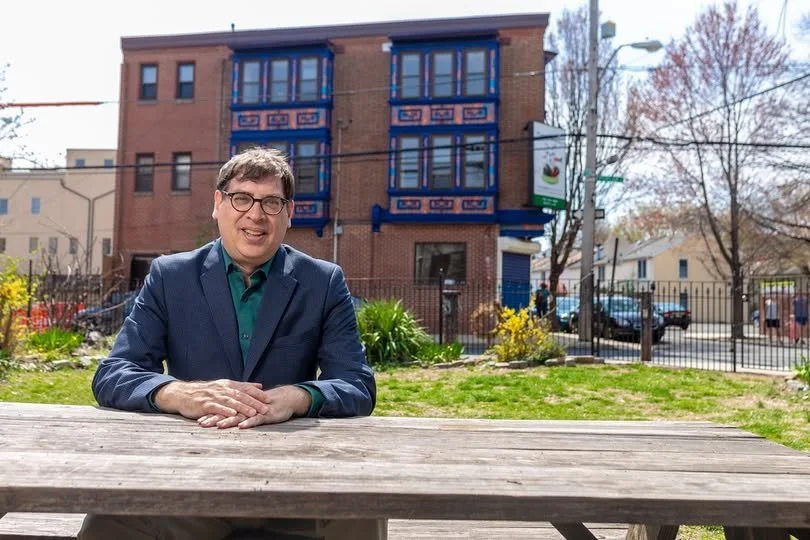
Marwan Kreidie, 2026. Image courtesy of Marwan Kreidie
Gawhara Abou-eid: You’ve described yourself as politically active long before your recent committee run. What first pushed you into activism and politics?
Marwan Kreidie: We left Beirut because of the Civil War. We came into the United States in 1976. What got me involved in politics was really college. I went to Drew University in New Jersey, and I got involved in the anti-Apartheid South African movement, but I was also very involved in the Palestine movement. There was virtually no Palestine movement at the time.
I actually got an unpaid internship at the [Palestine Liberation Organization] office in New York during my senior year. I remember bringing the Palestinian representative to Drew to speak, and it caused a big uproar.
Kreidie’s activism intensified after he moved to Philadelphia in the 1980s, when he became involved in local Arab American organizing and Democratic politics.
MK: One of the turning points was when we did a fundraiser for Wilson Goode when he was running to become Philadelphia’s first Black mayor. The next day his Republican opponent said he was taking money from the PLO. Wilson Goode returned all the Arab checks and kept the Jewish checks. To me, that was the beginning of understanding how Arabs were treated politically.
GA: At the time, you were organizing protests and demonstrations. Why shift toward working inside party politics instead?
MK: I organized demonstrations. I believed in direct action. But my feeling was I’d rather be on the inside than the outside shouting in.
That shift eventually brought Kreidie into Democratic organizing circles in Philadelphia and statewide politics. He later served on both the Philadelphia and Pennsylvania Civil Service Commissions after being appointed by former Philadelphia Mayor and Pennsylvania Governor Ed Rendell.
MK: Ed Rendell was probably the most important person in opening up American politics for our community. At least in Philadelphia, our community became valued politically.
GA: You later ran for Philadelphia city commissioner in 2019. What motivated that campaign?
MK: Philly’s a city of 43% Black 43% white, and the rest being the ‘others’. And I’ve always considered myself as one of the others. Arab Americans, Latinos, Asians and immigrant communities. You spend a Sunday going from a Black church to a Korean church to the LGBTQ center to South Philly Italian groups. You really see the mosaic of the city. I wanted to mobilize people who historically weren’t included.
I came in fourth [among the candidates]… So I lost, but it was a really fascinating race. The people who won raised over $250,000. I raised about $60,000. I’ve always hated money in politics. Maybe because I’m not good at raising money?
“There are people who won’t agree with you unless you dot every ‘i’ and cross every ‘t.’ They mean well. But I don’t think they’re effective. You need people yelling outside, but you also need people working inside.”
GA: Now you’re running for a Democratic committee position instead. Why focus on such a local role?
MK: It’s a precinct-level committee person position. Nonpaid. Very neighborhood-oriented. We want to put people in office who are going to come up with more progressive ideas. The Democratic Party tends to be very centrist, very established. We want to change that. The idea is to try to influence the party from the inside. We need to stay involved in the electoral process.
There’s a movement in the city to make the wards more progressive. The only way wards become more progressive is if committee people become more progressive. We want to move away from the same old establishment politics.
According to Kreidie, he sees the effort as part of a broader ideological struggle within the Democratic Party, particularly around Palestine, housing, affordability and alliances with labor and progressive groups.
GA: Some Arab Americans and pro-Palestinian activists criticized you for publicly defending Governor Josh Shapiro despite disagreements over Gaza and protest crackdowns. How do you respond to that criticism?
MK: I wrote an op-ed in the Philadelphia Inquirer [in 2024] saying that Josh Shapiro has the back of our community, the Arab and Muslim community. My overall feeling was, ‘Whatever happens, we need that relationship.’ So I played the card and was basically willing to take the hits for that. And the people who knew me understood and said it was smart.
I received vitriolic text messages and emails. I was called a traitor. My position was: if he became vice president, having someone close to him from our community mattered. We may disagree with him, and I do disagree with him on statements he made about Gaza and anti-Semitism, but relationships matter in politics.
Did [the $5 million grant to expand the Al-Aqsa Islamic Society community center] happen because of the relationship? I don’t know. But relationships matter.
Kreidie sees signs that Gov. Shapiro has become more engaged with Arab American concerns, including issuing an Arab American Heritage Month proclamation and his March 2026 writing to federal officials requesting an investigation after Nasrallah Abu Siyam, a 19-year-old Palestinian American from Philadelphia, was shot and killed by Israeli settlers in the West Bank last February.
MK: I think he’s become much more cognizant and understanding of our community.
GA: Critics would argue that maintaining those relationships risks compromising core principles.
MK: Maybe I’m willing to accept 65 or 70% instead of demanding 100%. When I was younger, I saw the world more black and white. Now I see a lot more gray. As bad as Biden was on the Middle East, I still think voting for Kamala Harris would have been much better for our community than Trump.
There are people who won’t agree with you unless you dot every ‘i’ and cross every ‘t.’ They mean well. But I don’t think they’re effective. You need people yelling outside, but you also need people working inside.
GA: You’ve spent decades advocating for Palestinian rights. Do you think the political landscape has changed?
MK: Absolutely. Before, if you mentioned Palestine, you were considered beyond the pale. That’s changed. Israel is toxic now for a lot of younger Democrats. AIPAC is toxic in the Democratic Party. [Still,] Palestine is in worse shape than it’s ever been. Gaza is a genocide. It’ll get worse before it gets better. But I think real changes will happen.
GA: What do you think Arab American political organizing still lacks?
MK: Consistency. We can’t just become a once-every-four-years voting bloc.
Kreidie warns against abandoning progressive coalition politics, even amid frustration over Gaza:
We can’t abandon our Black and brown allies or progressive allies.
And on his support for LGBTQ rights, an issue Kreidie acknowledged can divide some Muslim and Arab communities politically:
They’ve always supported us. We should support them.
GA: Looking back over your political career, what do you think has changed most?
MK: Twenty years ago, our money was being returned. Now governors issue Arab American Heritage proclamations. Have we achieved everything we want? No. We’re still behind the eight ball. [But] we’re here now. And people know we’re here.
***
Gawhara Abou-eid is an Egyptian-American researcher and journalist from Lewisburg, PA and an Al-Bustan News media fellow. They hold a BA in International Relations from The George Washington University, with a concentration in International Security Policy. Gawhara has published research for the League of Arab States in Cairo, and their journalism has appeared in The Standard Journal and The News-Item.

Al-Bustan News is made possible by the People’s Media Fund.