By Ragad Ahmad
June 26, 2025
Saif Manna's first memory of being in the kitchen is still vivid in his mind. He is eight years old, perched atop a kitchen stool, carefully sautéing onions for pasta sauce while his babysitter supervises. With the determination of a child, he prepares a special dish for his younger brother, Yousef.
"Even though he spat it out in disgust, I remember the joy of transforming simple ingredients into something I could share with someone else," he says.
Manna owns Manna Bakery, a pop-up operation that he runs out of his kitchen and refers to on Instagram as “Philly’s first Levantine inspired Third Culture Bakery.” He traces his early confidence in the kitchen to his parents' approach to cooking and teaching. Weekend mornings in the Manna household featured his father making pancakes and omelets.
"At first, my only responsibility was eating the burnt bits," Manna laughs. "But every weekend, my father encouraged me to take on another task until I eventually became his sous chef." It was his father's praise for his egg-cracking technique and the free rein his mother gave him in the kitchen that cemented his belief in his culinary abilities at such a young age.
Manna’s family was displaced during the Nakba from the Palestinian city of Akka, and was scattered across the Middle East. Though he grew up in Dubai, his formative culinary education took place during the summers he spent with his tetas, or grandmothers, in Jordan.
Manna’s grandmothers represented contrasting approaches to Palestinian cuisine, and each influenced his food philosophy. His teta Samira ran her kitchen "like a restaurant production," always prepared to feed the steady stream of visitors who passed through her home daily. "In the morning, she would wake up and plan the day depending on the people who would come by and the produce in season," he says.
Her pantry tins were filled with ka'ak bil tamir, a traditional Levantine biscuit filled with dates, and her musakhan, a dish consisting of caramelized onions, sumac, and chicken on taboon bread, inspired Manna Bakery's signature "musakhan buns." She made olive oil from the olives on her farm, shipping it to relatives worldwide and using it liberally in her cooking. "I thought I was just watching my grandma cook, but I was actually passively learning the craft I would later live by," Manna says.
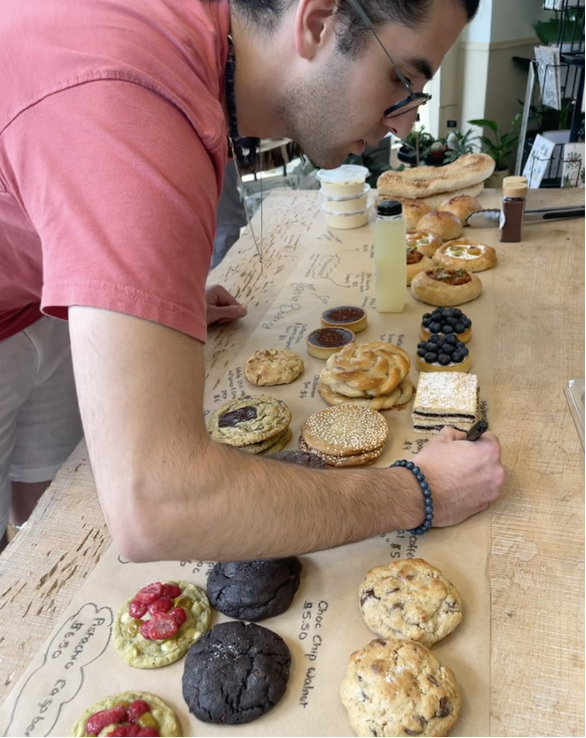
Saif Manna, owner of Manna Bakery, sets up his table at a pop-up event. Photo courtesy of Stefaniya Surikova
His other teta, Siham, offered "a personal dining experience," which was less about quantity and more about exquisite execution. "Her waraq (stuffed grape leaves) were the size of my pinkie," he recalls. "I would stuff my face with 40 in a minute. I didn’t realize at the time how much labor went into each one."
Her perfectionism made a profound impression. "The way she cooked was theatrical, and I could hear the music of her movement," he says, noting how her dishes left him "full in the stomach and full in the soul."
During these formative visits, Manna also absorbed his family’s painful history, listening to his grandfather tell stories about how he had fled Palestine "holding the hands of his brothers." These narratives of displacement and resilience became as essential to Manna’s understanding of his identity as the foods he was learning to love.
In 2018, Manna came to the United States. He began his studies at Temple University and pursued his passion to become a professional tennis player. But during his junior year, his culinary calling became clear, and he launched a baking business from his dorm room. He initially sold just cookies, but as the business gained popularity on campus, it became a much bigger venture.
"I didn’t merely want to make food. I wanted purpose behind it," Manna says. "My tetas' food, the food of Palestine, was what I craved."
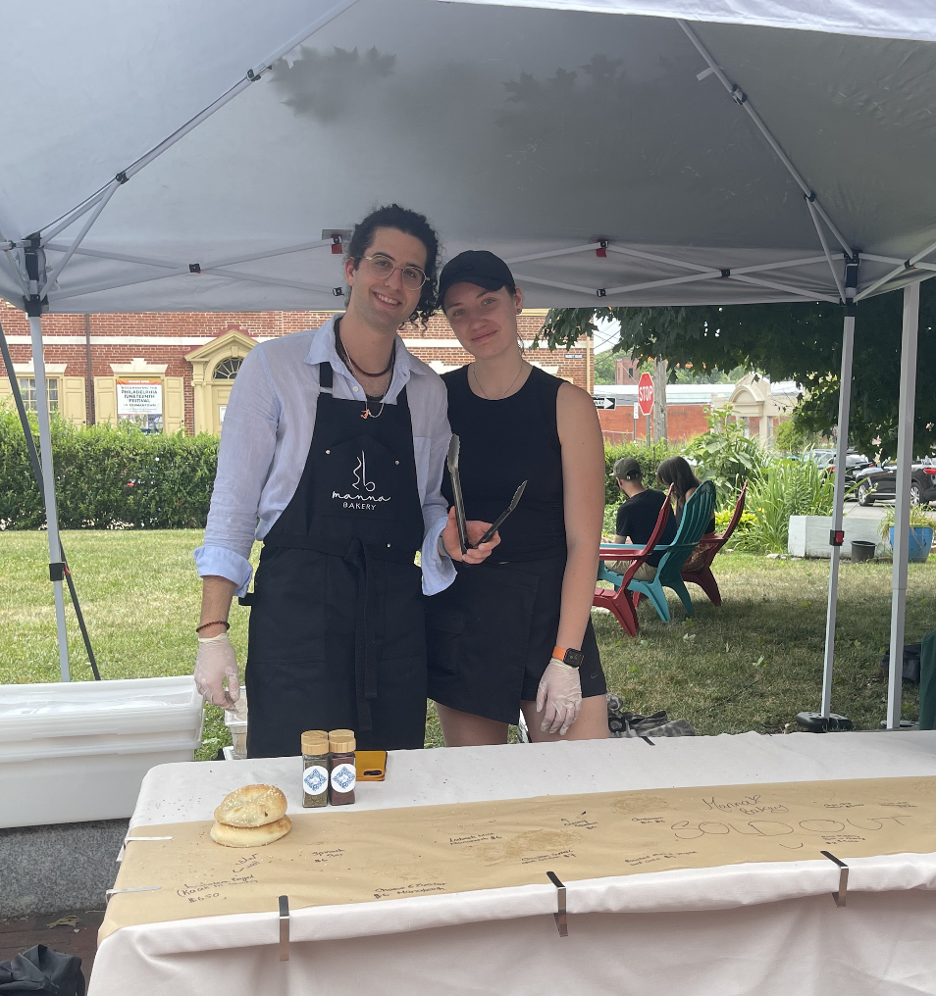
Manna and his partner Stefaniya Surikova after a sold-out pop-up. Photo courtesy of Stefaniya Surikova
According to Manna, you have to first preserve and master a tradition before you can innovate, especially in a time of the ongoing ethnic cleansing in Palestine. "Usually cuisine is stored in the land and its tetas as an archive, but when they are being destroyed and killed, people like me have to do the work to keep the cuisine alive." He insists that chefs, particularly Palestinians, must not modernize dishes to the point where the food becomes disconnected entirely from its origins.
Stefaniya Surikova, Manna's partner of six years, witnessed first-hand the evolution of his culinary journey. The two met at Temple in 2019 and bonded over food. "He was showing me his Instagram page where he was posting recipes, and he offered to cook for me," Surikova recalls. She requested fresh baked bread, cured salmon and herbed butter, though he wouldn't actually prepare that meal for her until three years into their relationship.
During the early days of the COVID-19 pandemic, when the couple was dating and spending more time together, Saif was baking banana bread daily and experimenting with cookies. It was Surikova who first suggested he try selling his baked goods. His initial attempt was modest— he baked a mere eight cookies for a pop-up in his dorm and didn’t sell a single one. But rather than discouraging him, the failure only fueled his competitive spirit. Less than a year later, Saif sold over 100 baked goods at a single pop-up.
After graduating in 2022, Manna decided to make Manna Bakery his full-time job. Their first major pop-up at the Philadelphia Art Museum sold out of the 200 products Manna had made that day. And at a recent event, Manna prepared 700 items and sold out completely in just three hours.
"Saif is unstoppable," Surikova says. "He is always thinking about how to improve and make Manna better. There is never a minute where he isn't talking about Manna."
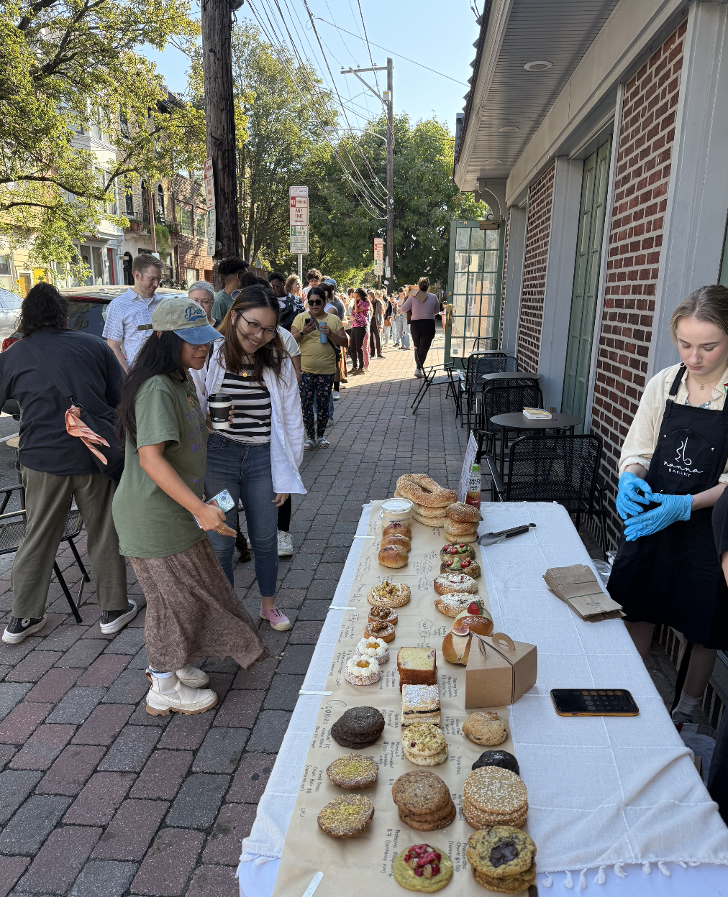
Locals often stand in long lines to purchase Manna’s baked goods. Photo courtesy of Stefaniya Surikova
Today, the bakery and its pop-up events serve not just food but also opportunities to learn a bit about Palestinian culture. On his table, Manna writes the story of each of his recipes, displaying each item with its Arabic name and the English translation. "Within the few minutes that it takes for someone to order their baked goods, they learn about the cuisine and the culture behind it," Manna says. He takes particular pride in hearing non-Arabic speakers ordering items by their Arabic names, such as "bamya manakeesh" for okra stew flatbread.
This cultural bridge-building resonates with customers like Zack Kreines, a 22-year-old Swarthmore graduate who discovered Manna through TikTok. For Kreines, who is Jewish, supporting Manna is an expression of solidarity. After trying pastries at one of Manna’s pop-ups at Clark Park, Kreines became a devoted customer, admitting that he “spends way too much money" at the bakery. But he considers it money well spent given the bond he has built with Manna over a series of conversations in long pop-up lines. He also appreciates how Saif introduces people to Palestinian culture through familiar foods. "Everyone has had a chocolate chip cookie," Kreines says, "but he has a cookie with za'atar in it.”
With plans for more pop-ups and a growing reputation around the city, Manna is making good on his intention to pass on the traditional cooking techniques he was taught. The only next step for Saif,” says Surikova, “is for Manna Bakery to become a brick and mortar business.”
***
Ragad Ahmad is a Palestinian American Muslim born and raised in Philadelphia. She currently studies Peace and Conflict Studies at Swarthmore College, where she explores issues of decolonization and climate justice.