
Jiryis Ballan Is Redefining the Borders of his Palestinian Identity through his Music
By Elissa Odeh
June 20, 2025
Jiryis Murkus Ballan does not want to be an exotic ornament. A composer, performer and researcher, Ballan’s music centers mainly around the buzuq, a traditional Levantine stringed instrument. Though he is deeply connected to his Palestinian roots, his music—which blends classical composition with electronic experimentation—resists cultural classification.
“I want to be known for the actual content of my music,” he says, “not just for who I am.”
Ballan’s childhood in Nazareth, in the Galilee region, helped shape the artist he would become. As he was growing up, his family was deeply involved in civil rights, art and music. “It created my own personality—not just as a Palestinian, but as my own person,” he says. “A global citizen.”
Throughout his youth, he explored different hobbies, including figure skating, acting and horseback riding, in search of his true passion. When he was 14, his interest in music was stirred when he picked up the jazz guitar, wanting to experiment in what he calls musical texture. At 18, his parents gifted him his first buzuq, and Ballan taught himself different playing and composition styles.
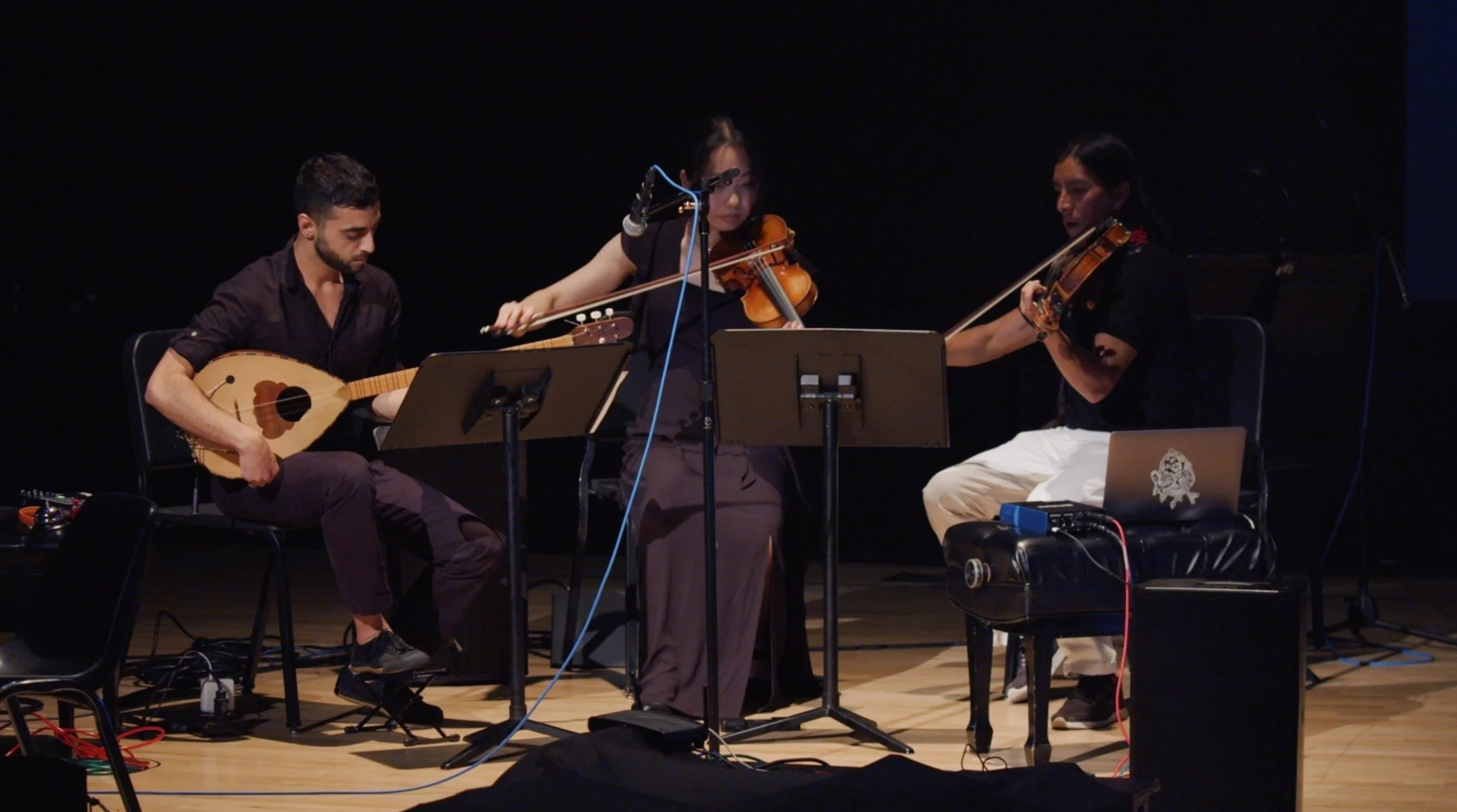
Jiryis Ballan, left, performing with fellow graduate students in the Integrated Composition, Improvisation, and Technology program at University of California, Irvine, in June 2023. Photo courtesy of Jiryis Ballan
“The buzuq is my blessing and my curse,” says Ballan, referring to the instrument’s magical sound but also its limited range. Those limitations, along with the qualities that make the buzuq “a diva,” sparked Ballan’s curiosity. “When you listen to a song by Fairuz, you hear the buzuq say, ‘I’m here, pay attention to me,’ and then, ‘I’m in the back—if you need me, I’ll come back.’”
After earning a master’s in music composition as a Fulbright scholar at SUNY Buffalo in 2016, Ballan returned home to collaborate in an ethnomusicological research project at the University of Haifa. The group studied the professional lives of Palestinian musicians in the Galilee, focusing on their work in wedding ensembles, their access to music education, their use of technology and the broader limitations Palestinian musicians face within Israel.
“Part of the discrimination against Arabs living in Israel is that we don’t have the same luxury of funds as Jewish schools,” Ballan says. As a result, many Palestinian musicians find themselves limited to performing at weddings or facing significant challenges if they choose to pursue higher music education, often at Hebrew-speaking institutions, where both the language and the cost create additional barriers.
Ballan’s desire to expand his musical language led him to pursue a PhD in Integrated Composition, Improvisation, and Technology at the University of California, Irvine, where he pushed the buzuq beyond its traditional sound using contemporary and digital techniques.

Jiryis Ballan during Caravan Orchestra’s rehearsals in Weimar, Germany in 2018. Photo courtesy of Jiryis Ballan
During his research, he chose not to emphasize his identity. But he acknowledges that by working with the buzuq, his identity naturally remained a part of the work. This tension between musical expression and cultural expectation has followed Ballan throughout his career. Though he is often invited to perform as a representative of Palestinian or Arab culture, he prefers to be recognized simply for his creative output. According to Ballan, many Palestinian artists feel constrained by the expectation to produce work that fits within a narrow cultural framework.
Ballan believes that Palestinians need to be able to express a larger narrative about who they are—one that reflects their presence not only in politics, but in art, music, filmmaking, academia and more. “As Palestinians, the occupation exists within us, and everything we do is political,” he says.
Far from rejecting his identity, Ballan says he chooses to expand how it is understood, redefining what it means to be a Palestinian artist. For him, identity is not fixed, but rather a fusion of cultural and personal experiences. “Our beauty as Palestinians is that we are so colorful,” Ballan says. “We are just like tatreez. We exist together with different shapes and patterns that make up who we are.”
As part of embracing his cultural background, Ballan has been exploring maqamat—traditional Arabic scales—embedding elements of both Arabic and Euro-American musical traditions into his compositions. He hopes to collaborate with more Palestinian artists to create music for Palestinian dancers.
“I like to imagine a future where Palestinians can create freely, without limits,” Ballan says. “It is not a place of power, but a place of expression where we can tell people who we are.”
For now, Ballan embodies this sentiment in his own work. He doesn’t shout for his work to be heard. Just like the buzuq in his hands, he calmly plays—confident that his music will stir a magical feeling in those who listen.
***
Elissa Odeh is a Palestinian journalist from Lansdale, PA. She graduated from West Chester University with a BA in media and culture and a minor in journalism. Her work has been published in Lehigh Daily, Daily Local, and the New Orleans Review.