250 Years On, Philadelphia Asks What Independence Day Is For
By Lauren Abunassar
July 15, 2026
As Philadelphia asked how best to celebrate 250 years of America this Fourth of July, some community members across the city were asking different questions: what, exactly, are we celebrating? And we should be celebrating at all?
Alongside the semiquincentennial celebrations and six World Cup matches taking place in the city, ICE presence has continued to grow. Pennsylvania ranks as one of the top 10 states with the most immigration arrests since Donald Trump took office in January 2025. Meanwhile, arrest quotas have surged from 1,000 per day to closer to 3,000, and Pennsylvania’s Moshannon Valley Processing Center, the largest immigration detention center in the Northeast, is currently at capacity with 1,876 detainees.
In this context, the question of the Fourth of July echoed throughout the city in different ways. Thousands of protesters marched alongside Veterans Against Fascism, with participants citing disgust towards the nation’s involvement in illegal wars in Iran and Gaza, an administration that caters solely to the “billionaire class,” and the increasing ubiquity of ICE around the country, not just Philadelphia.
“ICE is not inevitable,” posted Ashley Salazar, the president of Veterans for Peace St. Louis, who attended Philadelphia’s march. “It is a political choice. And political choices can be changed. Abolish ICE. Build justice instead.”
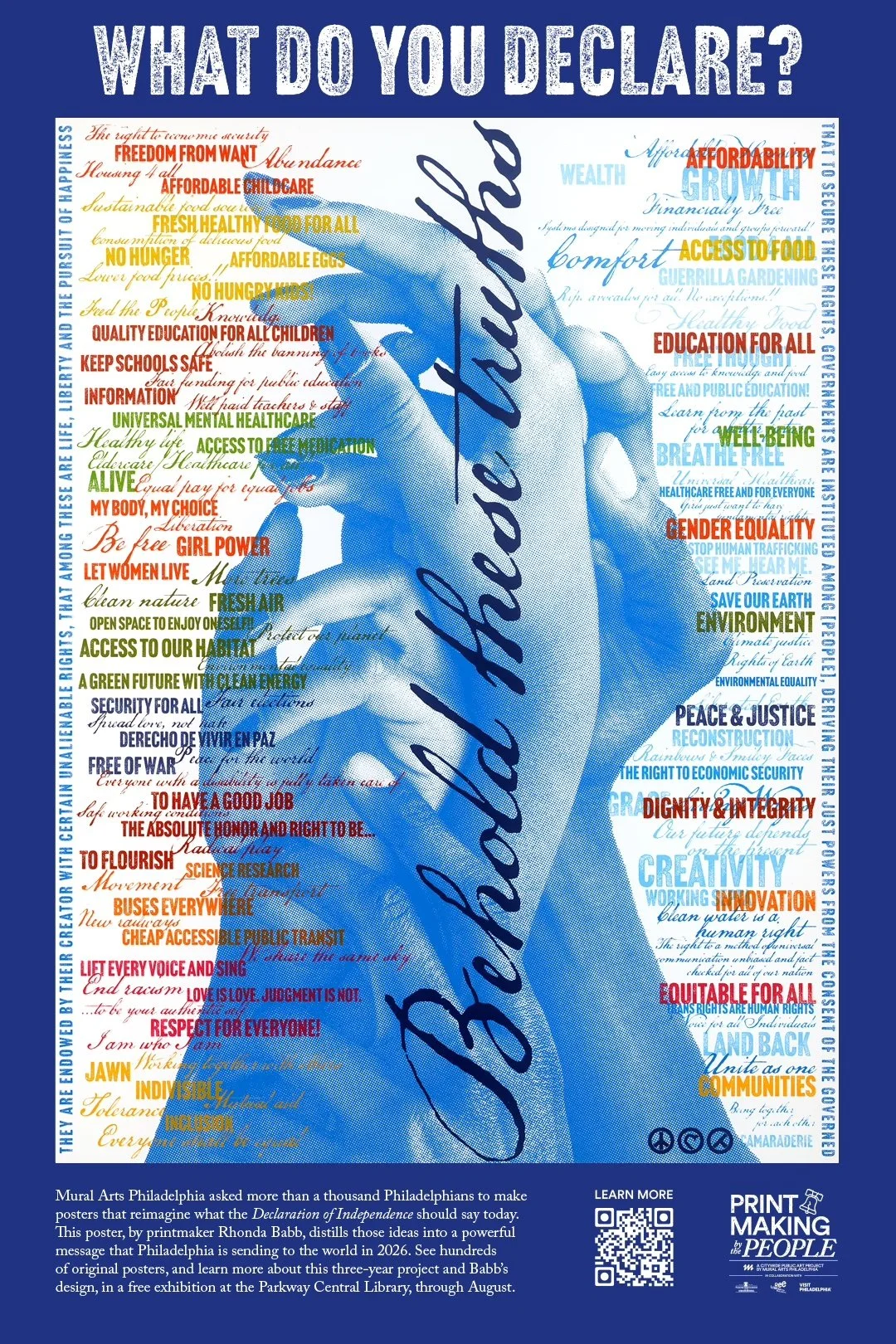
Created for the 250th, the Mural Arts project “Printmaking by the People” culminated in a poster, designed by artist Rhonda Viscusi-Babb and drawing upon the voices of more than 1,000 Philadelphians. ©Mural Arts Philadelphia
Alongside the American Friends Service Committee — a Quaker-founded organization working for peace and social justice — other activists, veterans, and community members also marched and signed their own “Declaration of Resistance” near Independence Hall.
And on the southeast sidewalk of Center City, a group of 25 protesters gathered and attempted to light an American flag on fire. Five were arrested.
Elsewhere in the city, dissent took a more satirical shape. For the second year running, local Philadelphia business Love City Brewing hosted a water balloon toss, giving community members a chance to throw water balloons at a Donald Trump lookalike. “We want to celebrate democracy, but at the same time recognize the sort of anti-democratic values that are creeping into our government and our culture," said Love City co-owner Melissa Walter. For Walter, it was important to create a space where Independence Day could be reframed not as a day to resist or denounce completely but a chance to redefine what, in this country, is worth protecting. “Democracy is about pluralism, it's about diversity, it's about being a welcoming space,” she said. “But for everyone."
Love City, which has publicly echoed what it calls Philadelphia’s “anti-king history,” has frequently connected its July Fourth gatherings to pro-LGBTQ values, anti-ICE sentiments and support for immigrant and refugee community members. While their water balloon rituals are new, the brewery has become a popular gathering for locals wanting a space to usher in the holiday without ignoring bleak political realities.
“[We’re] celebrating democracy while recognizing that democracy is in trouble,” Walter said. “We’re trying to figure out how to fix and help and encourage, all while it feels like we're under a different rule book.”
To the People of the World, What is the Fourth of July?
For some organizers, the goal wasn't to reframe the holiday — it was to reject the premise of celebration altogether. Behind Enemy Lines, a self-described militant liberal anti-imperialist activist coalition, staged key events across the city from June 26 through July 5 to challenge the idea of Independence Day as a festive occasion.
On July 1, the collective gathered at the Delaware County Courthouse to show support for the Swarthmore 9, a group of student activists who faced a year of jail time for their participation in a pro-Palestine encampment on Swarthmore College grounds. On July 2, they hosted a documentary on Mumia Abu Jamal, the political activist and journalist sentenced to death in 1982 for the murder of Philadelphia police officer Daniel Faulkner; though his death sentence was vacated in 2011, his conviction remains the subject of significant ongoing dispute. And on July Fourth, they gathered community members for an anti-Fourth protest.
“I've been very inspired by a quote from Frederick Douglass which says [to paraphrase], ‘What to the slave is the Fourth of July,’” said Adriàn, a representative of Behind Enemy Lines who asked not to share his last name. “I would ask the same thing today. What, to the people of the world, is the Fourth of July? What, to the children of Gaza or Iran, is the Fourth of July?”
For Adriàn, the holiday is about more than the misdeeds of a single administration; it is about what he referred to as the “DNA of this country.” This year’s Behind Enemy Lines programming has differed in tone from past actions the organization has held. In 2024, the controversial group famously staged a number of protests meant to disrupt the Democratic National Convention in Chicago. Many of their marches were unpermitted, drawing the ire of law enforcement.
This year, according to Adriàn, the group wanted to focus instead on sparking discourse with their events. Understanding that not everyone can put their body on the line at a protest, Behind Enemy Lines also interviewed community members about what 250 years of America means to them. “We’re not shutting anything down or telling people ‘we think your family barbecue is wack.’ We’re trying to bring people together to speak out, to participate in getting their voices heard and to refuse to celebrate.”
‘It Sounds Like a War Zone Here’
For other Philadelphians, the refusal to celebrate America stems from the devastations of daily life. Tara Bruno, a representative of the Pennsylvania Immigration and Citizenship Coalition (PIC), spoke about the increase in requests for Know Your Rights trainings in the lead up to the Fourth of July and the World Cup. Workplaces across the city — including hospitals, businesses and schools — are asking advocacy organizations like PIC to share information on what a community can do to protect immigrants and refugees. Are you required to cooperate with ICE? What are you legally obligated to do and legally allowed to refuse?
“There is no such thing as sanctuary or safety or welcoming anymore,” Bruno said. Patients have stopped showing up to hospitals, so PIC developed a training for members of the Children’s Hospital of Philadelphia medical team. They have helped community service organizations whose members are afraid to collect food or obtain postnatal care, because they are afraid to leave their homes given that about 30% of detainments happen as a result of profiling traffic stops, Bruno explained.
Law enforcement’s cooperation with ICE has also been an ongoing issue. “When ICE goes to [make an arrest] without a judicial warrant, having just an administrative warrant, more times than not local police enforcement units will support ICE regardless. They're not going to help the neighbor who's being dragged out of their house without a judicial warrant.”
In Pennsylvania, the number of 287(g) agreements — voluntary partnership agreements between ICE and state or local law enforcement agencies — has grown from just a few in early 2025 to over 100 in June 2026. As a result, Bruno says, no one knows who they can trust anymore. PIC trainings encourage immigrants and refugees to prepare, including establishing safety plans should they be deported: Have a lawyer ready. Have documents neatly consolidated. Have emergency contacts easily accessible.
Pragmatic considerations like these are sobering but unavoidable. “The government does a good job of emotionally breaking down the family, emotionally wearing down detainees, all so that they don't have the wherewithal to fight for their rights when they're violated," Bruno said.
Amid realities like these, she finds the concept of celebration almost surreal. “I literally texted my best friend [on the Fourth] and said, ‘it sounds like a war zone here in Philly.’ I didn’t understand what everybody was celebrating for.”
Behind these Truths
For those seeking an alternative future for America, Mural Arts Philadelphia staged a community art project, “Printmaking for the People,” marking the 250th with a series of printmaking workshops responding to the questions, “What would the Declaration of Independence say if it could be written today?” and “What visions do Philadelphians have for the promise of ‘life, liberty, and the pursuit of happiness?’”
An exhibit of posters that community members designed is open through August 29 at the Free Library of Philadelphia’s Heim Center for Cultural and Civic Engagement. Mural Arts is also planning temporary installations of a signature poster by artist Rhonda Viscusi-Babb throughout the city. When designing the poster, titled “Behind these Truths,” Viscusi-Babb wanted to encapsulate the voices of as many Philadelphians as she could.
“I became sort of aware through [the process of leading community printmaking workshops] how personal this whole thing was," she said. While hosting the workshops before the project’s final exhibition, she was struck by how willing participants were to share their thoughts on America today, and how much overlap there was in the topics people talked about, such as healthcare, immigration and environmental issues. In her own final poster, Viscusi-Babb included words from as many community members as she could. The mural represents an attempt not to resist the moment, but to record what Philadelphians actually believe.
“I hope that 10 to 20 years from now, when people look back on this project, they’ll see an inflection point,” she said. “In my work, I try to look for a better future. And hopefully people will look back on that and see we were coming to these global conclusions about what we need and what we desire as our society.”
Viscusi-Babb acknowledged this hope may just be a symptom of her innate optimism. But she has to think that way. She wants to believe that the America reflected in the project is an America that is starting to listen, she said. “And an America that is starting to build something better.”
***
Lauren Abunassar is a Palestinian-American writer, poet and journalist. Lauren holds an MFA from the Iowa Writers’ Workshop and an MA in journalism from NYU. Her first book, Coriolis, was published in 2023 as winner of the Etel Adnan Poetry Prize. She has been nominated for a National Magazine Award and is a 2025 NEA creative writing fellow.

Al-Bustan News is made possible by the People’s Media Fund.