The Destruction of Hebron’s Seed Bank and the Area Growers Helping to Preserve Palestine’s Agricultural Heritage
By Gawhara Abou-eid
September 5, 2025
On July 31, when Israeli forces damaged the Union of Agricultural Work Committees’ (UAWC) seed multiplication unit in Hebron, seed activist Melina Roise wasn’t surprised. But she was shaken. The damage of one of the West Bank’s few seed-saving centers, including its irrigation systems, water tanks and control room, represented more than an infrastructural loss. It was, to her, a blow to cultural memory.
“This isn’t just about seeds— it’s about people, taste, memory,” says Roise, who coordinates conservation efforts for the Palestine Heirloom Seed Library (PHSL) from her home in Catskill, NY.
The Hebron facility had long played a crucial role in preserving heirloom seed varieties critical to Palestinian foodways and climate resilience. The attack, reportedly carried out by the Israeli military without prior notice and under threat to staff, marked the second time UAWC infrastructure had been targeted. With preservation in the West Bank increasingly endangered, diaspora-based efforts like PHSL have stepped in to continue the work.
Based in Battir, a village in the West Bank, PHSL uses a decentralized model that involves farmers across the U.S. growing and protecting traditional Palestinian crops. According to Roise, one variety, originally sourced from Hebron, had fortunately been passed to a Hudson Valley farmer months before the strike.
“Ideally, the seeds are able to stay in a healthy enough amount in the West Bank that they never have to be returned,” Roise says. “But if [residents there] ever do need them, we’ll be ready.”
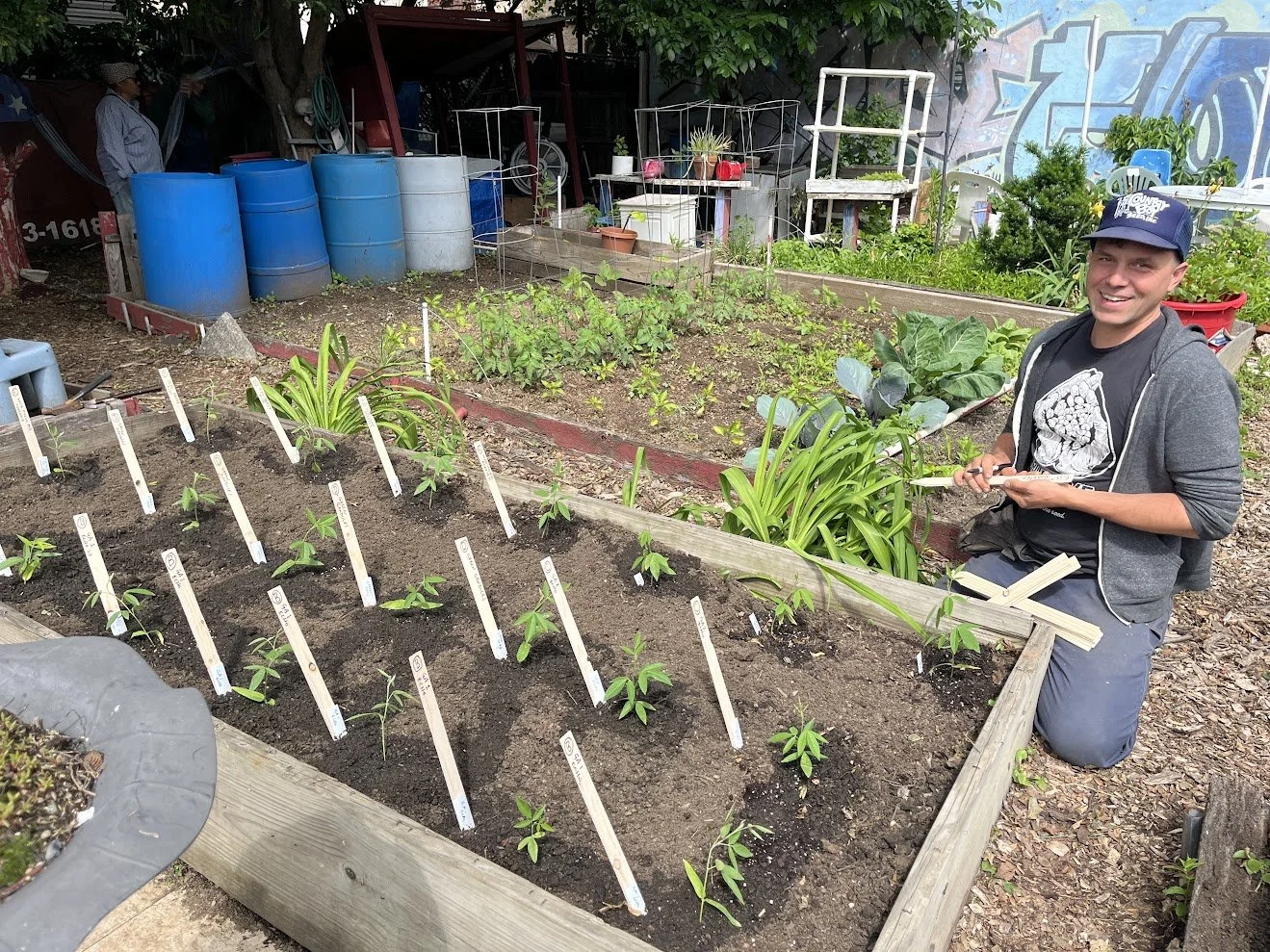
Owen Taylor, founder of Truelove Seeds in Philadelphia, planting northern adapted pigeon pea trials at Norris Square Neighborhood Project, spring 2025. Photo courtesy of Owen Taylor
Seed-keeping has become, by necessity, an act of political and cultural resistance. PHSL was founded by Jerusalem-born artist, researcher and conservationist Vivien Sansour, and its mission has grown more urgent as escalating settler violence and land seizures in Gaza and the West Bank since Oct. 7, 2023, increasingly threaten Palestinian agricultural autonomy. As Roise puts it: “When institutions are under threat, the community becomes the institution.”
Though PHSL and UAWC have operated separately, they find themselves responding to the same reality: one where preserving agricultural heritage may depend on people thousands of miles away.
Roise’s entry into seed work began through farming internships and later deepened while working with Indigenous seed keepers in North America. She recalls one elder who only had a handful of sacred corn seeds left.
“It was really scary,” she says. “The histories of erasure are so similar.”
PHSL’s model pairs crops with climates, growing heat-loving plants like eggplant and okra in southern states, while experimenting with cold-hardy grains in the north. But not every plant adapts easily. Some, like akub—a wild thistle—resist germination in pots or beds.
“It’s used to being eaten by birds or washed downstream,” Roise says. “Not gently tucked into neat rows.”
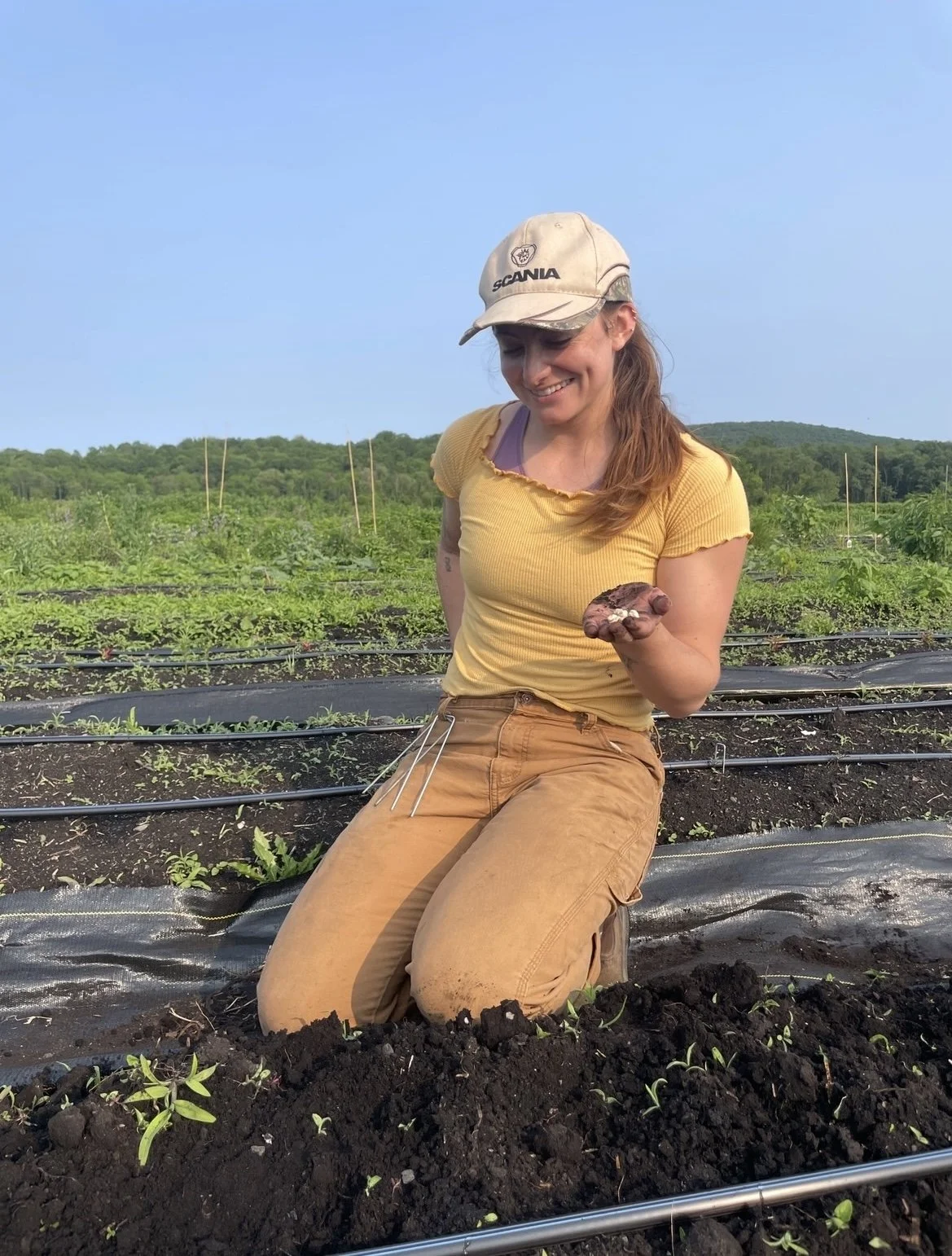
Melina Roise, Program Coordinator for the Palestine Heirloom Seed Library, planting chickpeas at Saboon Maazeh farm in Chester, NY. Photo: Joy Youwakim
Despite these challenges, the diaspora’s appetite for traditional crops grows. In Philadelphia, Truelove Seeds founder Owen Taylor cultivates crops widely used in Levantine cuisine, including the leafy green molokhia, kusa, and several zaatar varieties. Truelove collaborates with farmers locally and beyond, and demand, especially from Palestinian and broader Middle Eastern and North African communities, is high.
Olive trees, Taylor notes, don't enjoy the climate, limiting their cultivation outside of Palestine.
“Growing ancestral seeds is a living link to your past—and your homeland,” he says. Seed sales help fund further conservation and, when possible, repatriation efforts. But like Roise, Taylor views the work as much more than botanical.
“The destruction of the UAWC bank was an attack on life,” he says. “Seeds carry knowledge, flavor, history. They’re not just biology—they’re resistance.”
As international agreements restrict the circulation of seed material, Roise says, grassroots networks are building parallel systems. In fact, a 2023 study titled “Navigating toward resilient and inclusive seed systems,” published in the Proceedings of the National Academy of Sciences (PNAS), notes the critical role of smallholder farmers in maintaining global crop diversity through traditional and informal seed systems. Although formal seed systems tend to focus on a limited number of commercially valuable crops, the study that smallholders in regions such as sub-Saharan Africa, South Asia and Latin America obtain the vast majority of their seed through informal sources like farm-saved seed, local markets and social networks.
But despite their importance for agrobiodiversity and food security, these systems are often marginalized or inadequately supported by national laws and international policy, which can create legal and institutional obstacles to seed access, exchange and conservation.
To address this, PHSL has launched its Seed Protectors Project, a global network of farmers who grow and share Palestinian heirlooms. Each participant becomes a custodian, increasing the odds that rare varieties survive, even in times of crisis.
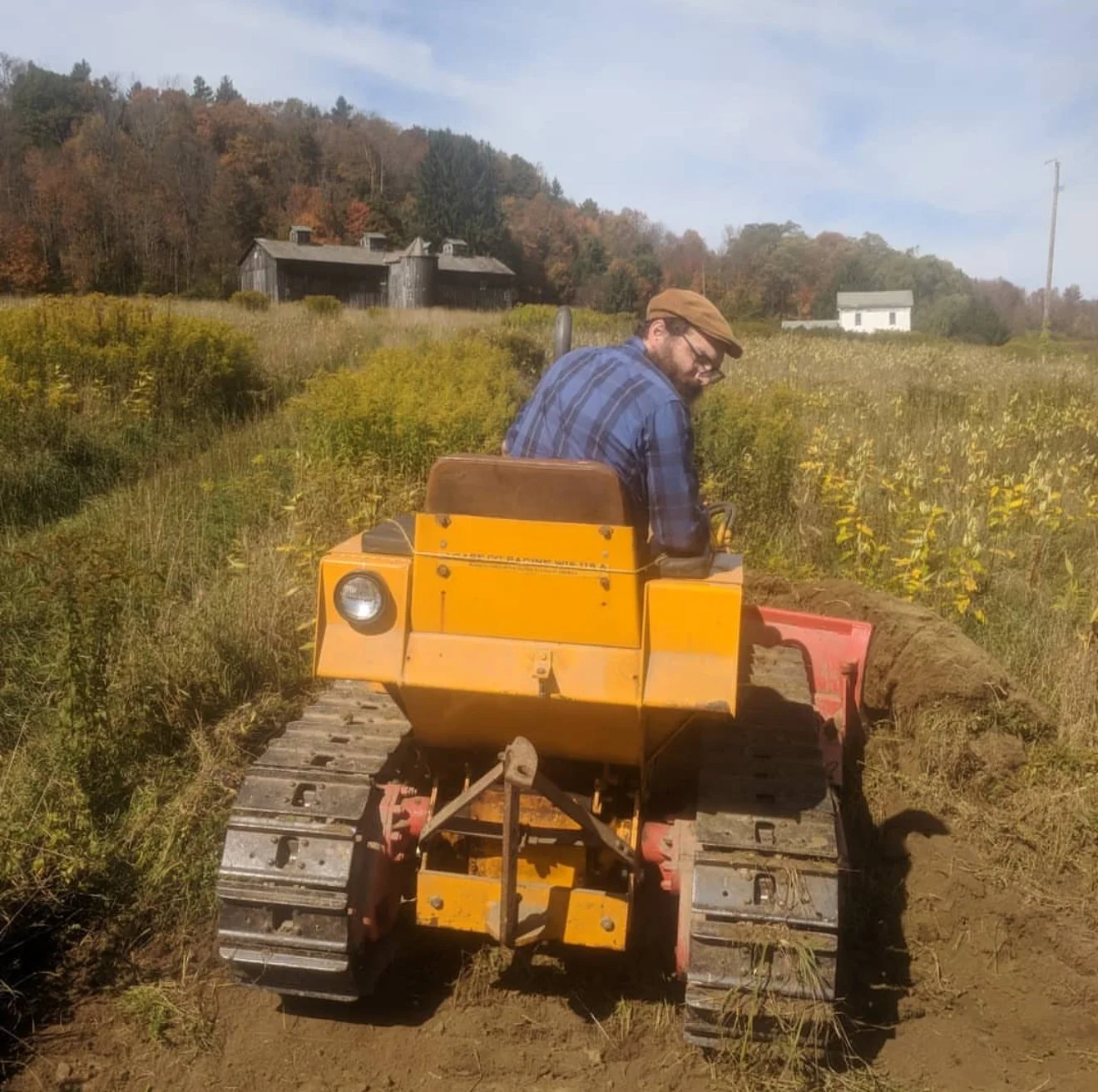
Nathan Kleinman, co-founder of the Experimental Farm Network, driving a Case 310 crawler dozer in Norwich, NY, in 2019. Photo courtesy of Nathan Kleinman
Also in Philadelphia, Nate Kleinman, co-founder of two local nonprofits, Experimental Farm Network (EFN) and Cooperative Gardens Collective, has taken up this work. He began by seeking out native Lenape seed histories near his hometown, Jenkintown, just outside of Philadelphia and later launched EFN in 2013. When the COVID-19 pandemic threatened local seed access, he expanded into mutual aid with CGC.
“Local seeds give people a fail-safe,” Kleinman says. “They’re free, they’re adapted and they’re part of your region. Commercial systems often overlook that.”
Currently collaborating with the Palestine Heirloom Seed Library, Kleinman helps distribute seeds across climates, from desert-adapted okra in Arizona to drought-resistant wheat in the Midwest.
For many recipients, though, these seeds represent more than resilience. Roise notes that families often plant them not just to eat, but to remember. A grandmother’s zaatar. A cousin’s tomato jam. These crops become conduits for story and survival. And even when the plants don’t thrive, the act of planting remains meaningful.
“There are many Palestinians here who want these foods. You can’t get them at the grocery store,” she says. “Sometimes the seeds fail. But the care doesn’t.”
Seed sovereignty, like cultural sovereignty, requires shared effort. Taylor describes this approach as “distributed preservation,” where no single farmer or organization carries the full weight. Each small act—saving seeds, sharing knowledge, teaching cultivation—builds collective strength.
The destruction of the Hebron seed bank makes this model not just ideal, but necessary. With institutions increasingly vulnerable and under attack, the stewardship of preservation now lives in the hands of many, including farmers, families and diaspora networks, each helping to ensure that Palestinian seeds, and the histories they carry, continue to grow.
“We want as many fail–safes as possible,” Kleinman says. “Because when seeds are lost, it’s not just food lost. It’s identity lost.”
***
Gawhara Abou-eid is an Egyptian-American researcher and journalist from Lewisburg, PA and an Al-Bustan News media fellow. They hold a BA in International Relations from The George Washington University, with a concentration in International Security Policy. Gawhara has published research for the League of Arab States in Cairo, and their journalism has appeared in The Standard Journal and The News-Item.

Al-Bustan News is made possible by a grant from Independence Public Media Foundation.