Pro-Palestine Faculty at Area Universities Report Censorship, Prosecution and Loss of Academic Freedom
By Ragad Ahmad
September 3, 2025
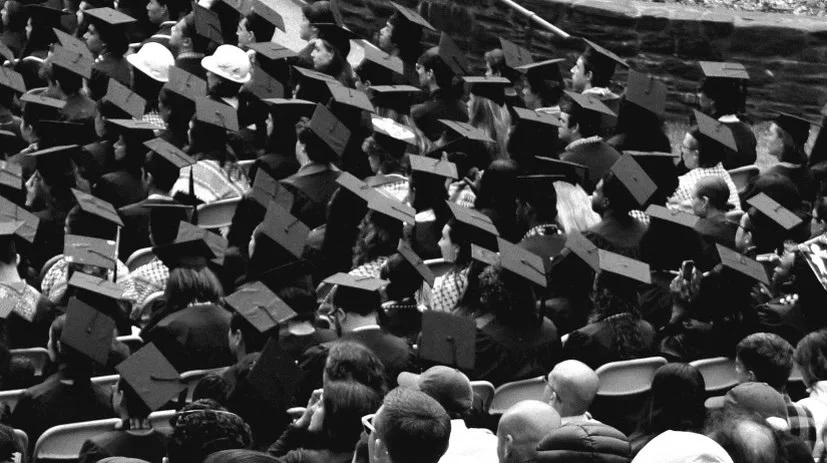
Swarthmore College Baccalaureate Ceremony, 2025. Photo: Ragad Ahmad
Since helping to organize the Palestine Writes festival in August 2023, Dr. Huda Fakhreddine has watched her academic world transform. "Our freedom to think and teach and learn is being compromised," she says, her voice carrying the weight of an almost two–year battle against institutional repression. Her work, once a space of intellectual inquiry, has become what she describes as a minefield of forbidden questions.
Fakhreddine is a tenured associate professor of Arabic literature at the University of Pennsylvania. According to her and other faculty members interviewed, a broader pattern has emerged. Faculty at Philadelphia-area universities are seeing a systematic targeting of academics who express pro-Palestine views since October 2023—months before executive orders dismantling diversity programs and federal investigations of faculty became headlines under the Trump administration.
The situation presents particular challenges at institutions like Haverford College, where Dr. Tarik Aougab is currently under investigation for his involvement with Faculty and Staff for Justice in Palestine, an advocacy movement with chapters at more than 130 universities in the U.S. The associate professor of mathematics deals in the certainties of numbers and proof, yet he now faces the uncertainty of anonymous civil lawsuits and congressional inquiries into "disciplinary actions" against him.
Aougab points to what he sees as contradictions at Haverford, an institution historically rooted in the Quaker principle of radical pacifism, its faculty handbook at one time prohibiting professors from accepting Department of Defense grants. This policy was later abandoned for financial reasons, but Aougab sees it as emblematic of the college's anti-militarist foundations. Those same founding values, he says, have now made faculty members like him into targets, with his commitment to justice being reframed by the administration as a threat to institutional stability.
Dr. Sangita Patnaik, an associate professor of English at Swarthmore College, describes the abstract threat of censorship as a concrete pedagogical crisis. In her course on the literature of human rights, she faces an impossible choice: include Hannah Arendt's "Eichmann in Jerusalem: A Report on the Banality of Evil”—a seminal work on genocide and moral responsibility—or comply with restrictions that have led other universities like Columbia to ban the book entirely.
Patnaik believes that Arendt's anti-imperalist views have made her analysis of Nazi war crimes incompatible with certain definitions of antisemitism that have recently been adopted across higher education, including that of the International Holocaust Remembrance Alliance. "How can you teach a class about human rights and not incorporate such a text?" Patnaik says, stunned by a new reality in which studying genocide has become grounds for accusations of hate speech.
Patnaik describes constraints that extend far beyond individual texts. A tenured faculty member with U.S. citizenship, she has observed less protected colleagues retreat into self-censorship. Faculty at Swarthmore have reported restrictions on research topics, limits on classroom discussions and what Patnaik characterizes as a pervasive atmosphere where intellectual curiosity itself is suspect.
Fakhreddine, who is set to teach a course titled "Resistance Literature from Pre-Islamic Arabia to Palestine" during the spring 2026 semester, argues that current events cannot be ignored in a college classroom. "In no world can you go into a classroom and not speak about genocide when Israel is implementing its final phase of execution in Gaza," she says.
Fakhreddine, like Aougab and Patnaik, believes that while the initial catalyst for these shifts was growing solidarity with Palestine, the implications extend far beyond any single issue. She warns that when universities can redefine academic freedom to exclude certain perspectives, when they can retroactively criminalize respected ideas and abandon institutional principles in the face of external pressures, then no field of knowledge remains safe. Universities that once prided themselves on protecting speech are now preemptively surrendering those protections, reshaping the very foundations of scholarship.
Among those disproportionately affected are international faculty, professors of color and anyone who publicly expresses solidarity with Palestinian rights. Fakhreddine notes that colleagues offer sympathy in private while maintaining public distance from anyone deemed controversial, creating a sense of isolation that she believes serves the broader project of silencing dissent.
This is not coincidental but by design, Fakhreddine says, describing the persistent marginalization she experiences as an Arab scholar, which makes academics like her feel like ‘guests’ rather than invaluable contributors to bodies of knowledge. But as these scholars fight to preserve spaces for critical thinking, they're defending more than their careers or even their institutions.
"Silence is not an option," says Fakhreddine. "I have a responsibility to my students, and we all have a responsibility to Gaza."
***
Ragad Ahmad is a Palestinian–American Muslim born and raised in Philadelphia. She currently studies Peace and Conflict Studies at Swarthmore College, where she explores issues of decolonization and climate justice.