As Crackdown in Iran Intensifies, Advocacy Group ‘Philly Iranians’ Questions Silence from International Community
By Gawhara Abou-eid
February 17, 2026
In 2009, as protesters filled the streets of Tehran after a disputed presidential election and security forces responded with violence, an assistant professor at Drexel University who writes under the pen name Porya Parsa reached what he calls a personal point of no return.
Although he was a teenager living in northern Iran at the time, he was working with publications and magazines and had connections within the country’s media. After the protests, he said, authorities intensified pressure on journalists and tightened restrictions on the press. Left to witness the massacre of peaceful demonstrators, he said he could no longer identify with Iran’s ruling system. He believes millions have come to the same conclusion in the years since.
“I drew the line in 2009,” Parsa said. “Others drew the line in 2019 after the bloody Abon massacre in which they killed at least 1500 people in the span of a few days. Some people drew the line in 2022.”
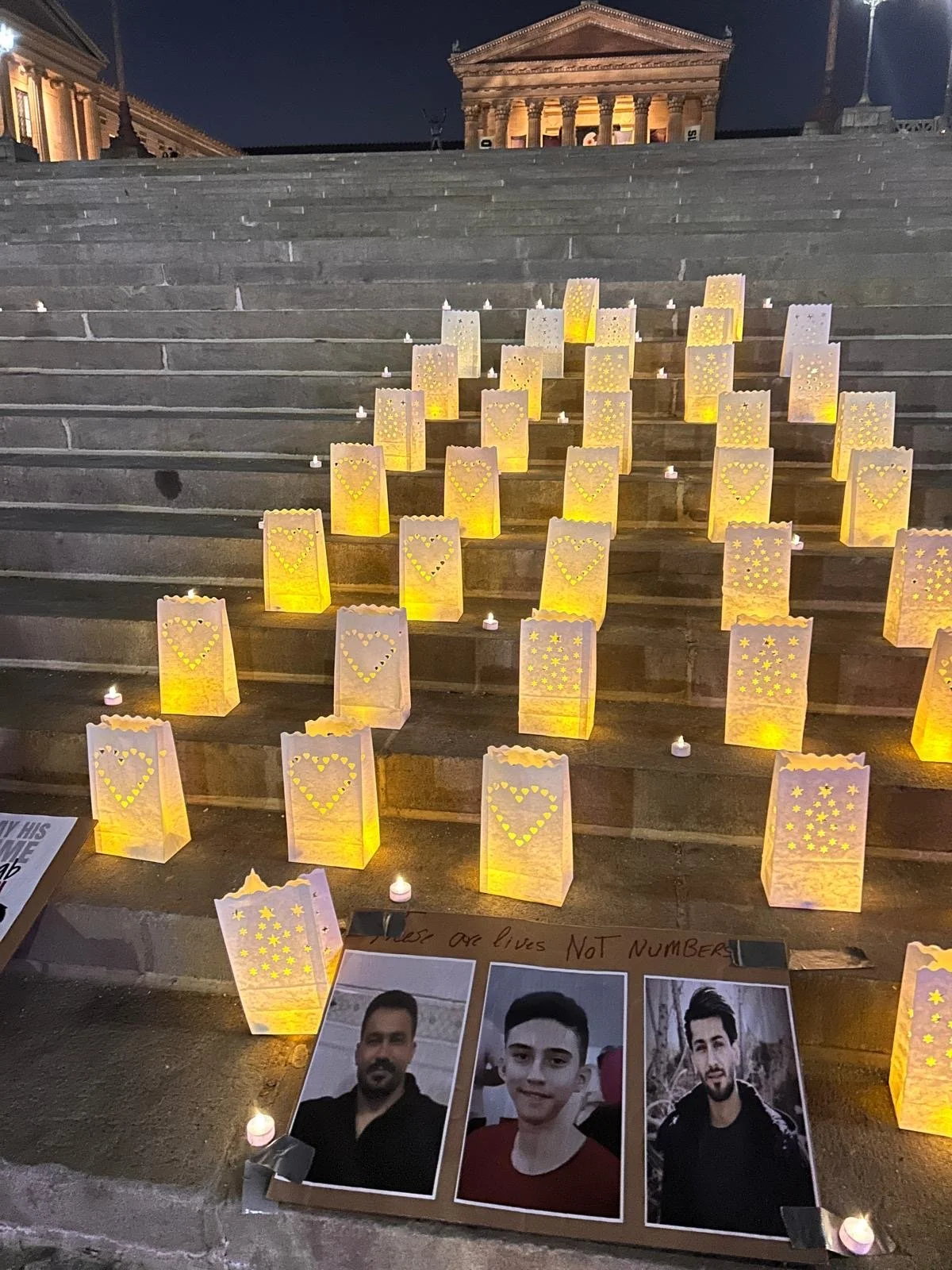
Philly Iranians holds a vigil on the steps of the Philadelphia Museum of Art on Jan. 22 for victims of the Iranian regime’s violent crackdown. All photos courtesy of Porya Parsa
That year’s breaking point came in September, when 22-year-old Mahsa Amini, a young Kurdish woman visiting Tehran, was arrested by the regime’s “morality police" for allegedly violating the country’s compulsory hijab law. According to reports, witnesses said she was beaten and taken into custody. She fell into a coma and died three days later, on Sept. 16.
Amini’s death sparked nationwide protests under the banner “Woman Life Freedom.” Authorities responded by firing live ammunition, metal pellets and tear gas at demonstrators.
Days later, a small group of Iranians gathered outside Philadelphia’s City Hall to mourn Amini. Parsa said that vigil became the seed of what would grow into a registered Pennsylvania nonprofit, and a local extension of a movement demanding fundamental change. The organization, Philly Iranians, launched an Instagram page in late September 2022 to post about local events and completed the process of registering in the state the following year. The group defines itself as “a volunteer-led, nonpartisan, multi-faith coalition of Iranians and allies in the greater Philadelphia area advocating to free Iran alongside the #WomanLifeFreedom (WLF) revolution.” Parsa serves on its board.
As protests and unrest continue in Iran, he sees an escalating humanitarian crisis.
“Right now, the regime is the number one enemy of the Iranian people,” he said. “Almost every Iranian says there's an ocean of blood between us and the regime. They did the most horrific massacre in the 21st century, and we’re still witnessing it.”
Escalating Violence, Limited Verification
According to human-rights organizations tracking the crackdown on protests that began in late December 2025, the death toll in Iran has reached thousands of confirmed fatalities, though the exact number remains unclear. While the regime’s state media has acknowledged around 3,117 dead, groups like the U.S.-based Human Rights Activists News Agency have reported more than 7,000 people killed nationwide and tens of thousands arrested. Independent verification of events inside Iran has been severely hampered by widespread internet and phone shutdowns imposed by authorities, limiting the flow of reliable information.
Based on what he has heard from relatives and friends in Iran, the death toll may exceed 40,000 people, Parsa said. The violence unfolded in two intense crackdowns lasting up to five hours each, with roughly 10 hours of bloodshed spread across 48 hours. Thousands of people have been detained or taken without any information about their whereabouts and may be at risk of torture or execution.
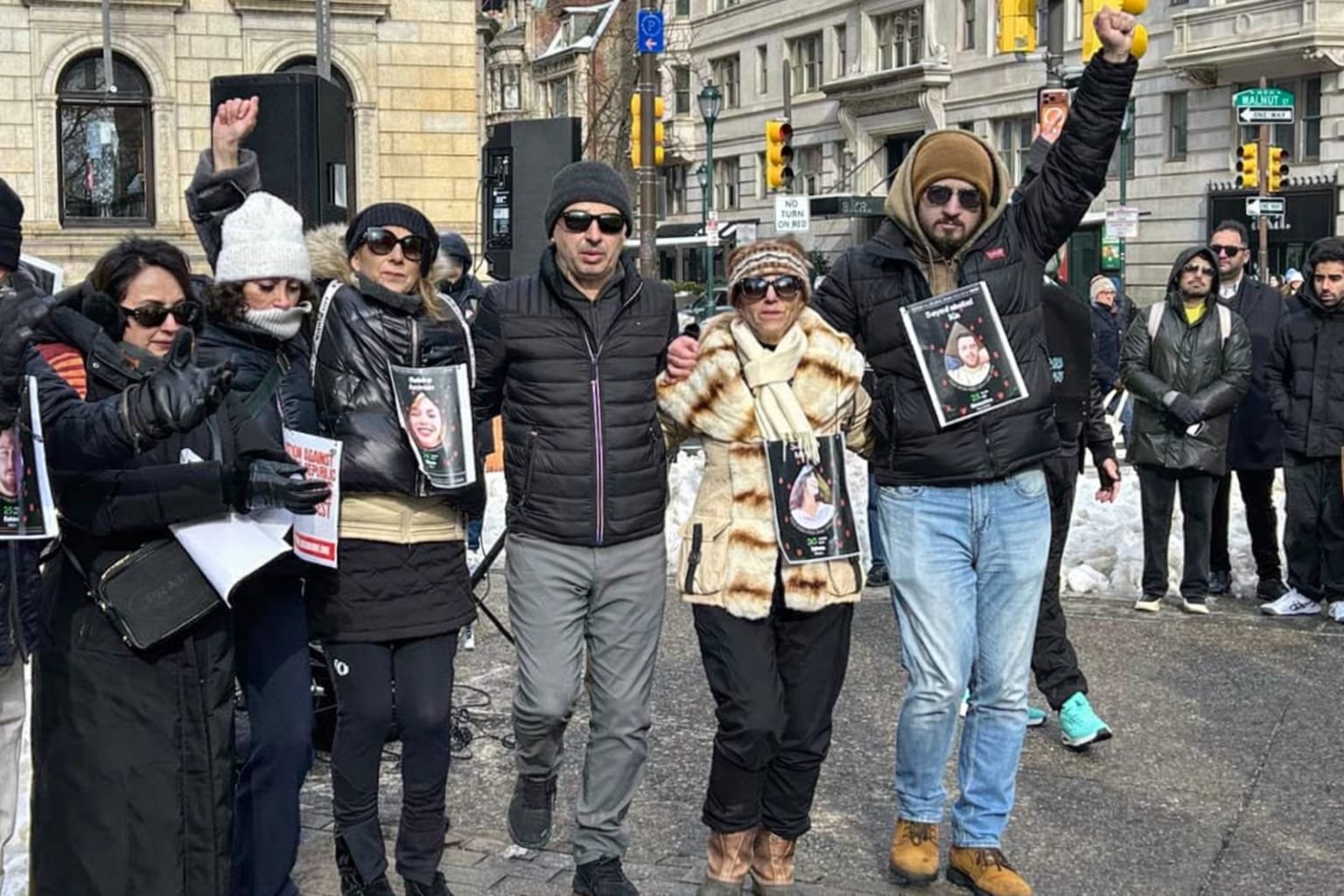
Porya Parsa (right) attends a rally with other members of Philly Iranians.
Parsa described the situation as akin to a hostage-taking, with families trapped inside the country while those outside watch helplessly. He characterized Iranian cities as heavily militarized, with security forces operating like killers, making even routine activities such as grocery shopping unsafe. Rapidly rising prices and economic strain compound the daily risks, he said. And communication with loved ones is now severely limited; short voice messages sometimes get through, but much of the time nothing connects.
Parsa is frustrated with international institutions, noting that many Iranians had hoped the U.N. or similar organizations would intervene to protect citizens. He cited deep divisions among member states and resistance to strong action by powerful governments, saying that diplomatic gridlock and the influence of countries opposed to external pressure on Tehran have made meaningful international responses difficult to achieve.
Building a Solidarity Movement in a ‘Desperate Time’
According to Parsa, Philly Iranians has seen a contrast between global mobilization over other crises, in Palestine and Sudan for example, and what they view as a lack of attention to events in Iran. He also addressed visible cooperation between some Iranian and Israeli diaspora activists at rallies, where Israeli flags sometimes appear. The presence of Israeli flags, he said, is meant to counter decades of official rhetoric from Tehran.
“Somebody asked us, ‘Are you pro-Palestine or are you pro-Israel?’ And this really isn't how we look at it,” he said. “We are pro-human rights forever in the world. So, in most of the rallies where you may see Israeli flags, it isn't that those people are pro-Israel. The message is that if the Islamic regime has been chanting for 47 years, saying, ‘We're going to wipe Israel off the earth,’ that is not us. We are friends with Israel. We carry their flag. We acknowledge that these people exist and they have rights like all other humans.”
He believes geopolitical alignments have influenced solidarity movements. Parsa said that despite the group’s reliance on Israeli and U.S. support, many in the Iranian diaspora still expected support from Palestinians or groups aligned with them, noting that Iranian rallies are generally welcoming to anyone who wishes to attend.
“It’s just logical to accept the help in a desperate time when somebody says we are willing to help,” he said. “Some activists argue that the Iranian people and the United States share a common adversary in the current regime.”
At the same time, Parsa expressed frustration with U.S. media coverage, pointing out that journalists often give a platform to Iranian officials rather than to citizens and members of the diaspora.
“I hope that especially the liberal media accepts that the regime's narrative is bullsh-t and stops giving space just in the name of freedom of speech or looking at both sides,” he said. “That is legitimizing a terrorist group. When you're talking about other terrorist groups… none of them killed 40,000 people in two nights. The Islamic Republic regime is the number one terrorist in the world. And still a lot of media outlets are giving them a platform or giving their sympathizers a platform just to spread misinformation.”
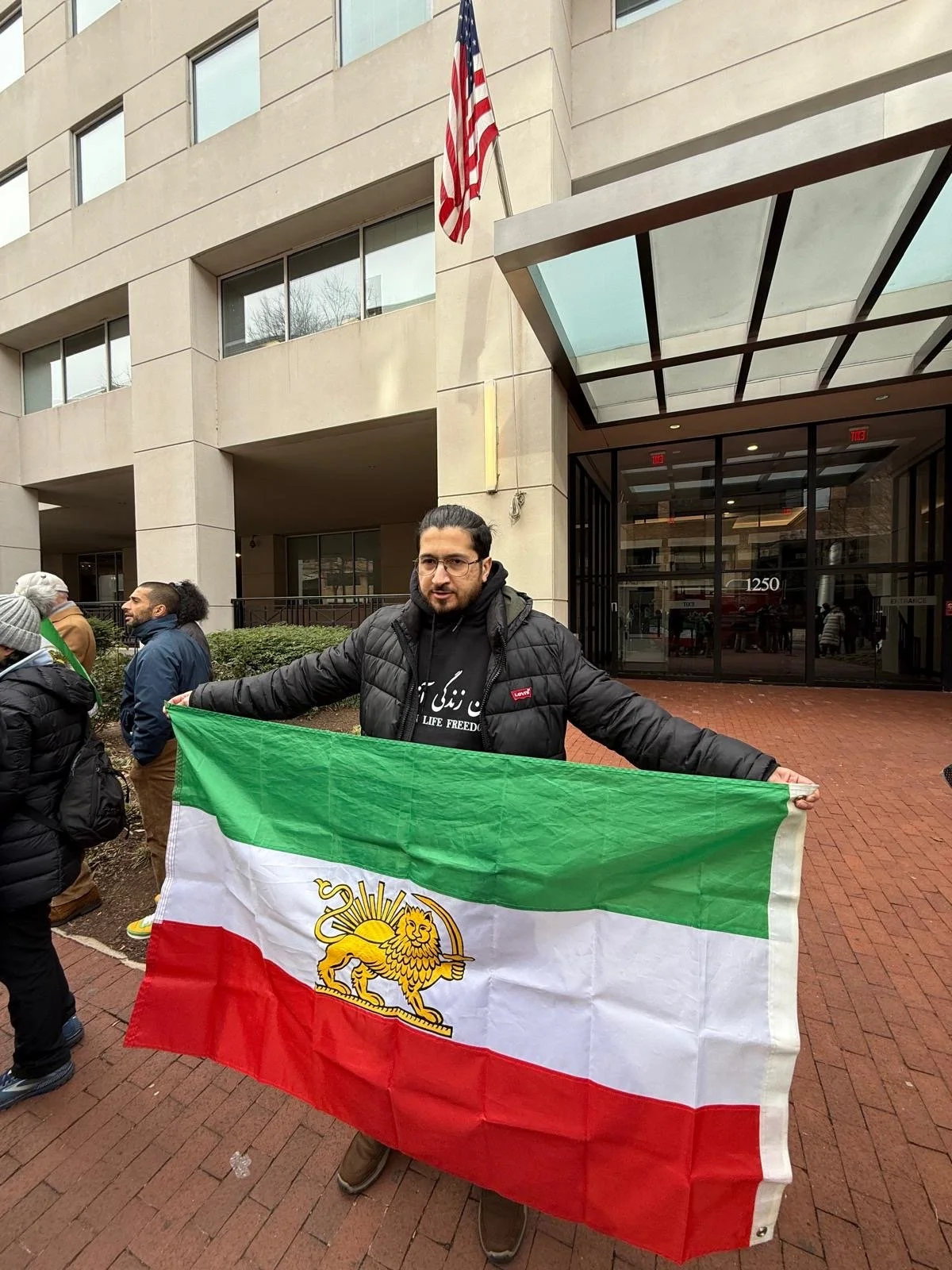
Porya Parsa protests in front of the Interests Section of the Islamic Republic of Iran in Washington, D.C.
A Vision for Regime Change
For many Iranian Americans, the crisis is deeply personal. A 2025 survey conducted by SurveyUSA for the Public Affairs Alliance of Iranian Americans (PAAIA) found that 88% of Iranian Americans have family members living in Iran, including 26% with immediate relatives such as parents, siblings or children. Among those who immigrated within the past 25 years, nearly half still have immediate family there.
On U.S.–Iran policy priorities, 44% of survey respondents identified promoting regime change as a top concern, and 41% cited promoting human rights and democracy in Iran. Other priorities included lifting sanctions (22%), preventing regional conflict (21%), limiting Iran’s support for terrorism (19%), negotiating a new nuclear deal (16%) and tightening sanctions (14%).
On the role of sanctions in foreign intervention, Parsa stressed that broad, untargeted sanctions would mainly hurt ordinary Iranians rather than the government. He called instead for immediate, targeted maximum pressure against the Islamic Revolutionary Guard Corps, stating it controls most of Iran’s economy. But outside pressure alone is insufficient, he said, adding that any pressure campaign should be paired with a transitional government capable of negotiating relief and stabilizing the economy. In Parsa’s view, this combination of targeted sanctions and domestic political planning is the only way to weaken the regime while protecting citizens, ensuring both leverage over the government and longer term stability.
When survey respondents were asked what type of government would work best in Iran, 55% favored a parliamentary democracy or republic, 17% supported a constitutional monarchy, 6% preferred a reformed Islamic republic and 3% supported maintaining the current system.
Prince Reza Pahlavi, the exiled son of Mohammad Reza Pahlavi, Iran’s last monarch who was deposed in 1979, has emerged as a symbolic figure for some in the diaspora advocating for political change, Parsa said. While not all activists see him as a permanent leader, Parsa noted many are willing to give him a chance to help guide a transition from the Islamic Republic to a secular government. The process would include a referendum under international observation, allowing Iranians to determine the country’s future system. Pahlavi’s emergence, Parsa said, represents the first time in recent memory that a named figure has openly expressed support for the people rather than the regime, offering a potential path toward leadership rooted in public consent rather than official authority.
For Parsa, the focus must continue to be on those protesting and enduring daily life inside Iran.
“Millions of people have been in the streets,” he said. “They don't want to fight anyone. They just want to be friends with everyone and live their lives in peace.”
***
Gawhara Abou-eid is an Egyptian-American researcher and journalist from Lewisburg, PA and an Al-Bustan News media fellow. They hold a BA in International Relations from The George Washington University, with a concentration in International Security Policy. Gawhara has published research for the League of Arab States in Cairo, and their journalism has appeared in The Standard Journal and The News-Item.

Al-Bustan News is made possible by a grant from Independence Public Media Foundation.