
Explainer: The ‘Invisible Crisis’ in Sudan
By Ben Bennett
December 27, 2025
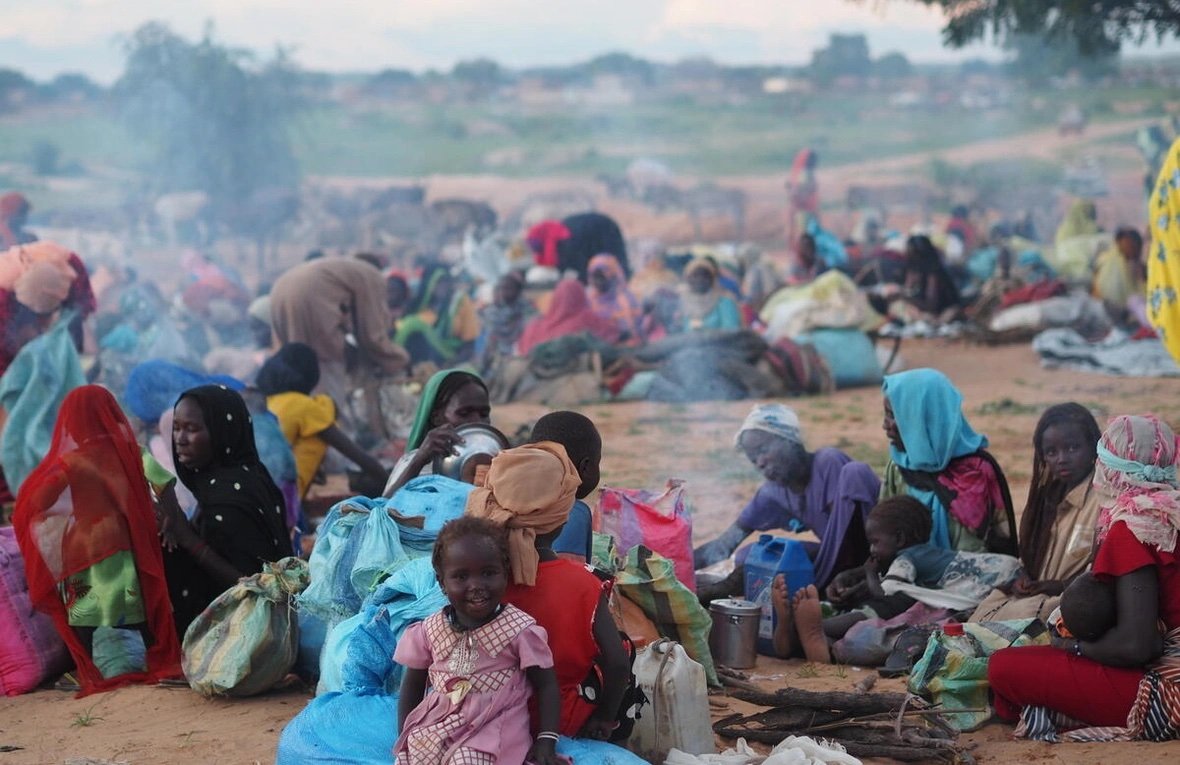
Sudanese refugees. Image © UNHCR/Ying Hu
The current conflict in Sudan, now in its third year, is being called “the world’s largest humanitarian crisis.” However, awareness about the crisis continues to be limited, despite its scale and the availability of information on its impact. This explainer attempts to provide a brief overview of the complex conflict, its human toll, the position of the United States government and its response to the crisis.
A Lack of Awareness
Americans’ awareness about Sudan remains low relative to other global crises, chiefly in Gaza and Ukraine. In both instances, the U.S. is directly involved, supporting Ukraine and Israel with billions of taxpayer dollars, giving the American public an incentive to pay attention.
A March 2025 Gallup poll showed American support for Ukraine at 46%, an all–time high. In October, Pew research study showed that nearly one–third of Americans think the U.S. is providing too much aid to Israel, and more than two–thirds hold an “unfavorable opinion” of the Israeli government.
In the case of Sudan, the U.S. does not provide direct aid to either side of the conflict. The most recent poll of American opinion on Sudan was conducted in October 2023, six months after the war began, revealing that 31% of Americans didn’t understand the conflict at all and 44% didn’t understand it very well. By this point, the fighting had already displaced almost 6 million Sudanese.
On–the–ground reporting also continues to be limited. Sara Qudah, Middle East and North Africa regional director of the Committee to Protect Journalists, has said that reporters in Sudan are “often invisible" to those outside the country’s borders and lack the same access, protections and international attention that journalists covering other areas receive. This lack of reporting from within the country and the overall lack of international media interest in Sudan has led to some calling it an “invisible crisis.”
The Human Toll
Since the conflict began, nearly 13 million more Sudanese civilians have been displaced and some 30 million people are in need of humanitarian support.
According to the World Food Programme, 25 million people, around half of the country’s population, are facing extreme hunger levels. The UN predicts that over three million children under five will suffer from malnutrition in the coming year.
Infectious diseases such as measles, cholera and malaria have reemerged, and this month, a measles outbreak has been spreading rapidly through the Darfur region. In addition, the RSF has reportedly inflicted widespread sexual violence and torture as part of its campaign.
The combination of violence, famine and displacement has led to an estimated death toll of 400,000.
A Brief History
The war in Sudan began in April 2023, when violence erupted in the capital Khartoum between two factions of the country’s government: the Sudanese Armed Forces (SAF) and the paramilitary Rapid Support Forces (RSF).
The RSF evolved from “Janjaweed” militias in the early 2000s. The Sudanese government armed, trained and supported these groups to put down a rebellion by the Sudanese Liberation Army in Darfur in 2003, where the Janjaweed massacred civilians and burned their land, displacing hundreds of thousands.
The RSF has been active in Darfur for more than 20 years. The militias grew over time, and in 2013 Omar al–Bashir, then President of Sudan, combined them into one unit: the RSF. A 2017 law placed the group under the umbrella of the SAF.
In 2019, a RSF and SAF military coup ousted Al–Bashir, replacing him with a civilian government. Two years later, the same groups participated in another coup, creating a power vacuum in Sudan.
At a panel discussion on Dec. 16 called “Understanding the Conflict in Sudan” at the University of Pennsylvania, Africana studies lecturer Ali Dinar explained that what we see today is a fight between the Sudanese government and the militia that it created just a decade earlier — “a war for power, and for taking the state and for domination.”
“[It] has consumed all of what is left of Sudan,” Dinar said.
As the war continued, international interests began to take root in Sudan. Today, the SAF is backed through various means by Egypt, Iran, Turkey, Saudi Arabia and others. According to Dinar, the RSF is primarily supported by the United Arab Emirates.
During past crises in Sudan, including the secession of South Sudan and the grave humanitarian conditions in Darfur in the early 2000s, there was “intense western engagement,” said Mark Malloch Brown, former British politician and diplomat who also participated in the UPenn panel.
“There was, both in the continent and internationally, a level of engagement which is missing now,” he said, adding that the interest that is shown in the current war is of a “sinister” nature, given the UAE’s interest in propping up the RSF and fueling the conflict rather than trying to facilitate a ceasefire.
The UAE denies supporting the paramilitary unit, saying in a statement that it “unequivocally condemns the horrific attacks against civilians in Sudan.” However, international sources claim that the Emirates have been sending weapons and financial support to the RSF.
The U.S. Response
During his administration, President Biden was criticized for turning a blind eye to the humanitarian crisis, not holding the UAE, a U.S. ally, accountable for propping up RSF forces.
“The American efforts until now have lacked seriousness,” Malloch Brown said. “[There] have been one or two representatives who are incredibly personally engaged in trying to get in peace in Sudan, but they have lacked any support from the White House, or even from the senior levels of the state department.”
The current administration claims that they will be more active in the peace process. Secretary Marco Rubio has called for a ceasefire and hopes to collaborate with the UAE. This, according to Malloch Brown, could be the start of an effective diplomatic approach.
Following a Nov. 18 meeting with Saudi Arabia’s Crown Prince Mohammed bin Salman, the president pledged that the U.S. would help broker peace in Sudan. Since then, diplomatic efforts have increased, and American officials have met with representatives from Saudi Arabia, Egypt and the UAE.
U.S. ambassador to the UN Jeffrey Bartos spoke at the UN Security Council on Dec. 23 and encouraged the SAF and RSF to accept the peace plan the Trump administration has proposed. Supported by the UAE, Saudi Arabia and Egypt, the plan consists of an initial three–month truce leading to a permanent ceasefire, as well as humanitarian aid delivery and a process for the creation of a civilian transition to a new government.
However, critics remain skeptical of the administration’s plans to end the conflict, citing the financial conflicts of interest with key nations, the lack of pressure from the international community and the lack of consequences if a truce is not reached.
***
Ben Bennett is a Chinese-American visual journalist based in Philadelphia and an Al-Bustan Media Fellow. He is a recent graduate of American University's journalism program, where his coverage focused on underserved communities and the intersection of politics and popular culture.

Al-Bustan News is made possible by a grant from Independence Public Media Foundation.