
Tatreez Workshop Helps Keep a Palestinian Tradition Alive in South Philly
By Elissa Odeh
May 16, 2025
On the evening of May 8th, a dozen women gathered with needles and thread on Passyunk Avenue to learn tatreez, the traditional Palestinian embroidery style.
The workshop, held at the Minimal Chaos Souk in South Philadelphia, was organized by Samar Dahleh, a 25-year-old Palestinian American resident of Springfield, PA, and was part of growing efforts to carry on the tradition in the diaspora. Dahleh, who originates from the West Bank city of Tulkarm, started learning tatreez in 2022 as a hobby. It soon became her mission to help preserve the craft and educate people about its cultural and historical significance.
Dahleh opened the workshop with a presentation on the history of tatreez and the meanings behind different motifs, explaining how traditional patterns evolved into forms of political expression and protest, as Palestinian women stitched hidden messages on their thobs, or dresses.
“It was always a form of passive storytelling, where women used different colors and patterns to share about their lives, where they were from, whether they were married or had kids and what they hoped for,” said Dahleh. “But after the Nakba it became a symbol of resistance. The motifs documented what was happening—a way for women to preserve their history and heritage.”

At the tatreez workshop held at the Souk, Samar Dahleh (right) and attendees chat over embroidery and mezze provided by Philly Hummus Girl. Photo: Yasmine Dahleh
The practice of tatreez dates back 3,000 years to the Canaanite people in the present-day Levant, and during the 19th century it largely became a symbol of Palestinian culture. The motifs and colors of the designs vary from region to region based on an area’s geographical features and the culture and values of its people.
Thobs made in Gaza, for example, feature waves, representing Gazans’ deep connection to the Mediterranean Sea, while embroiderers in Ramallah adorn their dresses with the olive branch, a now-universal symbol of peace that signifies the Palestinian people’s roots in the land. In southern Palestine, the cypress tree is widely incorporated into designs to symbolize hope and endurance. It is occasionally embroidered upside down and accompanied by missiles.
“These patterns show that, yes, there are negative things affecting Palestinians,” Dahleh said. “But at the same time, the gardens will not stop blooming, and we will continue to be a resilient people. This is the story Palestinian women have wanted to tell with their dresses.”
Regional disparities in wealth and resources have also historically accounted for differences in motif, Dahleh explained. Ramallah, a relatively affluent city in the West Bank, is known for colorful and detailed embroidery, while patterns in Dahleh’s more economically depressed hometown of Tulkarm tend to be more minimalist, featuring plainer colors.
“Palestinian women did not have the resources we have today, so they traditionally made tatreez work with anything that looked even remotely beautiful,” she said.
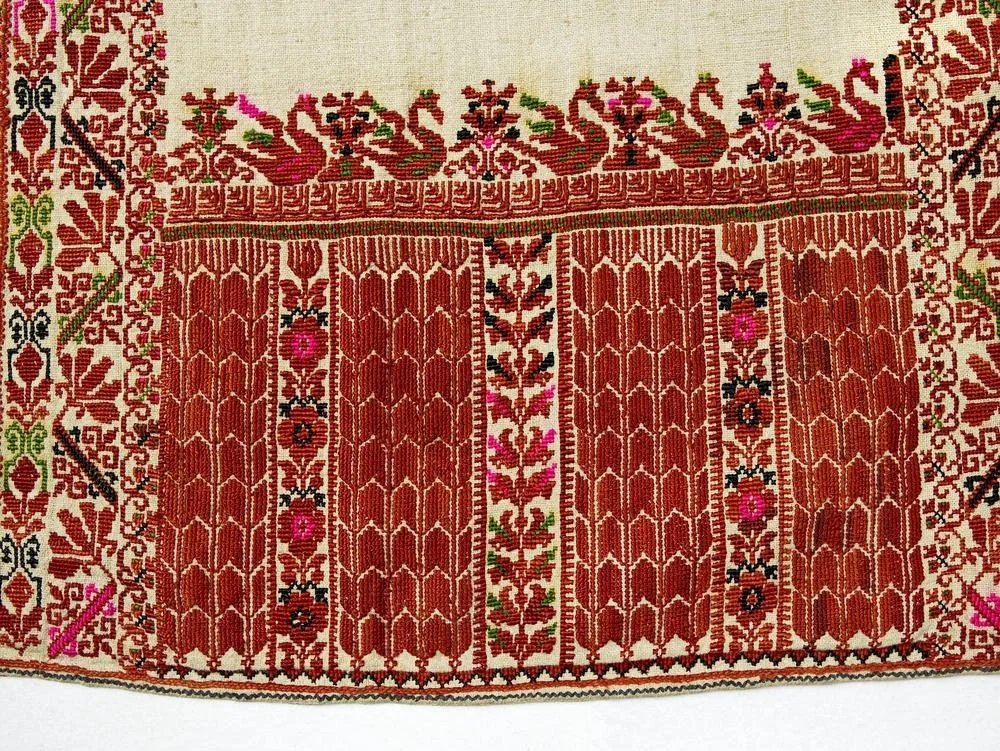
Detail of a “thob ruhbani,” Ramallah, ca. 1900. © The Trustees of the British Museum. Shared under a Creative Commons Attribution-NonCommercial-ShareAlike 4.0 International (CC BY-NC-SA 4.0) licence.
And while tatreez is primarily associated with thobs, many women incorporate it into other elements of their everyday lives, stitching it on wallets, handbags and hair pieces. They also adorn their walls with embroidered decor. “These women don’t think of themselves as artists,” Dahleh said, but rather as bearers of an inherited tradition.
For Dahleh, the community element of tatreez is what draws her to it the most. “You are supposed to sit like the khaltos (aunties) used to, do tatreez together, chatter and enjoy a cup of tea,” she said. As they stitched, the workshop participants at the Souk talked and laughed, pausing to eat a Middle Eastern mezze provided by Miranda Stephen, owner of Philly Hummus Girl.
Among the attendees was Nicola Bell, a 47-year-old Irish resident of South Philly. “I knew what tatreez was, but I didn’t know the cultural and historical aspect of it. So being here and learning all about it was a fascinating experience,” she said.
Third-generation Syrian American Rebecca Saadeh Nelson, 46, described the workshop as a valuable personal experience. “When I walked in, it brought me warmth to be in a place where there is Middle Eastern culture,” she said. “I don’t have much connection to my Syrian heritage, so it just gave me a lot of joy to connect to my culture and learn about it.”

Workshop host Samer Dahleh provided motif templates for participants to use in their embroidery. Photo: Yasmine Dahleh
These reactions inspire Sarah Naji, the Syrian American owner of the Souk. “The most amazing thing is seeing how many non-Arabs showed up today,” she said. “I love seeing people learn about how beautiful our history and culture are.”
As Dahleh continues to host workshops and embroidery circles around the city, she hopes to build a self-sustaining tatreez community that provides an intimate space for people to connect through their needles and thread and honor generations of Palestinian women’s artistry.
“Tatreez is more than just a craft. It’s a form of cultural preservation that is important for us to learn and continue to pass down to future generations. We have to keep telling the stories that our predecessors have told,” Dahleh said. “That is how we keep our history alive.”
***
Elissa Odeh is a Palestinian journalist from Lansdale, PA. She graduated from West Chester University with a BA in media and culture and a minor in journalism. Her work has been published in Lehigh Daily, Daily Local, and the New Orleans Review.