
Despite the Challenges, These Immigrant Entrepreneurs See Opportunity in the U.S.
By Gawhara Abou-eid
July 30, 2026
For local restaurateurs Rahim Hussein and Omar Alkahily, the “American Dream” has never been defined simply by owning a business. Rather, it is about having the opportunity to live safely, build something meaningful and choose a path that was not readily available to their families before immigrating to the United States. But that pursuit has not come without obstacles. For Arab Americans and other immigrant communities, building a future in the U.S. can mean navigating financial barriers, cultural misunderstandings and moments when their identities shape how others view their ambitions.
Hussein, the owner of New Philly Buffet in Essington, PA, built his vision of entrepreneurship from watching his Palestinian immigrant parents establish a life in Philadelphia. Alkahily arrived in the city to pursue a Ph.D. in media communication at Temple University, but his path shifted after he became involved with Malooga, a Yemeni restaurant he first visited as a customer. He invested in the business in 2021, eventually becoming its CEO, and later helped launch Mazaj Cafe and Bakery alongside Malooga co-founder and executive chef Mohammed Aqlan.
Together, their experiences reveal the complexities of pursuing the American Dream’s promise: the barriers that can stand in the way, the communities that make it possible and the determination required to create something lasting.
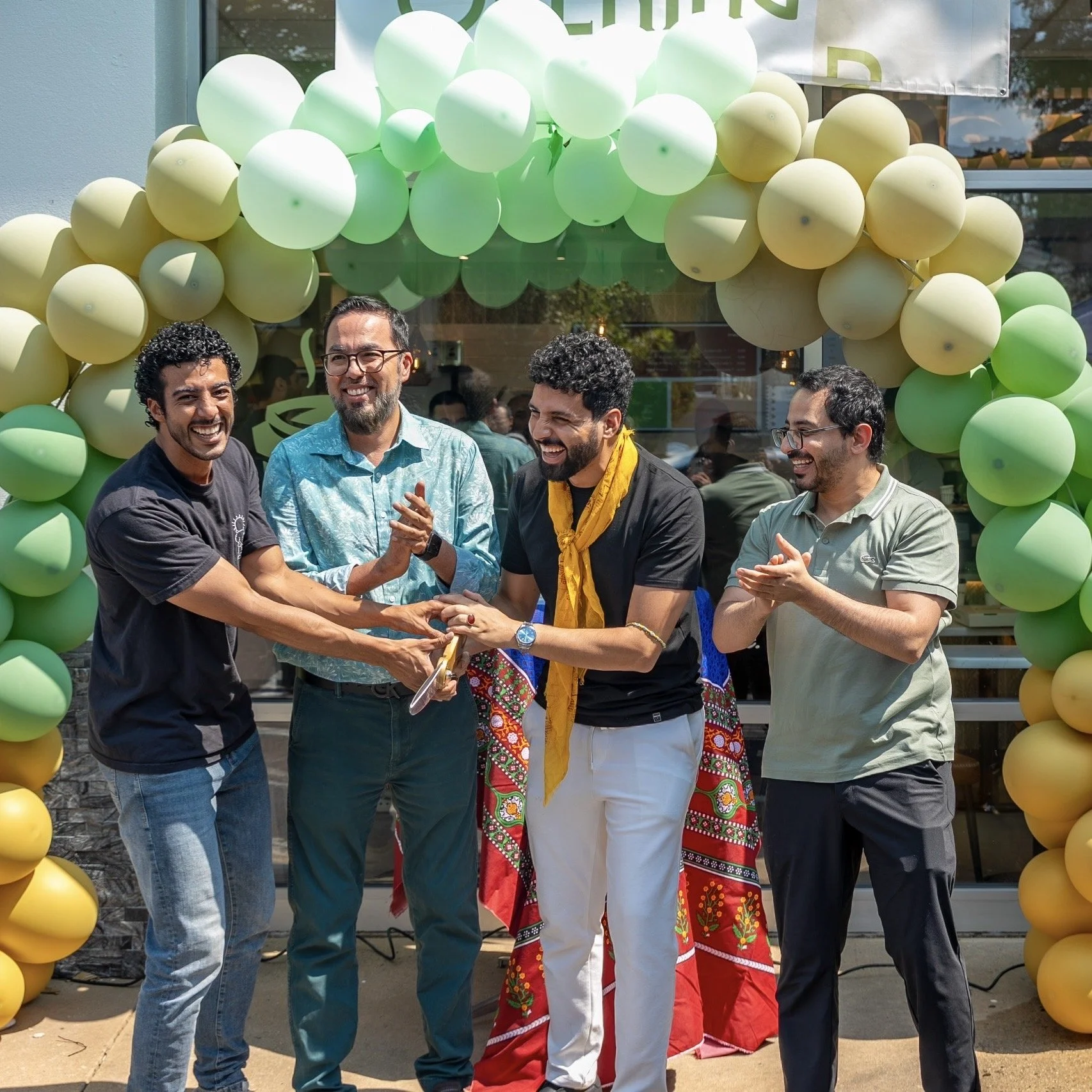
From left, Omar Alkahily, Mohammed Tashkandi, Yousef Muneer and Mohammed Aqlan, the partners behind Mazaj Cafe and Bakery, celebrate the restaurant’s opening. Photo courtesy of Omar Alkahily
Preserving Culture Through Entrepreneurship
The foundation for Hussein’s family’s restaurant venture existed long before they opened its doors. "From an early age, we always knew that we wanted to be business owners… and have something of our own," Hussein says. For nearly a decade, the family operated a catering business specializing in Palestinian and broader Middle Eastern cuisine for weddings, funerals and community gatherings throughout the Philadelphia region. His mother became well known in the city's Arab community for her traditional Palestinian desserts.
After purchasing a diner near Philadelphia International Airport, Hussein and his brother initially attempted to operate it as a traditional American diner but, as Muslims, were committed to not serving pork or alcohol. That decision created difficulties, as many customers expected both. Rather than compromise their religious values, in September 2025 the family transformed the restaurant into New Philly Buffet & Diner, serving Palestinian and Middle Eastern cuisine and what Hussein describes as the area's first halal buffet.
Alkahily, on the other hand, didn't set out to own a restaurant. "I was just thinking of something on the side while I'm doing my Ph.D.," he says. "But apparently it is a full-time thing now."
Today, Mazaj Café and Bakery in Willow Grove, PA reflects the cultural affinities of its founders. Alkahily is half-Saudi and half-Yemeni, while Aqlan was raised between Yemen and Saudi Arabia. Another partner grew up in Saudi Arabia, while a fourth was raised in Yemen. Rather than modernizing or fusing their traditions, the team intentionally chose to prepare classic recipes that reflect the foods they grew up with.
Challenges, Values and Moving Forward
Like many entrepreneurs, both Alkahily and Hussein have faced obstacles involving hiring, financing, operations and growth — all part of building any business, according to Alkahily. "The challenges are just normal challenges,” he says. “If it was easy, everyone would be doing it."
Some of the more unexpected setbacks have come from people’s assumptions about their businesses and cultural background. At times, potential landlords appeared hesitant to work with them because of who they were and what they represented, Alkahily says. But the most surprising criticism came from within the diaspora itself. While many members of the Arab community have supported the businesses, Alkahily observed that some “harmful” public comments have come from people who share his cultural background. He distinguishes between criticism meant to help improve the business and comments intended to hurt it.
“If you email me and say, ‘I’m very upset, and this is unacceptable,’ that’s actually a very good email,” Alkahily says. “I read it and I learn.” What confuses him, he says, are comments encouraging others not to visit or support the restaurant. “But we found that 90% of people are amazing people who are interested, who want to have the conversation, want to try something new, who want to spend money on something they have never tried before.”
For Hussein’s family, the decision to prioritize halal standards over profit at New Philly Buffet shaped the diner’s identity. "As Muslims, we try to stay away as much as we can from making what we consider to be ‘haram money,’" Hussein says. Although that decision made business harder at first, Hussein believes it ultimately helped the restaurant find its audience, adding, "It kind of went from a disadvantage to an advantage.”
Creating Opportunity Beyond the Kitchen
As Mazaj expanded, Alkahily began to see it as a place where people could build skills, find stability and remain connected to their communities.
One job applicant, in particular, changed the way Alkahily thought about hiring. The baker, Khalil, had listed just one job on his resume — 14 years at a bakery in Syria before immigrating to the United States. At first glance, the one-line resume looked too thin for an experienced baker. But after noticing the bakery's Arabic name, Alkahily called and learned that Khalil had spent more than a decade mastering traditional techniques before arriving in the U.S. He quickly became one of Mazaj’s greatest assets, introducing recipes, methods and traditions that have helped shape the bakery's menu.
Alkahily also came to understand what motivated Khalil beyond a paycheck. The baker described leaving previous jobs in the U.S. because he felt they lacked mutual respect and appreciation for his experience prior to immigrating, saying dignity matters as much as wages. But Mazaj offered him opportunities to share his expertise and teach others.
"Arab men… usually appreciate something beyond the financial value," Alkahily says. "They expect a certain way of respect."
That lesson has stayed with Alkahily, whose business employs students, recent immigrants and young professionals from a variety of backgrounds, offering opportunities for growth and tuition reimbursement. The restaurant does not exclusively hire Arab employees, but many Arab and Muslim families feel comfortable knowing their children work in an environment where they can be paid, promoted and supported while remaining connected to their culture and having their values understood, Alkahily says.
Hussein has seen something similar at New Philly Buffet. The restaurant regularly supports community organizations through donations, fundraising events and partnerships while introducing many customers to Palestinian cuisine for the first time. The buffet format, he said, makes unfamiliar dishes feel approachable, leading guests to ask about Palestinian traditions, family life and culture.
Both men believe it is Philadelphia's diversity that has made those conversations possible. Alkahily likes to say, “In Philadelphia there's something for everyone." The city's openness has allowed businesses rooted in Yemeni and Saudi traditions to find customers eager to experience something new, he says.
Defining the Dream
Hussein inherited his idea of the American Dream from his parents. "For us — and a lot of people that come from that background — [it] is just honestly [having] a place to be safe and be able to make something of yourself," he says. "It means being able to pursue whatever you want. You have options." He acknowledges that life in the U.S. isn't without hardships, but opportunity, he says, remains central to the immigrant experience.
Alkahily’s experience in the United States — particularly the size of its economy and the possibilities available to entrepreneurs — also shaped his understanding of opportunity. He believes that success does not come just from becoming a business owner, but from having a purpose behind the work.
"[It’s] not about if you are successful," he says. Instead, entrepreneurship should be viewed as a tool for creating something meaningful. "It's not the goal. It's the starting point."
***
Gawhara Abou-eid is an Egyptian-American researcher and journalist from Lewisburg, PA and an Al-Bustan News media fellow. They hold a BA in International Relations from The George Washington University, with a concentration in International Security Policy. Gawhara has published research for the League of Arab States in Cairo, and their journalism has appeared in The Standard Journal and The News-Item.

Al-Bustan News is made possible by the People’s Media Fund.