
What Does It Mean To Be Egyptian? In the Diaspora, It Depends on Who You Ask
By Gawhara Abou-eid
August 14, 2026
Ask an Egyptian how they identify, and the answer can sound simple: Egyptian. But ask what that means — Arab, African, Middle Eastern, Coptic or some combination — and the answer touches on history, language, religion, geography and belonging. Some see “Egyptian” as an identity that stands on its own. Others embrace Arab identity as part of their culture but not their ethnicity. For some, religion is an important part of how they understand their connection to the nation’s history. And for others, the categories overlap without requiring choosing just one.
Mariam Akraz was born in Minya in Upper Egypt and moved to the United States with her family at eight, immigrating after several years of applications in the wake of the Arab Spring. Raised in a Christian family, she later graduated from Temple University and became a sports journalist. Akraz describes herself first as Egyptian.
“It's a rich civilization; it's a very old history,” she says. “We have our own kind of distinct features and genetics… For me, the most perfect way to put it is ‘Egyptian.’”
Akraz also identifies as Coptic, though she does not see Coptic identity as synonymous with Christianity. Historically, “Coptic” derives from terms meaning Egyptian, although its modern usage in the West is almost exclusively associated with Egyptian Christians. “It's just a common misunderstanding that Coptic people are just Christians in Egypt,” she says.
Moving to Philadelphia made Akraz more conscious of her identity because she began encountering questions about where she was from, what language she spoke, what race she was and whether she was Arab. “There was more awareness about my identity than [there] was back home,” she says. For Akraz today, understanding that identity is especially significant because of the history of discrimination and violence against Christians in Egypt.
“That's why I really want to make sure that when I'm representing myself I’m representing years of persecution in Egypt, years of living in harm …as a minority,” she says.
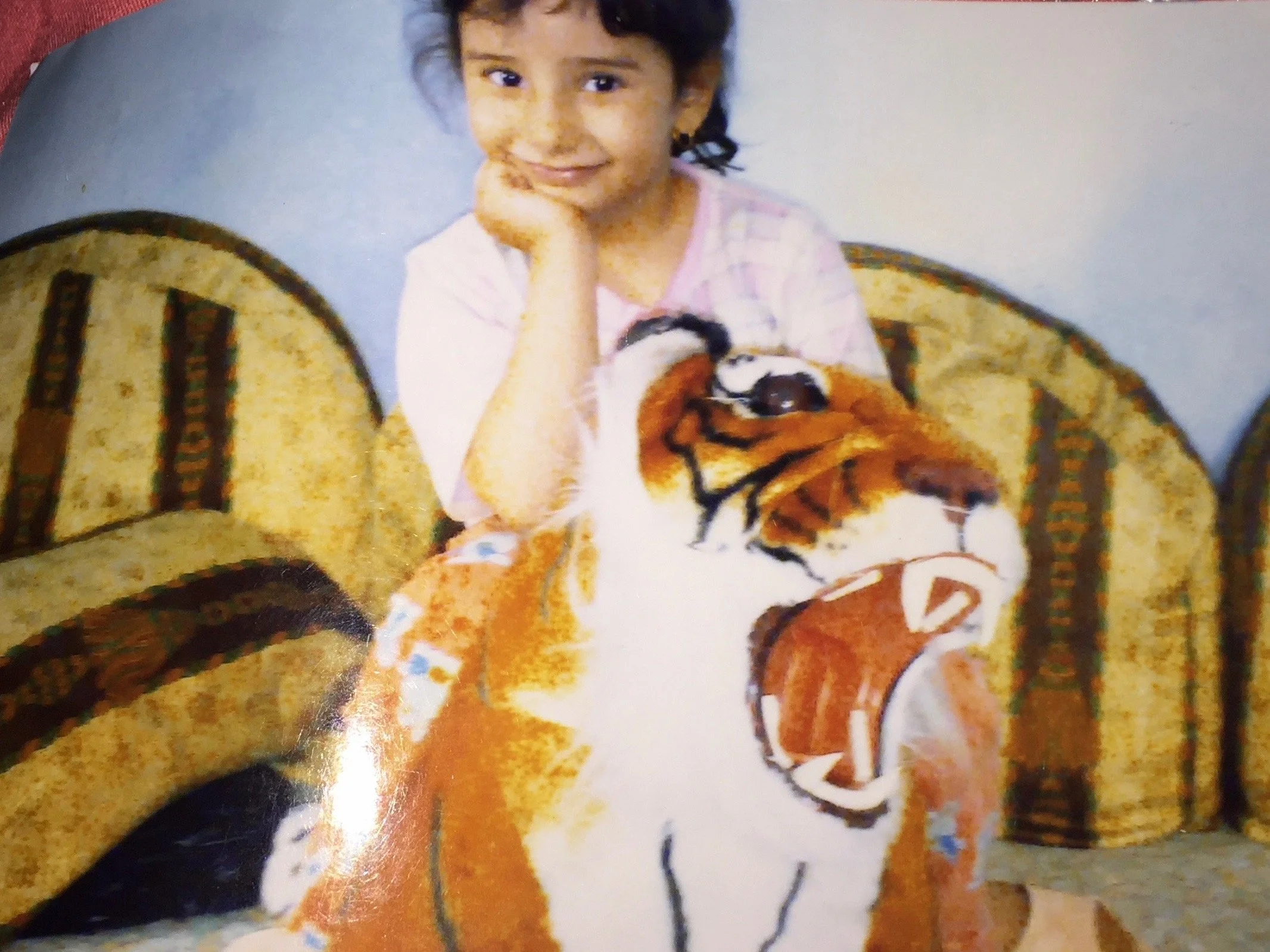
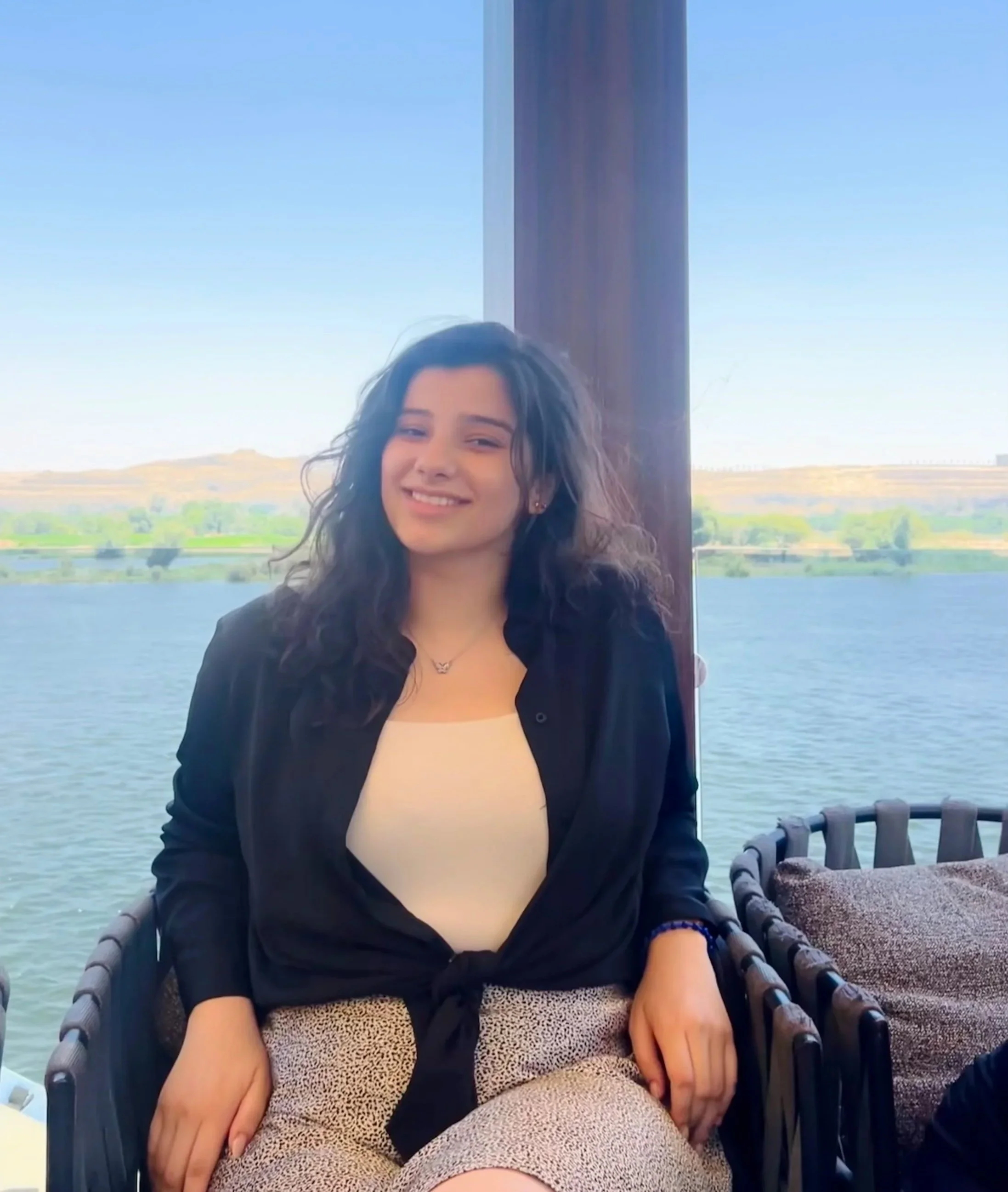
Above: Mariam Akraz as a child in Minya in 2007. Below: Akraz on a visit to Upper Egypt in 2023. Photos courtesy of Mariam Akraz
Mohamed Ghanem, 24, an Egyptian American born and raised in 6th of October City, Egypt, reached a similar understanding through his own research into Egyptian history. “We're not really African, we're not really Arab,” Ghanem says. There's everything in Egypt. There's black, white… We're pretty much our own thing.”
Ghanem distinguishes culture from ethnicity, arguing that Egyptians are culturally Arab, since Arabic dominates daily life and Arab culture has become part of Egyptian society. But that does not necessarily make Egyptians ethnic Arabs. “Ethnically, we're — it's kind of controversial to say — but we're pretty much Coptic,” he says.
A Muslim, Ghanem says many Christians in Egypt resist identifying as Arab because of the history of the Arab conquest, while many Egyptian Muslims identify as Arab because of the faith’s regional history and its basis in the Arabic language. Ghanem believes that Egyptians are commonly taught to understand themselves as Arab without sufficiently examining the country’s earlier history.
He also notes the widespread conflation of ‘Arab’ and ‘Muslim’ among both Egyptians and outsiders. “[In Egypt] we're many Muslims, so people here just think 'because we're Muslim, we're Arab,’” Ghanem says. “ A lot of foreigners [also] think any Muslim is automatically Arab.”
Scholarly Explorations of Identity
Historian Mirna Wasef has researched sectarianism in 20th-century Egypt, particularly the relationship between American missionaries, the Muslim Brotherhood, girls’ education and Coptic communities. Her research shows that Coptic identity extends beyond a single religious definition: Egyptian Protestant Christians and some liberal Muslims have also claimed it.
In a 2018 article, Wasef notes that claiming a Coptic rather than Arab identity can be understood as making oneself “more Indigenous,” with some people equating Coptic identity with being authentically Egyptian. She presents this as an important modern identity claim, while emphasizing that Coptic identity itself is plural and can be religious, ethnic or cultural. She also examines how the Coptic Orthodox Church’s narratives of surviving invasion and persecution since the seventh century have helped provide Christians with a framework for understanding discrimination in modern Egypt.
A 2007 study by researcher Phoebe Farag, a member of the National Council of Churches’ Justice for Women Working Group, found that Egyptians in the diaspora were divided over whether they identified as Arab. Those who accepted the term commonly connected it to shared Arabic language, culture, history, food and music, while others rejected it because of its religious associations or because they saw Egyptian identity as more specific.
Farag ultimately describes “Arab” as a geopolitical and linguistic designation rather than inherently a religious or ethnic one, noting its use across the Middle East and North Africa. Her respondents likewise used Coptic, Egyptian, Christian, American and North African identities in different combinations, demonstrating that these categories can overlap rather than function as mutually exclusive identities.
An Identity of Many Parts
Fathy Elhadidy was born in Egypt and moved to the United States at nine years old, and he describes a different experience. After spending most of his life in Northeast Philadelphia, he moved to South Philadelphia and became a co-founder of Egyptian Heritage, an organization that brings together Philadelphia-area Egyptians. Unlike Ghanem, Elhadidy does not see Egyptian, Arab, African and Middle Eastern identities as competing categories. “If anybody asks me what I am, I'm just Egyptian,” he says. “And any part of Egypt is within every Egyptian.”
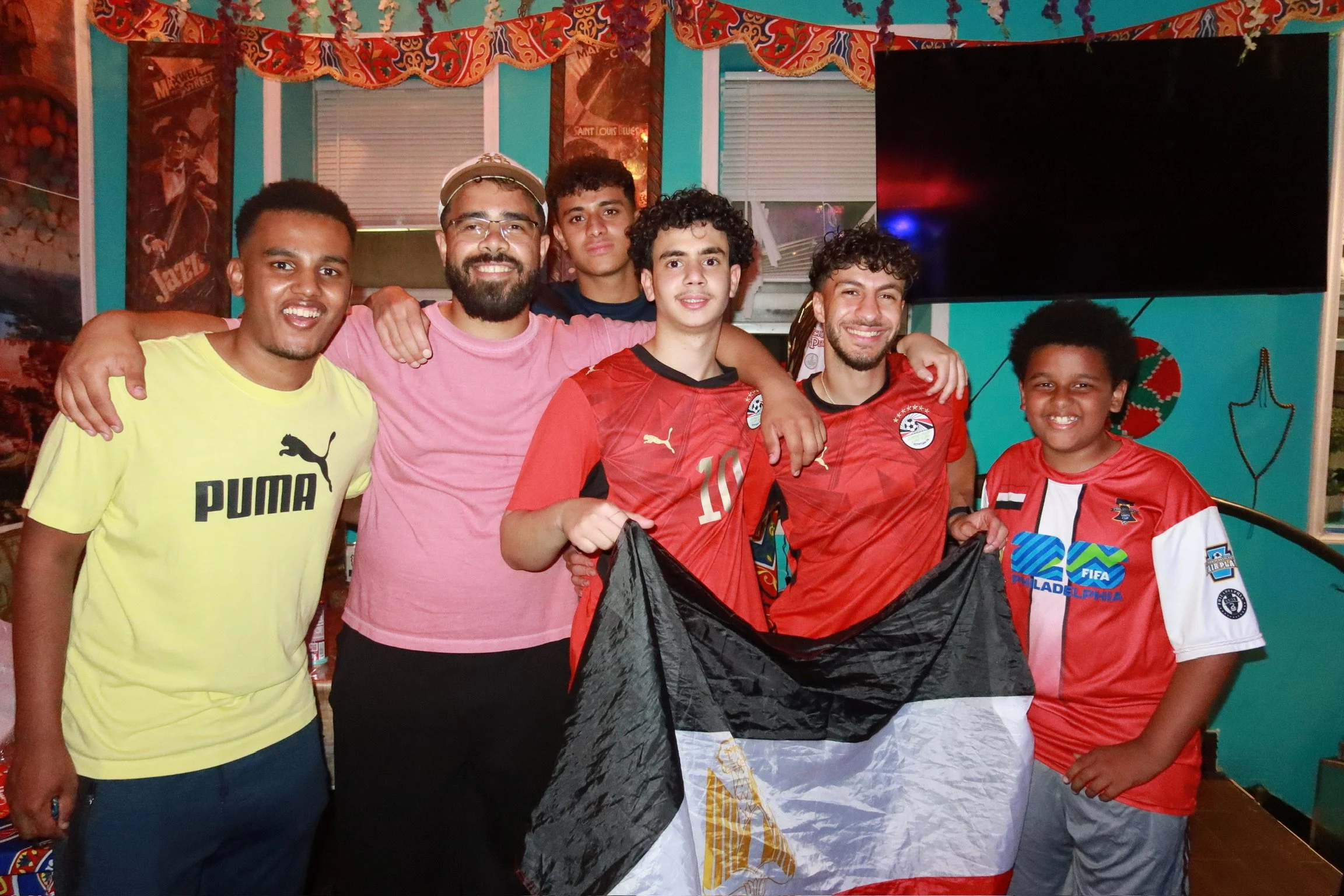
Fathy Elhadidy, second from left, attends the first Egyptian Heritage watch party during the FIFA World Cup in July, when Egypt defeats New Zealand 3-1. Photo courtesy of Fathy Elhadidy.
Representation in the media adds another layer; the way Egyptians are portrayed can influence how Egyptian heritage and identity are understood by people within and outside the community. According to Akraz, social media has made conversations about Egyptian history, Coptic identity and the question of whether Egyptians are Arab more visible than they were when she was younger. She says that increased visibility can give people access to histories and perspectives they may not have otherwise encountered, encouraging them to investigate their own backgrounds. But those conversations can also become contentious, she adds, resulting in bullying and discrimination.
Ghanem points to Netflix’s “Queen Cleopatra” as an example of how such disagreements can extend into mainstream entertainment. The 2023 docudrama, which starred British Jamaican actor Adele James as Cleopatra, prompted intense debate in Egypt over how the ancient queen — and Egyptian history in general — were being represented. Critics questioned the historical interpretation of Cleopatra’s ancestry, while the wider controversy also became entangled with contemporary debates about race and the appearance of ancient Egyptians.
Elhadidy has a different criticism: Egyptian stories are often reduced to pyramids, mummies and ancient history. “We're a lot more than that — the Egyptian culture, the Egyptian people,” he says. For him, the focus is not that Egyptians have too many ways of understanding themselves, but that those possibilities are narrowed when people rely on one-dimensional depictions of Egypt.
“I just feel like people should be open to the new possibilities and not [limit] themselves to what they see in the media or how one or two Egyptians portray what it is to be Egyptian,” he says.
***
Gawhara Abou-eid is an Egyptian-American researcher and journalist from Lewisburg, PA and an Al-Bustan News media fellow. They hold a BA in International Relations from The George Washington University, with a concentration in International Security Policy. Gawhara has published research for the League of Arab States in Cairo, and their journalism has appeared in The Standard Journal and The News-Item.

Al-Bustan News is made possible by the People’s Media Fund.