
Soccer Fans Find Community and Solidarity at Club World Cup Games in Philadelphia
By Ragad Ahmad
July 31, 2025
A love of soccer runs deep in Arab cultures. More than entertainment, it's a language of identity, community and resistance. And for Palestinian-Americans in Philadelphia, this summer's FIFA Club World Cup offered a glimpse of what the sports world could look like as Lincoln Financial Field was transformed into an unexpected space for cultural celebration and political solidarity.
Adam Matari, a 29-year-old business owner, attended eight tournament games. "I never thought I would experience Philly hosting a Club World Cup in my lifetime," he said, noting that the tournament's timing coincided with heightened awareness about the situation in Palestine.
Matari’s involvement in the sport spans personal passion and professional expertise. Having grown up playing for his hometown team in Montville, New Jersey and Temple University’s club team, he later worked for FC Barcelona in operations and recruitment. "[Soccer] has been an expression of freedom and an escape from the world since I was 6 years old," he said.
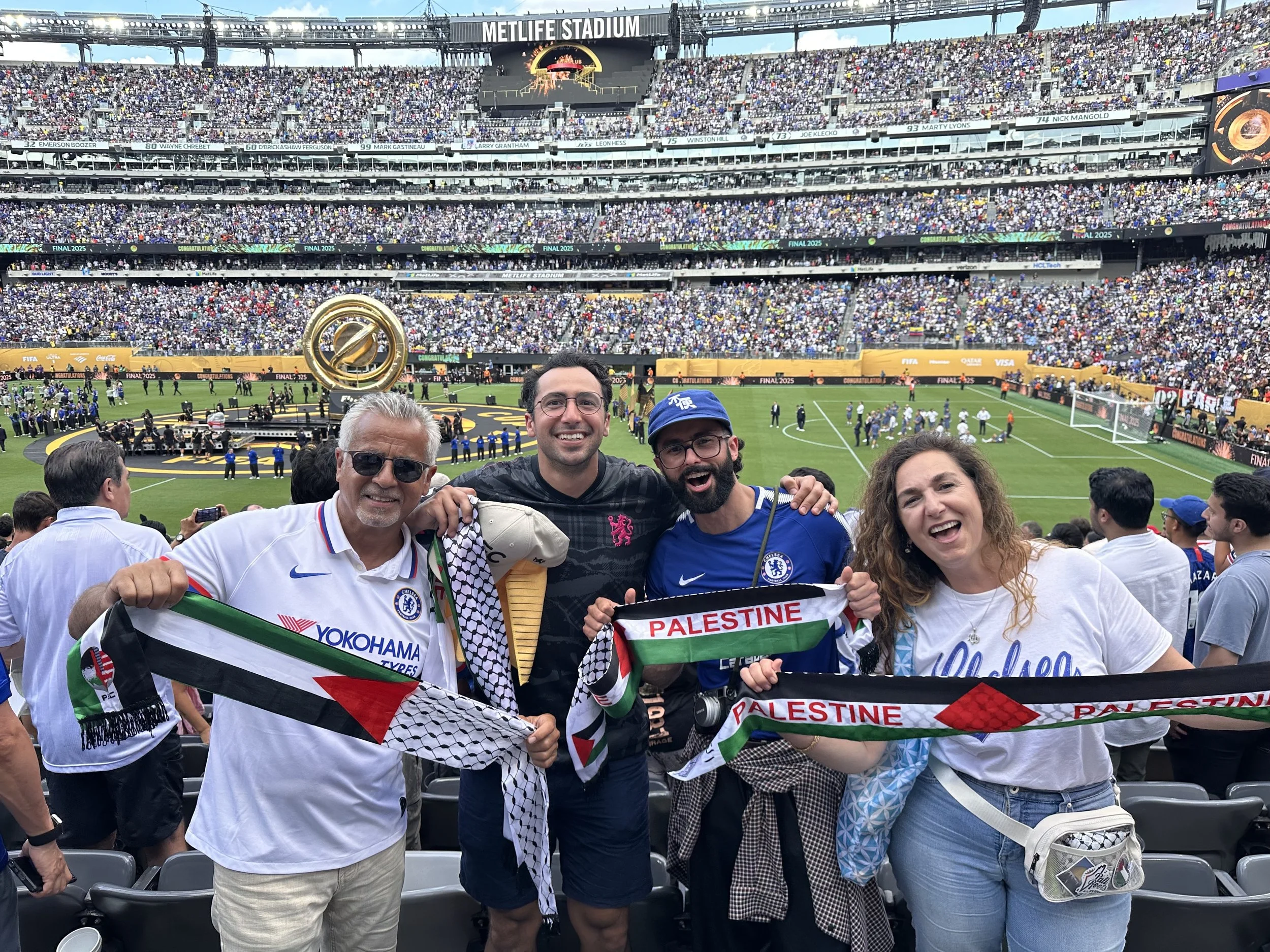
Adam Matari, second from left, and his family at a 2025 Club World Cup game in Philadelphia. Photo courtesy of Adam Matari
Athletic trainer Natalie Abulhawa, 28, feels a similar cultural connection to the sport. Born and raised in Philadelphia, she started playing soccer at age 3 and went on to represent Palestine's national team as a midfielder between 2014 and 2017—a rare achievement that connected her to the broader Arab soccer tradition. "Soccer has always been one of the biggest parts of my identity as a Palestinian," she said.
Yet despite its central role in Palestinian culture, meaningful representation in global sports remains frustratingly rare, and Palestinian athletes face particular challenges at every level. The Palestinian national team has never qualified for the World Cup despite the sport's immense popularity in both Palestine and the global diaspora. As Matari notes, the Israeli occupation prevents Palestinian athletes from participating in international tournaments. “Not everyone has the privilege to play,” he said.
Abulhawa recalls being forbidden by coaches to wave a Palestinian flag during her own games. For fans who rarely see their culture celebrated in mainstream sporting venues, moments of visibility are even more precious. So when Arab teams took to the field in Philadelphia during the Club World Cup, the response was immediate and overwhelming.
"The stadium was full of Palestine flags," said Saif Kawash, a 39-year-old compliance officer who brought his young children to watch Italy’s Juventus play the Moroccan team Wydad. For local Palestinian fans accustomed to sports environments where their cultural symbols might be unwelcome or controversial, the visual impact was unprecedented.
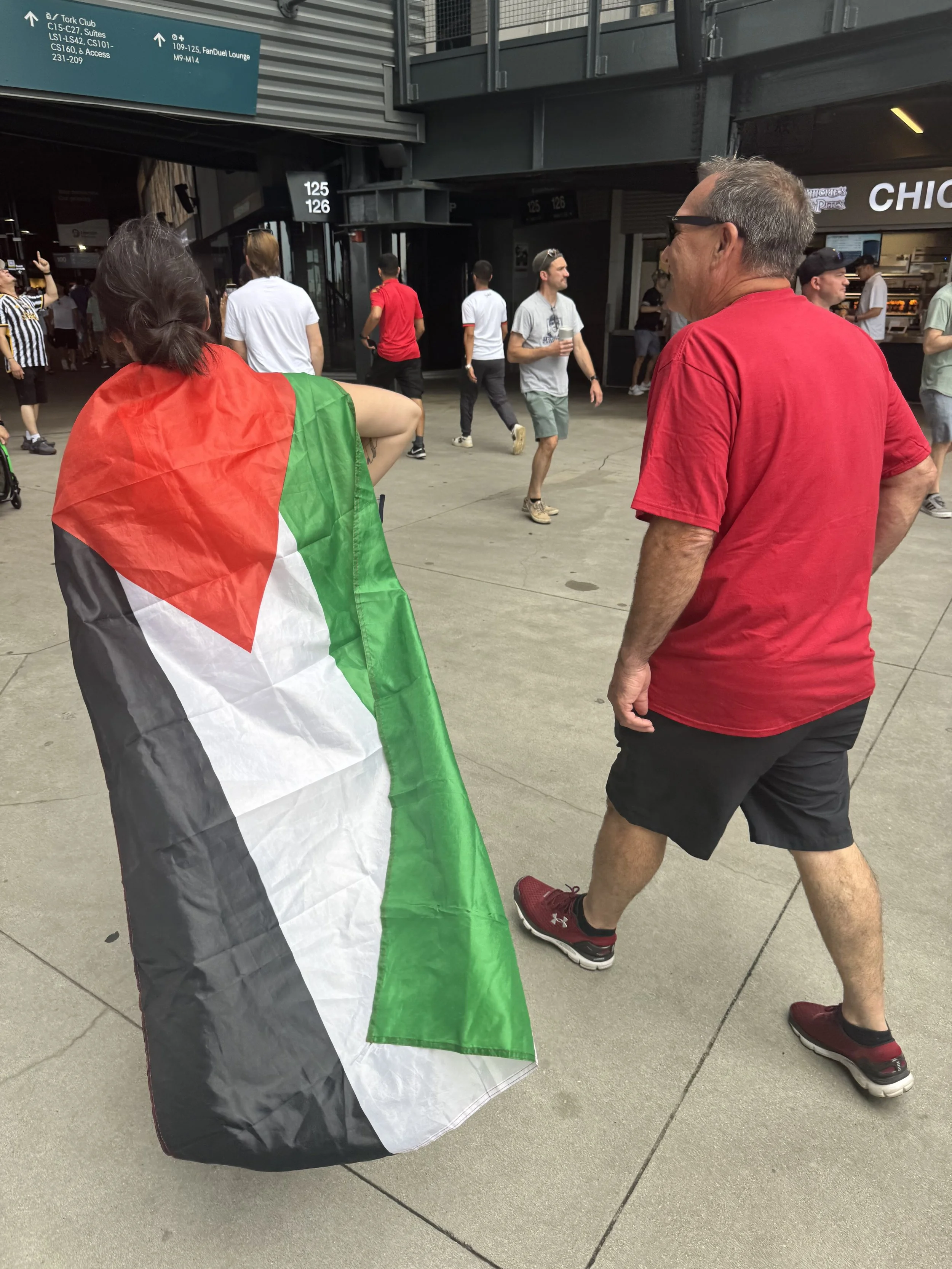
Natalie Abulhawa and her father make their way to a match at Lincoln Financial Field. Photo courtesy of Natalie Abulhawa
Abulhawa attended both Wydad matches and witnessed solidarity that transcended national team loyalties, such as a player on Saudi Arabia’s Al Hilal team wearing a Gaza wristband during one game. "And there was a Moroccan chant in support of Gaza that nearly brought me to tears," she said.
When Kawash’s father-in-law wore a Palestine jersey to a match, he was approached by many attendees wanting to take pictures with him. "The Arab fans were so proud and so hardcore," Kawash said. "It was completely different from all of the games I've seen."
Matari, too, found the rare experience of mainstream visibility without controversy powerful. "I felt seen for the first time," he said. He was particularly moved by the coordinated displays of Palestine solidarity. During Espérance Sportive de Tunis’s game against Chelsea, fans held up balloons in the colors of the Palestinian flag. For Matari, the importance of this display was heightened by the fact that it was witnessed by FIFA officials, who denied the Palestinian Football Association’s request to sanction the Israel Football association in light of the genocide in Gaza and discrimination against Palestinian players.
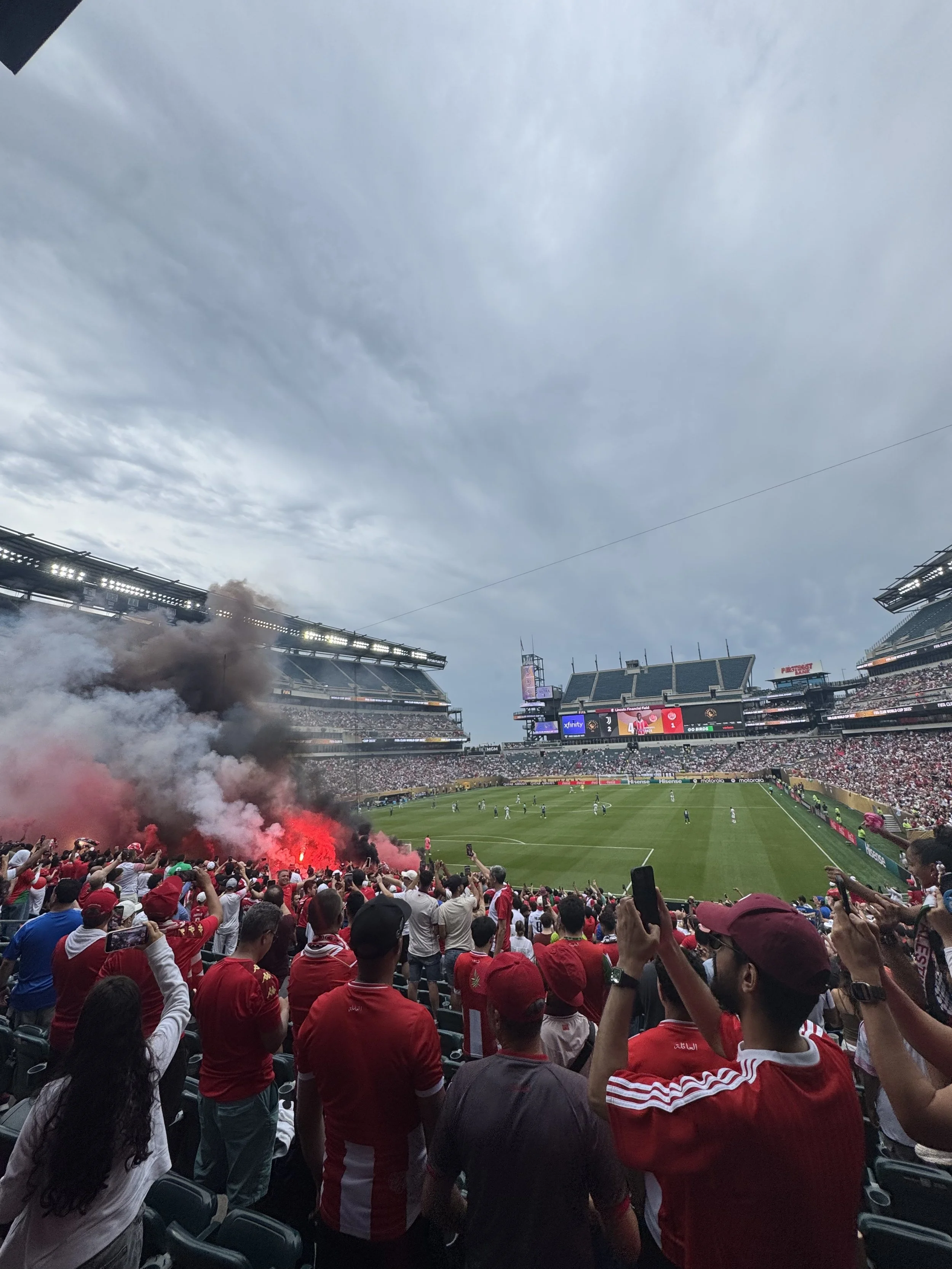
At the match between Juventus and Wydad, Abulhawa witnessed solidarity that transcended national team loyalties. Photo: Natalie Abulhawa
The tournament's effect on younger generations proved equally significant. Kawash's sons, 6 and 3, recognized the Palestinian flag and were excited to find symbols of their heritage being celebrated. "The kids were pointing out flags," Kawash said. "For them to be in such a welcoming environment was important for me."
Abulhawa wants to keep the momentum going. Inspired by a desire to sustain the intergenerational community connections formed during the tournament, she is considering organizing her own soccer tournament. “We have an opportunity to establish a MENA sports community that supports Palestine," she said.
And while the matches may be over, their impact continues to resonate. “Something special has been built here,” said Kawash, reflecting on the energy of his experience. “Next year’s actual World Cup will only be better, and the voice of Palestinian solidarity will only be louder.”
***
Ragad Ahmad is a Palestinian–American Muslim born and raised in Philadelphia. She currently studies Peace and Conflict Studies at Swarthmore College, where she explores issues of decolonization and climate justice.