
Why Mental Health Can Feel Like a Luxury for SWANA Immigrants
By Elissa Odeh
July 10, 2025
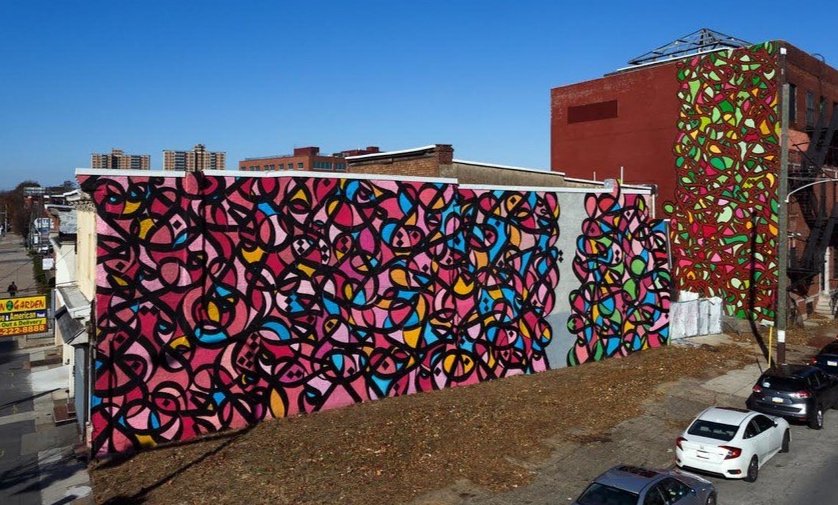
“Soul of the Black Bottom,” a mural in West Philadelphia created by French–Tunisian artist eL Seed in 2017. Photo courtesy of Al-Bustan Seeds of Culture
When Georgina left Egypt at 18 with her mother and siblings, she imagined “living the American Dream” by going to college and pursuing her newfound freedom. Instead, with her father still in Egypt, she found herself grappling with a foreign system entirely on her own. She put her education on hold and became the backbone of her family—handling everything from immigration paperwork and job searches to translating at doctors’ appointments.
“I found myself in a position of responsibility where my family relied on me for almost everything,” says Georgina, who asked that her last name be withheld to protect her family’s immigration status. “My life became all about work. I had no time for anything else.”
Georgina’s experience reflects the reality faced by many SWANA (Southwest Asian and North African) refugees and immigrants throughout the Philadelphia area for whom mental health can feel like a luxury, overshadowed by the urgent daily struggle of adapting to the demands of life in the U.S.
“Immigrants are often so focused on survival that taking care of one’s emotional well-being seems like an unattainable privilege,” says Philadelphia-based psychotherapist Yusra Aziz, whose parents immigrated to Northeast Philly in the 1980s from Iraq and Morocco.
Through her work with SWANA immigrants and refugees, Aziz has noted a deep grief in her clients that is exacerbated by the weight of displacement, disconnection and constant uncertainty. “Aside from just trying to survive,” she says, “you’re also dealing with culture shock, the expectations of living in America, language barriers and isolation. All of it only delays the healing process.”
Children of immigrants often shoulder these pressures as they go through what Aziz describes as ‘adultification,’ in which a child takes on the responsibilities of an adult. “Children are making doctors’ appointments, handling legal documents and helping their parents navigate a society that they themselves still do not fully understand,” she says, recalling accompanying her grandmother to the doctor so she could translate. “At the same time, they’re learning how to live multiple lives and trying to fit into a culture that doesn’t fully accept them.”
For SWANA children trying to blend in with their American peers, their identity can feel like a hurdle, and they learn what parts of themselves to conceal to avoid shame and exclusion. Aziz notes that many begin alternating between different masks to escape being perceived as the ‘other’.
Palestinian-Jordanian immigrant Rawan Haddadin sees this struggle playing out in her own household in Doylestown, a predominantly white community 40 miles north of Philadelphia. “I always feel this guilt toward my children because they have to deal with two different worlds,” she says. “It’s a struggle for them to fit in, because life at home doesn’t look like life outside, when they’re at school or hanging out with their friends, and no one really understands that.”
To avoid bullying and social exclusion, children of SWANA immigrants often abandon their cultural roots. Iranian-American therapist Sanaz Yaghmai, who practices in Philadelphia with refugee and immigrant communities, describes this as a protective mechanism. “It’s not a consciously made choice to distance themselves from their culture,” she says. “It’s a survival tactic—a way to finally feel accepted.”
Georgina, who lives with her family in the small town of Hatfield about 30 miles north of Philadelphia, is still learning how to balance both worlds. She feels disconnected from the friends she left behind in Egypt, who cannot understand the challenge of starting over in a new country. At the same time, she struggles to relate to Americans because of cultural norms and traditions that set her apart. “You don’t know who you are anymore—you’re stuck in between,” she says. “You have to mold yourself into a new person just to learn how to exist in these completely different environments.”
After all, SWANA refugees and immigrants are trying to make a life in a society that has long held harmful stereotypes about them, reinforced by media portrayals depicting them as uncivilized, violent or uneducated. “It’s dehumanizing,” says Yaghmai, adding that such narratives discourage refugees and immigrants from seeking mental health support, as they fear that their struggles—with anger, domestic abuse and other kinds of violence—will be perceived as confirming Western assumptions about their communities.
"SWANA immigrants are always trying to control how they are perceived,” Aziz says. “We cannot seem too angry or too passionate. We cannot take up too much space, because the media already paints us as backward, primitive and somehow less-than-human. That’s why many of us struggle to open up to Western therapists.”
Language also creates a significant barrier. Many immigrants and refugees arrive with a solid grasp of written English but find it difficult to speak comfortably, especially when discussing something as personal as emotional health. And while many institutions offer interpreters, Yaghmai says that translation alone often falls short. “An interpreter might not have the right words to express the emotion behind what’s being said. So much meaning can get lost.”
And immigrants may carry the emotional weight of generational trauma, displacement and political turmoil in their places of origin. Many find it hard to detach from the ongoing crises unfolding in their home countries, Aziz says. They often feel guilty for leaving to seek a better life, which they see as abandoning the people they left behind—"as if the survival of their people back home is tied to their own endurance and resilience.”
This mindset is deeply rooted in the collectivist values shared by many SWANA cultures, in which the needs of the group come before those of the individual. According to Aziz, an individual may feel ‘absurd’ for seeking help for their private emotional pain over the pain of their families and the societies they left behind. And then there is the stigma within these communities against emotional vulnerability, which is seen as shameful. “It is a common belief that ‘you don’t air your dirty laundry,’” Yaghmai says. As a result, individuals can fall into a cycle of silence, suppressing unprocessed wounds to avoid shame and judgment.
Haddadin has seen firsthand how SWANA cultures discourage the sharing of painful emotions. “Our societies do not teach us how to validate feelings,” she says. “We are either defensive or avoidant.” She now confronts those culturally inherited patterns with her children. “My daughter tells me that I’m not understanding her—and she is usually right. We do not know how to deal with our children’s emotions because no one ever dealt with ours.”
Yaghmai and Aziz both see the need for new conversations about mental health that address deeply rooted generational and cultural habits. Healing is a long and complex process and, as Yaghmai notes, it doesn’t always begin in a therapy room.
“One thing I’ve learned over the course of my career is that we need to step away from Western modalities when working with immigrant mental health,” she says. “The most powerful, long-lasting transformations often happen in shared spaces, when healing takes place in community.”
Some professionals are creating safe spaces for refugees and immigrants to express their emotions and be met with understanding and empathy. Yaghmai has organized trauma-informed yoga group sessions for refugee communities in Philadelphia, offering healing through movement, communal storytelling and reflection.
“What all immigrants want is a witness to our stories, someone who will listen and get it,” says Aziz. Through her private practice, Our Healing Vision Counseling and Consultation LLC, she connects with clients through shared experiences of displacement, adaptation and identity. She also founded the SWANA Therapist Collective, an initiative aimed at increasing visibility and connection among SWANA therapists across the country.
For Georgina, her Egyptian Coptic church community in Hatfield has provided her a space where she no longer feels alone. Having graduated this year with a bachelor’s degree in early education, she hopes to become a teacher whose classroom helps immigrant children feel safe, welcomed and proud of who they are.
But safe spaces alone are not enough, says Aziz. They must be paired with access to resources and programs for immigrants and refugees acclimating to life in Philadelphia. “Mental health is nothing without the basics,” she says. “I cannot tell someone to heal their trauma if they’re struggling to put food on their table.”
For displaced populations, emotional healing depends heavily on access to essential resources, such as housing, employment, healthcare, legal and language services. While support programs exist—including HIAS Pennsylvania, which provides legal and social services to more than 4,000 low-income and vulnerable immigrants annually, and the Nationalities Service Center, which helps with employment, education, and healthcare—access remains limited due to ongoing funding and capacity challenges. Additionally, many SWANA immigrants are simply unaware that these services exist. There is an urgent need, Yaghmai says, for better outreach efforts to connect newcomers with the support available to them.
Without increased awareness, funding and cultural understanding, mental health care remains out of reach for many in SWANA diasporas, who develop resilience out of necessity. “Immigrants have no choice but to be strong,” says Georgina. “They leave everything behind and start over from nothing just for the chance to provide their families with a better future. They are true heroes.”
***
Elissa Odeh is a Palestinian journalist from Lansdale, PA. She graduated from West Chester University with a BA in media and culture and a minor in journalism. Her work has been published in Lehigh Daily, Daily Local, and the New Orleans Review.