
The Hyphen Never Sits Still
By Gawhara Abou-eid
August 21, 2026
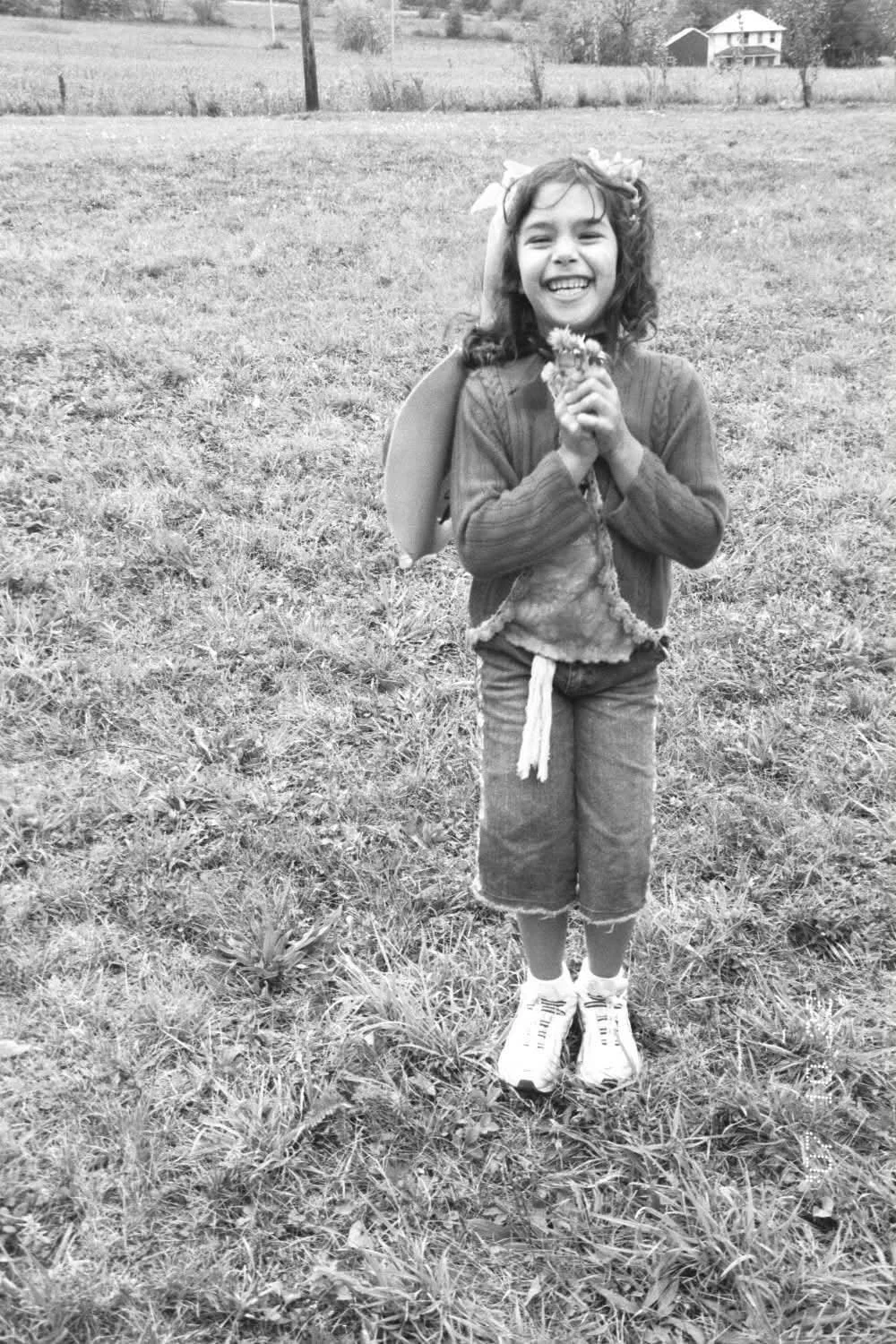
The author, age 7, plays in a field in Catawissa, Pennsylvania. All photos courtesy of Gawhara Abou-eid
My last name is Abou-eid.
“Father of the feast,” I would tell my classmates when they asked what it meant. It was the easiest answer, an expedient translation. The real story was less certain — perhaps it came from a Syrian paternal ancestor who was the father of a child named Eid? Perhaps “Eid” was meant to be interpreted as its root, “awda,” or return? I don’t know.
What I do know is that my seven younger siblings carry the same last name without the hyphen. When I asked my parents why, they told me it didn’t matter how many times they broke it down for people. No one could get close to pronouncing it correctly, and the systems meant to record it often couldn’t accommodate the hyphen. So, eventually, they left it behind. The name grew more Westernized, softened and reshaped for the mouths of those saying it. My first name means “jewel” in Arabic. But untethered from its mother tongue, it felt less like one.
I understood. I gave my neighbors in Iowa, and later rural Pennsylvania, the benefit of the doubt, of course. How could they pronounce it? It belongs to a language they had never heard, one whose sounds they couldn’t make. As I got older, I realized I had changed my last name so that it could better suit their tongues. More often than not, no one even tried to pronounce it. They turned it into jokes, nicknames, abbreviations. And if you were an Arab kid growing up in rural America, you took it. You laughed.
You laughed at the 9/11 jokes too. The bombing jokes. You became best friends with the people who made them because sometimes belonging meant learning how to laugh at the thing that made you different before someone else could laugh at it first. I was a Muslim kid with a visibly Arabic name. And to this day, I cannot bring myself to introduce it the way it is intended. I’m Gawhara Abou-eid. Ga-ha-ra. A-boo-eed. More hyphens.
“Which one do you like more — Egypt or America?” Teachers asked. Classmates asked. Family members asked. “Both,” I would say. “I feel like I belong to both.”
When I was younger, it was true. Before the age of 11, I spent the school year in Cairo and my summers in the United States. My mother worked endlessly throughout the school year with one singular purpose: to buy the tickets, to get us back on a plane, to make sure we maintained the language and the culture of her family, the language of her sacrifice.
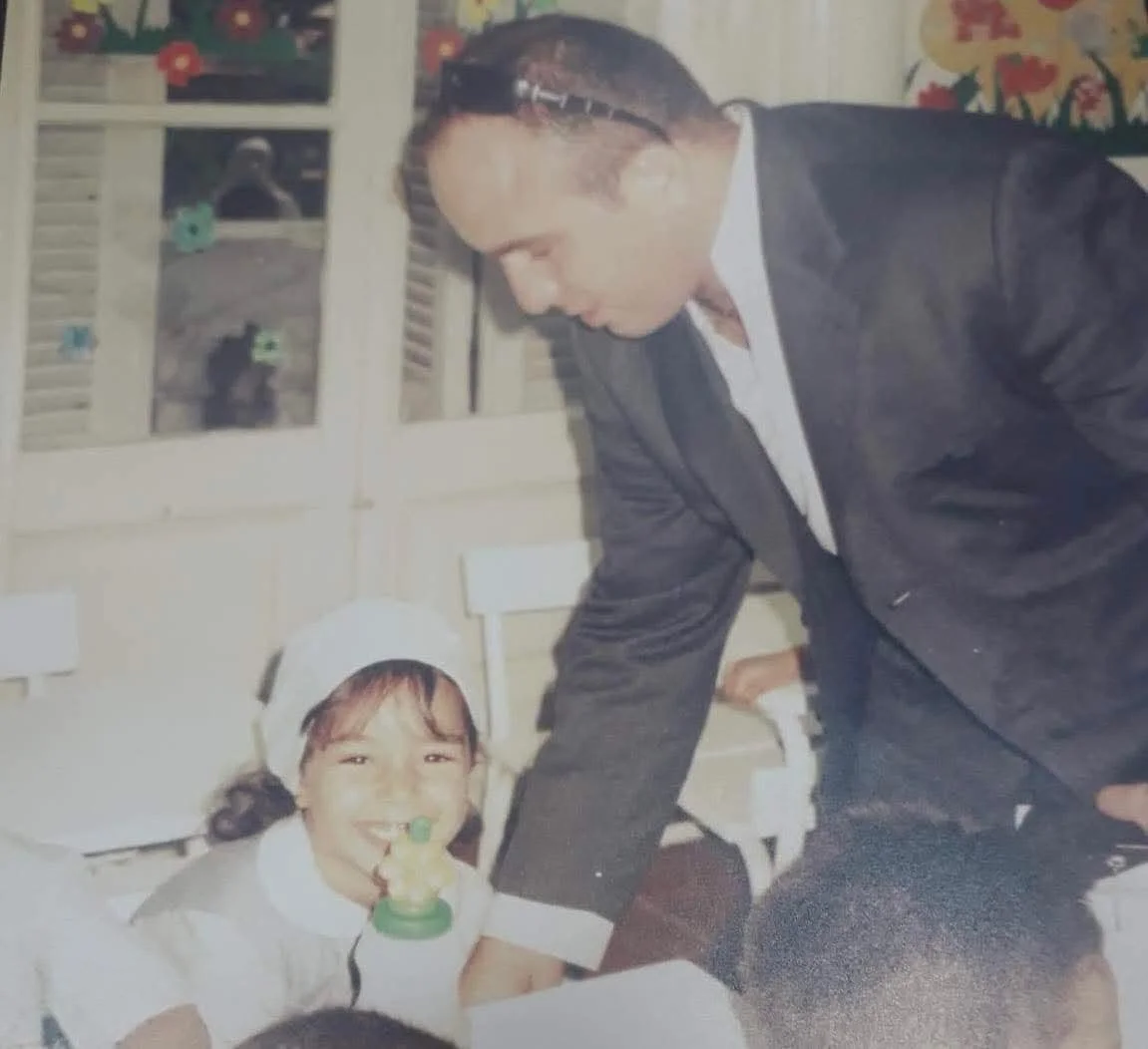
Gawhara, 4, poses with her father on her first day of kindergarten at Baby Home School in Zamalek, Egypt, in 2005.
My childhood was divided by airports. I knew the particular exhaustion of a long flight followed by the exhilaration of hearing Arabic, or English, everywhere. I knew that America was where I went to Head Start summer programming to maintain my English, and Egypt was where I went to school and remembered who I was supposed to be. Moving between the two countries, I carried small habits from one to the other without realizing until someone pointed them out.
During our Head Start days, my siblings and I would wet toilet paper before going to the bathroom because we were accustomed to using bidets. We washed our mouths with soap after eating. I covered my mouth when I yawned or laughed too hard because we were told the devil would pee in our mouths otherwise. (In truth, it was simply perceived as disrespectful). I said “close the lights” and “open the lights.” I brought fava beans for communal breakfast at summer daycare and was met with questions from the adults about how I could eat “that” in the morning.
None of these things were strange to me. They became strange when people looked at me like they were. When every mannerism you learn growing up — every phrase, gesture, habit, and instinct — becomes a source of attention and questioning, it doesn’t take long to become conscious of every move you make. Later on, and without realizing, I began to monitor myself. How I spoke. How I dressed. How loudly I laughed. Whether I was being too American. Whether I was being too Egyptian.
Even my memories seemed to require translation. I started to forget what it was like to not be friends with my principal and teachers. In Egypt, we started our days chanting the national anthem and songs in identical and precisely fitted uniforms and perfectly straight lines, waiting for our principal to enter as ceremoniously as a royal. Even in preschool, we had a daily chant for our principal: “Goodbye, goodbye, goodbye, Auntie Nazek.”
We were taught unquestioned respect for elders. We played outside without being watched, grabbed snacks at the koshk — a small, roadside kiosk selling all the essentials for everyday life — with our friends, and grew up with customs that felt completely ordinary until they crossed an ocean. I didn't understand yet that I was learning how to belong to two places. I only knew that each had rules the other did not.
Then the Arab Spring happened.
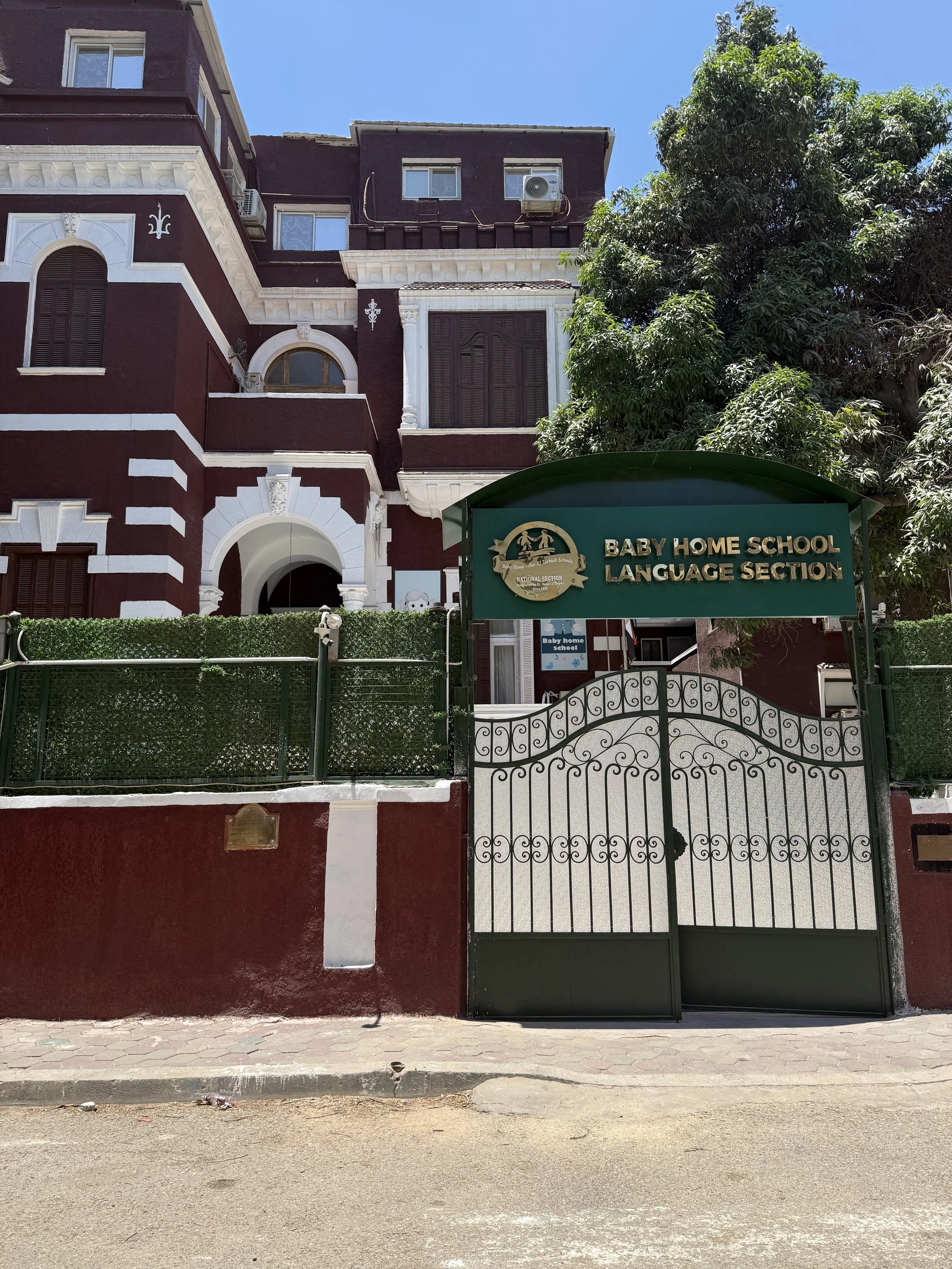
Baby Home National Middle School in Zamalek, Egypt
I used to be the kid who brought cupcakes for my summer school classmates in Pennsylvania, and then I would wish them goodbye and not see them again until the next summer. That was my normal. When the world around us changed, so did our ability to move through it. My family began spending more school years in the U.S. Time spent at home grew shorter. The balance tipped gradually until Egypt, which had once been half of my life, became somewhere I was increasingly visiting rather than living.
I also started losing my language. Not all at once. I could still speak, read and write Arabic. I could still understand it. But I began struggling to express more complicated thoughts and feelings. I missed the slang. I searched for words. I could hear the difference between the Arabic I spoke and the Arabic spoken by those who had never left.
During my freshman year of high school, I attended an American school in Cairo. I thought returning would make things easier. Instead, I learned how quickly belonging can become conditional. In a school of fewer than forty students, there was nowhere to disappear. I was bullied for standing up for other kids, for being too quiet, and for refusing the version of teenage life my classmates expected from me. I didn’t drink. I didn’t date. They thought I would be more “Americanized.”
I couldn’t help but note the irony. My parents had worried that America would encourage all the sins they wanted to protect us from. Instead, it was my Egyptian peers who judged me for refusing those things. I had spent years imagining Egypt as the place where I would automatically fit, mistaken familiarity for belonging.
Eventually, my sister and I returned to the U.S. I adjusted to a different set of expectations and learned to take pride in being responsible, faithful, and dependable. But underneath that was a simpler truth: I was envious of the freedom other kids seemed to have, and I still wasn’t sure where I belonged.
“For a long time, I thought that was simply what diaspora meant: belonging to two places without completely belonging to either. ”
By then, I was also learning what it meant to be the eldest of eight. There is a particular kind of pressure in always being expected to set an example. I had been the highest-achieving student in my grade in Egypt, but at some point that achievement stopped being like something I was proud of and more like something I owed people. I became afraid of small mistakes. A bad grade could feel larger than it was. I was supposed to be the first-generation success story: the daughter of immigrants who worked hard, got good grades and made every sacrifice worth it. I was very good at being that person.
Until I wasn't. I burned out, and for the first time, I began to question how much of my life had been built around being who I thought I was supposed to be. I came to terms with my sexuality, my gender, and my own opinions of the world around me. I started to understand that some of what I had called responsibility was really fear: fear of disappointing my family, of disrupting the balance I had spent years protecting, of letting people see parts of me I had learned to keep separate.
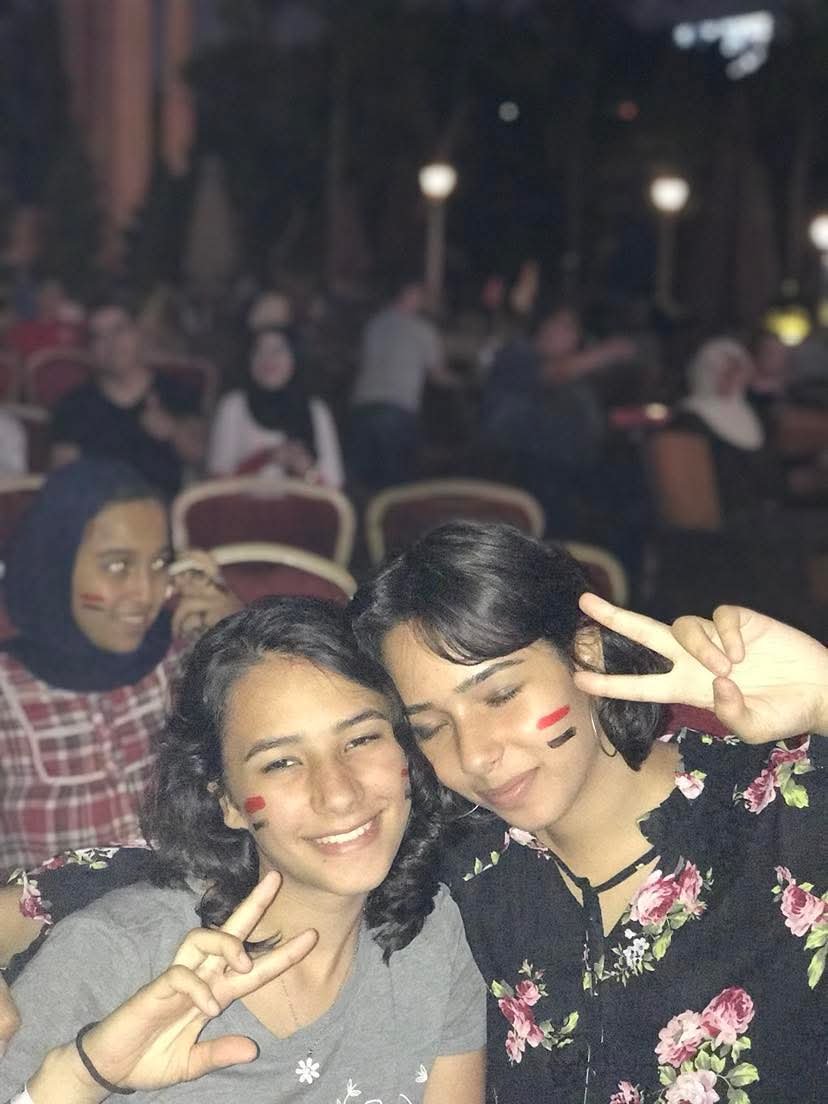
Gawhara watches a World Cup match with family at the Gezira Police Club in Zamalek, Egypt, age 17.
To be part of a diaspora is to become an actor from a young age. You learn which parts of yourself belong in which room. You tell one side only a small portion of who you are. You hide another portion from the other side. You learn to deflect. You learn to leave things unsaid — not because you want to deceive the people you love, but because honesty can have consequences. I act to this day.
In Egypt, my father left an established career in the secret service and a life he knew to stay with us in the U.S. My mom left behind years of being an English teacher. Approaching fifty, my parents’ credentials and experience had yet to translate cleanly into the country they had moved to. My father, a history and law graduate in Egypt, was so knowledgeable in history that he could have taught college-level courses. But because his English is not strong enough, and he obtained his degrees in another country, the work available to him has been limited to whatever could keep the family moving forward.
I have watched what immigration asks of people. And yet I have never been able to separate my love for my parents from the anger I sometimes feel toward the expectations they carried with them. That contradiction is part of my inheritance, too.
For a long time, I thought that was simply what diaspora meant: belonging to two places without completely belonging to either. Egyptians are like this. Americans are like this. This is only accepted here. This would never be accepted there. It wasn’t until I was twenty-one that I realized I had done exactly what I had spent years being afraid of: I had turned people into categories. I had even confined Egyptians in my generation to my own hyphen: either you had been exposed to life outside Egypt and were “open-minded,” or you had never left and were therefore closed-minded. Either. Or.
But some of my closest friends now are Egyptian. They know me as I am: queer, nonbinary, loud, unconventional, opinionated and not particularly interested in traditional labels. They don't require me to make one part of myself smaller so another part can fit.
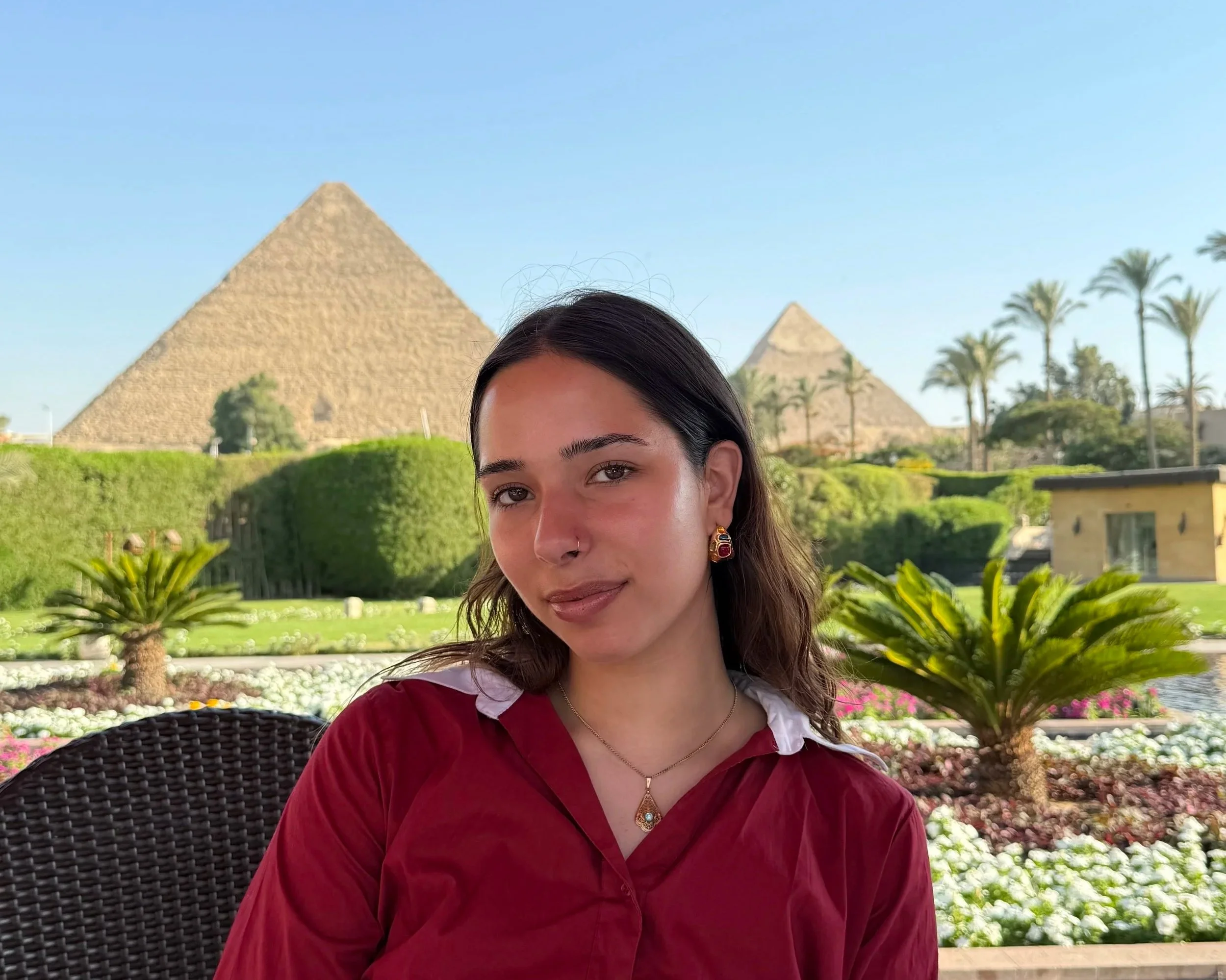
Gawhara Abou-Eid, 25, in front of the pyramids in Cairo, Egypt, in summer 2026
I don't need to pretend that America was always kind to me to acknowledge what it gave me. And I don't need to pretend that Egypt was always kind to me to love what it gave me. Egypt taught me generosity. The instinct to feed people before asking whether they're hungry. To fight over the bill because everyone wants to pay. To give what you have to the people you love.
But I no longer try to be the model Arab and Muslim, to serve as proof that my parents’ sacrifices were worth it. I can honor what my parents gave me without becoming the person they imagined. I can love my family without giving them every piece of myself. And I can belong without passing an exam first.
Maybe that is why the hyphen has always felt so important to me. I thought my job was to decide which side of it I belonged on. Now I think the hyphen was never asking me to choose. It was asking me to admit that I had become something neither word could fully contain.
I love being Egyptian. I love being American. I love being Muslim. I love being queer. I love who I have grown into. And I hate all of them in the same breath. Not because I hate these identities themselves, but because each one has, at some point, been used to tell me who I am supposed to be. I have spent so much of my life living as proof against a label that I sometimes forgot I did not need to be proof of anything. I’m just a kid who happened to be born in the U.S. to Egyptian immigrants who practice Islam. Happened to be raised in rural white Christian America.
I can carry contradiction without resolving it. I can be both. I can be neither. I can change. And maybe that is what the hyphen was trying to tell me all along. Not that I was divided. Not that I was incomplete. But that I was still moving. That I am still moving. The hyphen never sits still. Neither do I.
***
Gawhara Abou-eid is an Egyptian-American researcher and journalist from Lewisburg, PA and an Al-Bustan News media fellow. They hold a BA in International Relations from The George Washington University, with a concentration in International Security Policy. Gawhara has published research for the League of Arab States in Cairo, and their journalism has appeared in The Standard Journal and The News-Item.

Al-Bustan News is made possible by the People’s Media Fund.