
Art as Resistance | Vox Populi’s ‘Acts of Resistance’ Refuses to Look Away
By Lauren Abunassar
September 1, 2025
Art as Resistance is a monthly column by Lauren Abunassar, exploring the ways that MENA–SWANA artists and performers are defying erasure with socially engaged art.
***
At the heart of “Acts of Resistance,” a one-night performance series and fundraiser that took place on August 16 at contemporary art space and gallery Vox Populi, was the notion that art should reflect the world we live in.
The goal of the event, which featured live play readings, community discussions and an art market with local vendors, was to raise money for the United Nations Relief and Works Agency (UNRWA) and Gaza Soup Kitchen. Co-organizer and local theater artist Maddy Gillespie expected a decent turnout for the evening, and she was astonished to see tickets sell out. A waiting list to get into the theater performance slowly grew as the night went on.
The event was spread out amongst Vox’s gallery spaces and twisted hallways. In one room were lino prints of Palestinian flags, murals of Arab olive trees, small swatches of hand-embroidered tatreez. Meanwhile, the theater room was dedicated to the performance of submissions written for the event on the theme of surviving and resisting imperialism.
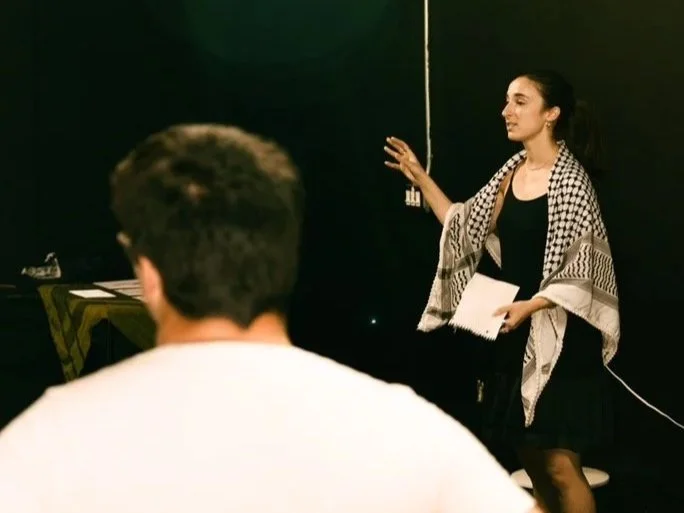
Maddy Gillespie is a Philadelphia-based theater artist originally from New Hampshire. She was inspired to co-host “Acts of Resistance” in an effort to spark discourse on the ongoing genocide in Gaza while also generating tangible financial support for aid organizations like UNRWA. Photo: Otha Hernández
Audience members were invited to not just listen to the readings but to pause between them, turn to each other and discuss guided questions offered by moderators. There were shared breathing exercises and somatic rituals—and resounding chants for Palestine’s liberation. Tickets sold, lino prints sold, even $3 cans of sparkling water at the theater entrance sold. Everything went directly into the virtual fundraising bucket.
The evening brought in over $4,400, exceeding Gillespie’s goal to raise $3,000 for Gaza. It’s a tangible success, but also a symbolic one: “I do think that artists have a responsibility to engage with and speak about the world that we are living in,” she said. “I ground myself in the connection to humanity that art gives us.”
For Gillespie, “Acts of Resistance” was born out of both a deep investment in this humanity and a frustration with its failures. She was angry that even with the ubiquity of the genocide’s livestreaming, so many theater communities in Philadelphia were not discussing it. If Palestine is on our phones, she wondered, should it not be on our stages?
“Thinking about all of the Palestinian-Americans and people in the diaspora who have sacrificed so much and actually lost their jobs for speaking out, and, being a white theater artist, I thought, ‘how can I not speak about this?’” she said.
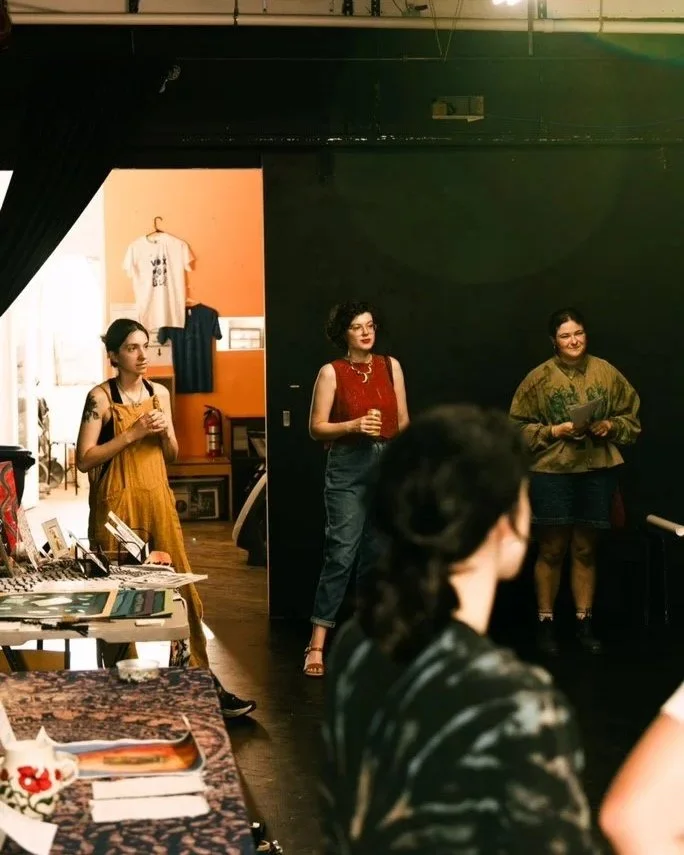
“Acts of Resistance” consisted of both performed readings and audience discussion, as well as an art market where attendees could purchase Palestine-inspired artwork. Photo: Otha Hernández
So Gillespie turned to a community of fellow artists to piece together the event, determined to offer tangible support for Gaza, rather than just ideas and rhetoric. Alongside co-organizers Otha Derek Hernández Peña and Leah Claire Borrie, both artists and theater workers, Gillespie brainstormed formats and a submission call for the evening.
She also turned to Palestinian writer-director Zaina Yasmin Dana, who, earlier this year, cast Gillespie in her reimagining of “Othello.” Dana’s adaptation, which sees the titular tragic hero of Shakespeare’s play as a Palestinian man who joins the IDF, was wildly successful, selling out every show. It was a reminder to Gillespie, who played Desdemona, that Philadelphians actually do want to see Palestine on stage.
Dana offered advice on fundraising logistics and what “Acts of Resistance” might look like. Dana’s brother, Qais Dana, who played Othello alongside Gillespie, soon joined the event as a performer. So did Mark Yowakim, a Syrian-American actor, singer and poet who traveled from New York for the event.
The network of support grew quickly and steadily. The response from the event organizers, as well as the audience itself, was a testament to the power of grassroots organizing.
“Bringing people together in community is a way to restore some of that hope and energy we are really struggling with,” said artist, writer and researcher Shebani Rao. Rao, who performed her piece “DEI Bitch,” said she has long gravitated towards the ability of storytelling to explore how one makes change while still embedded in inherently unjust structures.
“We move through the world telling ourselves stories. And I think art has the power to inform those stories or reshape them or build new ones. It’s essential [to resistance movements],” said Rao.
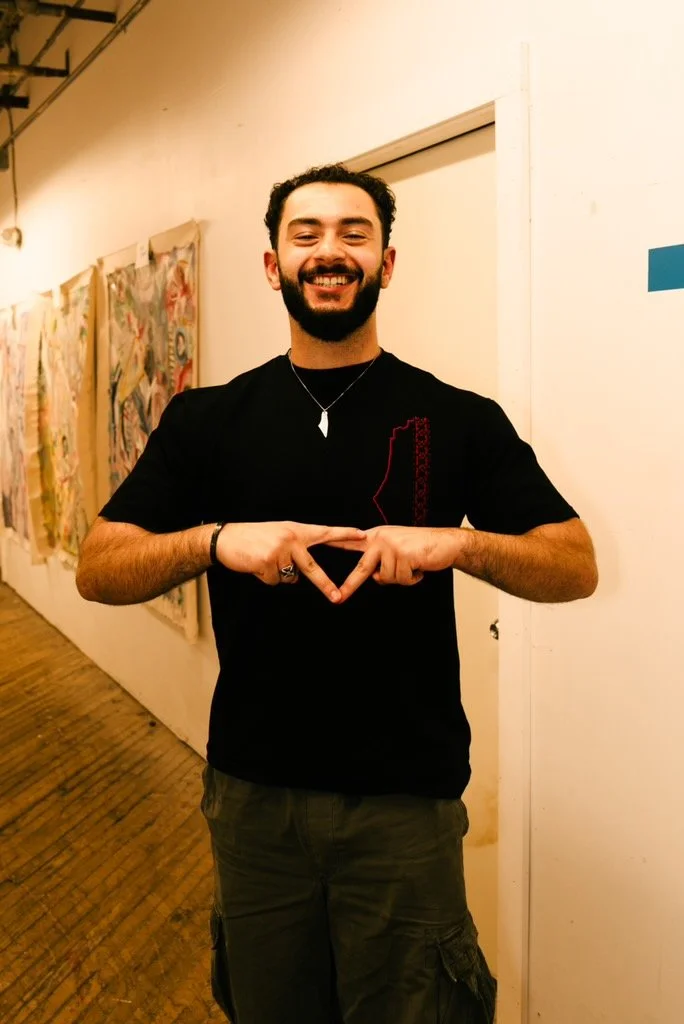
Qais Dana was a performer in “Acts of Resistance.” He starred alongside Gillespie as Othello in “Othello (vs. The Military Industrial Complex),” a Palestinian adaptation of Shakespeare’s play written and directed by his sister Zaina Yasmin Dana and staged in September 2024. Photo: Otha Hernández
It’s a sentiment echoed by poet Sanjana Bijlani, who prefaced a reading of her own work by giving audience members copies of the last will and testament of Anas al-Sharif, the 28-year-old Al Jazeera journalist killed in an Israeli strike on Gaza on August 10.
“When we choose to experience and engage with art, whether our own or others’, I feel that we’re able to tune into what is intentionally erased from our knowing,” Bijlani said. “We get to choose how we preserve the truth and how it reverberates within and through each of us. Art can offer a space of refusal and affirmation, to not lose our ability to care and to insist on our ability to hold each other accountable.”
At the same time, community gatherings like “Acts of Resistance” become a way, according to Bijlani, to reject the notion that our grief or our desires for freedom and witness are singular—an understanding that is a key piece of reclaiming agency.
For Egyptian-American playwright RFA (they/them) who contributed “The Boy and His Asafeer in the Square,” which takes place during the 2011 Egyptian Revolution in Tahrir Square, reclaiming this agency means understanding struggle as a collective endeavor. “The first protests I ever went to were one for Palestine and one for Egypt. I was four and seven,” they said. “I was raised between exiles, chants and a dream. Through it all, the dream never left.”
Reflecting on the way Egypt has been what RFA describes as “a pawn of the empire”—the nation’s recent $35 billion gas deal with Israel being one example—it felt important for them to contribute to “Acts of Resistance.”
“As an Egyptian who has seen my government and country display such hate towards Palestinians, I thought it was important [to offer this play] as a message that, no, my people are not for this,” RFA said. “My family has always been involved in the struggle in some form and has been impacted by it, impacted by this aggression. And so it was never a choice for me to be involved in resistance in a capacity. That’s where art came in: as an entry point.”
They are reminded, they said, of the way art can be used to create solidarity and encourage action.
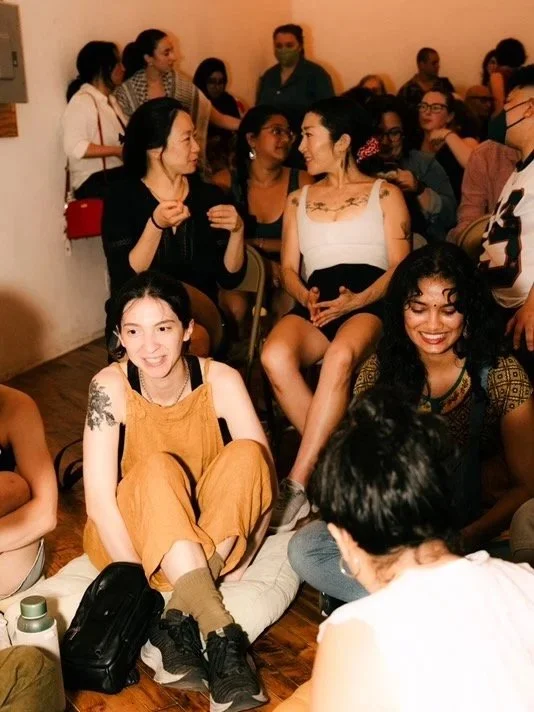
Between readings, audience members were encouraged to participate in discussion and somatic breathing exercises. Event organizers also led the audience in ‘Free Palestine’ chants. Photo: Otha Hernández
And indeed, what makes grassroots organizing and community-gathering like “Acts of Resistance” so essential is the way they draw attention to the importance of shared presence and the refusal to look away. It’s a stark contrast to the occasional silence of the art world that has so vexed community members like Maddy Gillespie. And it’s a reminder that art can serve as a locus of change.
Sanjana Biljani, like the evening’s other participants, embraces the ability of art to act as a powerful force. “I know that the opportunity to practice my writing in shared spaces allows me to hold myself accountable for how I choose to resist and maintain my connection to truths that exist beyond my own,” she said.
This understanding of intersectional activism and connection gets at the spirit not only of “Acts of Resistance” but of resistance itself. It suggests that art does not just reflect the world we live in. It insists that another one is possible.
***
Lauren Abunassar is a Palestinian-American writer, poet and journalist. Lauren holds an MFA from the Iowa Writers’ Workshop and an MA in journalism from NYU. Her first book, Coriolis, was published in 2023 as winner of the Etel Adnan Poetry Prize. She has been nominated for a National Magazine Award and is a 2025 NEA creative writing fellow.