Art as Resistance | Artist Naz Khoury Reimagines Glass as a Form of Archive and Memory
By Lauren Abunassar
November 3, 2025
What does it mean to explore memory, lineage and inheritance — or even destruction — through a medium as fragile as glass?
It’s a question at the heart of Lebanese-American artist Naz Khoury’s first solo show, “To Tie a Knot,” which recently concluded at Philadelphia’s Da Vinci Art Alliance. The exhibition featured a collection of Khoury’s work across mediums: a long fiber net sprawled across one of the gallery’s walls, an elaborate light sculpture was installed by the gallery window, revised photographs from Khoury’s family archive were positioned throughout the space. But it is Khoury’s glass sculptures that are perhaps the most notable, each one a monument to the act of preservation in a medium that is, by nature, fragile and impermanent.
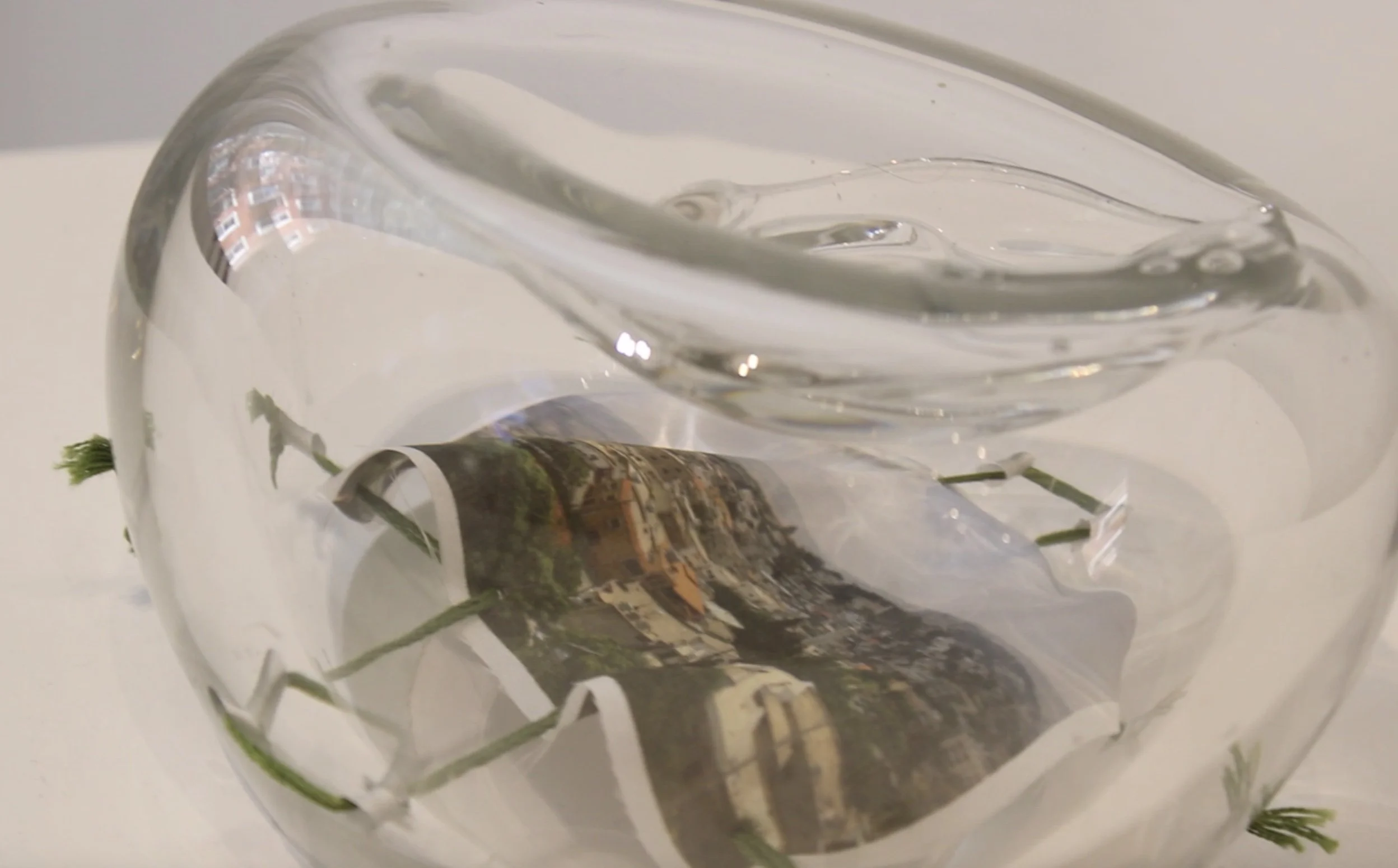
Several of Khoury’s glass sculptures in “To Tie a Knot” featured internally suspended family photographs held in place by thread. Above, a work from the series “To Hold A Memory Close,” 2024. Khoury described many of his artistic influences as rooted in his childhood visits to his family’s native Jbeil, Lebanon. Photo by Lauren Abunassar
“I think something that draws me to glass so much is that it is a very experience-based medium where the process itself is so captivating and exhilarating and fun, but also difficult,” Khoury said. “When you make the work, you're aware that there is a very large chance you're not going to get anything from it. Something may break, something may not exist at the end. But the process of making it is so special.”
Lately, Khoury has been centering the procedural in his artistic practice even more than the narrative or the conceptual. Though he finds himself deeply influenced by themes of nostalgia, his family roots in Jbeil, Lebanon, and drawing geographical connections between seemingly disparate locales, he is also interested in how these themes can be channeled more indirectly through a meditation on material history itself.
“Glass is a medium with a very large history that began in the Levant but is accredited to Rome, France, Finland and the American studio glass movement,” Khoury said. “So there's a lot of forgetting [about] the origins of glass… At the same time, the physical glass itself comes from silica mines, which are non-renewable resources. The United States has incredible silica from the mines of Appalachia, from Jersey, from all over the country. Mining is an environmentally destructive process… So glass, like the studio industry itself, falls into the same exploitative patterns of trade as everything else.”
It’s a heady complication that asked visitors to the exhibition to consider our own complicity in multiple forms of destruction — whether the environmental destruction and pillaging that has long riddled both the Arab world and Appalachian communities, or the colonial power that has recast the Syrian-invented craft of glassblowing as a European practice. This recasting is a consideration that Sarah Trad, the Lebanese–American curator of “To Tie a Knot,” was excited to see developing in early conversations about the exhibition.
“Growing up as an Arab kid in the American public school system, a lot of times the way that we teach history to Americans, especially around foreign affairs, is completely distorted,” Trad said. “And so it was always a big passion of mine to set the record straight.”
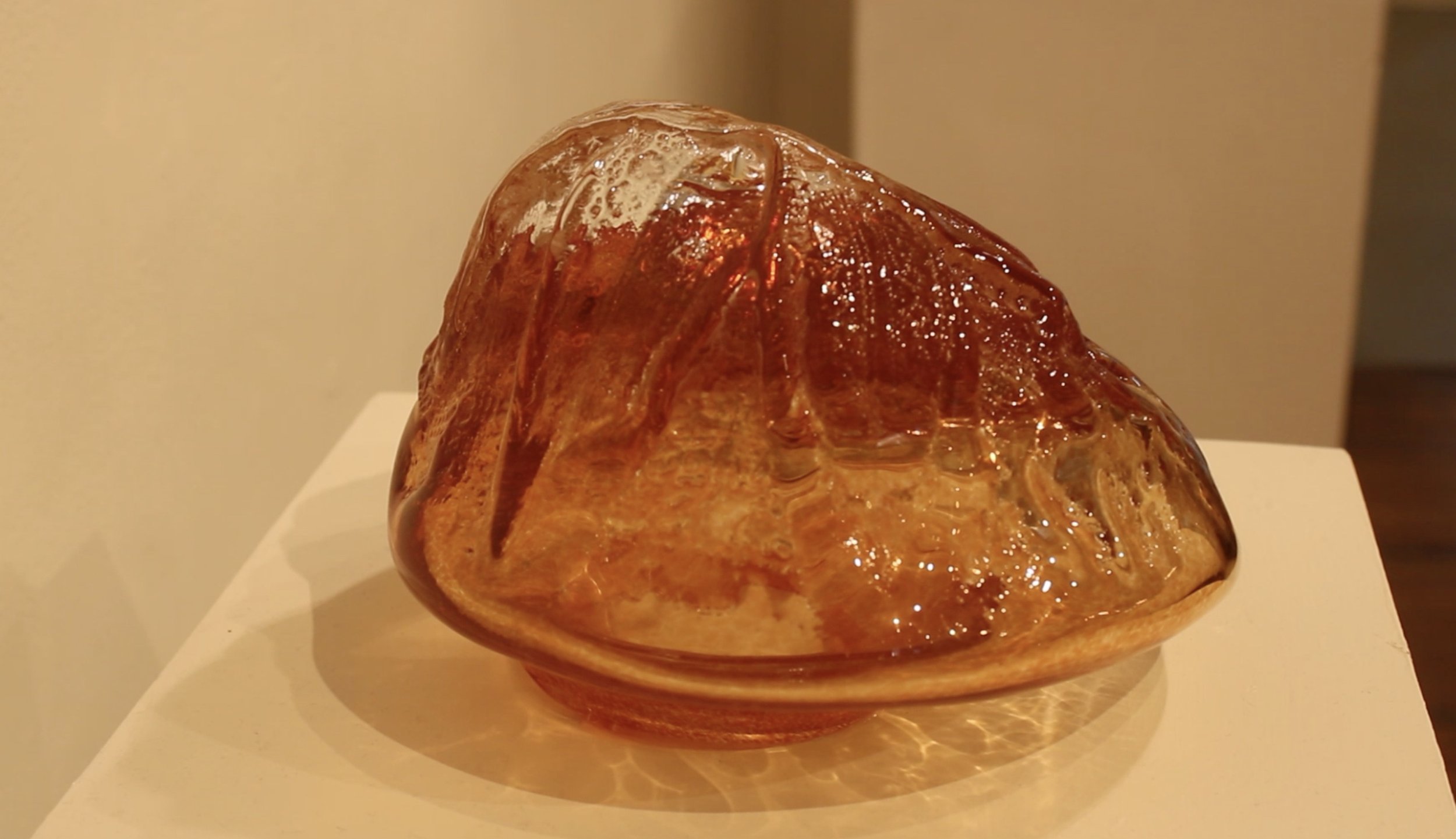
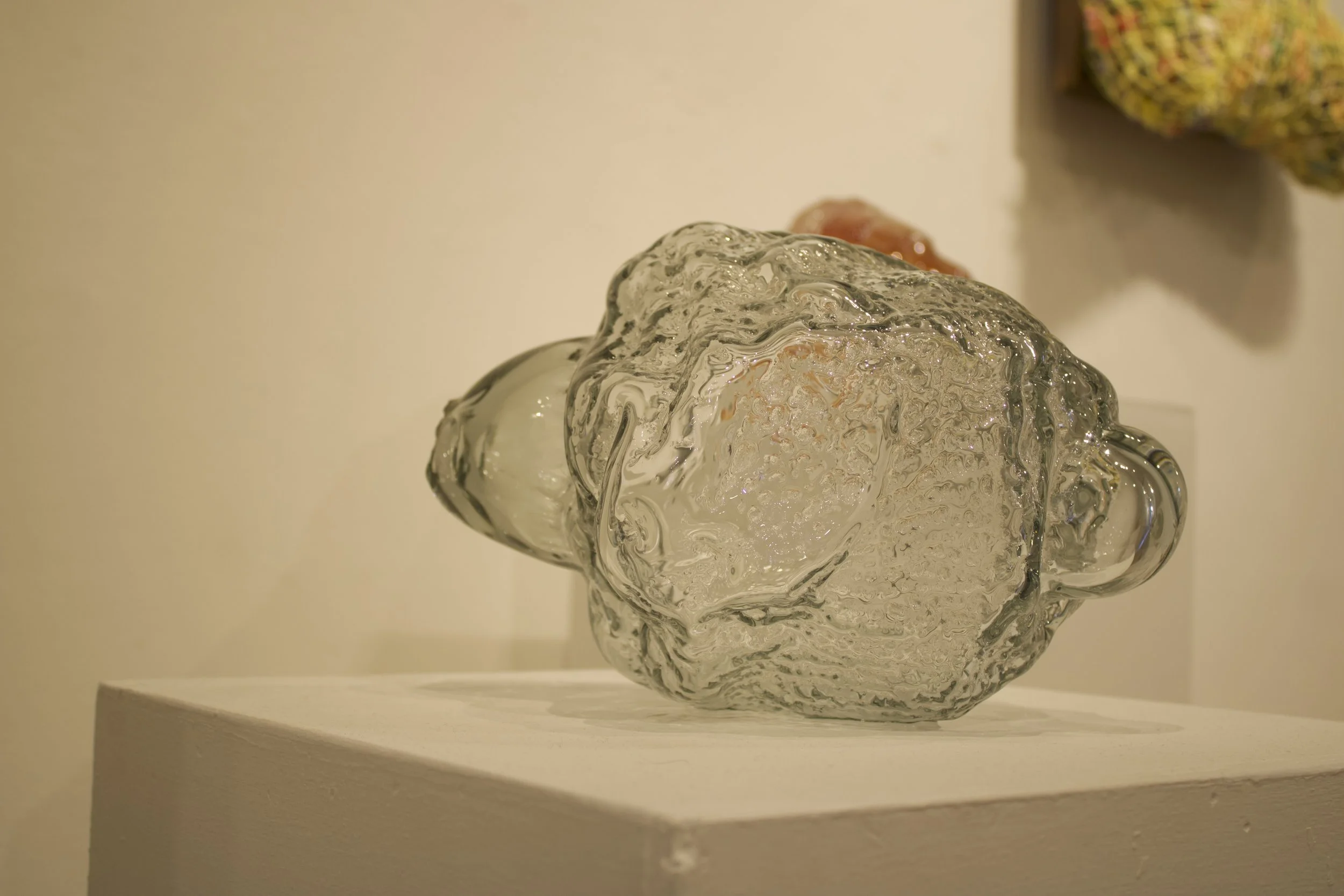
Works from Khoury’s series “To Nurse a Lost Love,” 2025. Photo by Lauren Abunassar
“To Tie a Knot” was an extension of this impulse, which also inspired Trad to pair Khoury’s work with an October 19th tatreez demo with Palestinian artist Samar Dahleh. Placing works by Dahleh and Khoury — who are connected by a joint interest in history, environmentalism and traditional forms of making and craft — in conversation was a way for Trad to begin exploring her own interest in cultural stewardship, art as a means of cultural preservation and the restorative possibilities of traditional craftwork.
The founder of Batikh Batikh, a pop-up cinema and gallery that centers the work of SWANA women and queer artists, Trad began organizing the exhibition as a part of the Da Vinci Art Alliance’s Linda Lee Alter Fellowship. The fellowship is intended for curators who work with queer artists and are creating a space for queer topics.
For Trad, a big part of answering this call has meant ensuring that artists and curators are not leaving archival and documentary practice up to Western art institutions. It’s also about debunking the myth of distance between the SWANA region and the Western world.
“Naz’s work is very much in line with my practice of trying to juxtapose what's happening in the States and the diaspora with what's happening in the SWANA region,” Trad said. “I think a lot of times in the States, people feel very isolated or feel like the things [happening] abroad don't affect them. And so one thing that really drew me to Naz’s work was this interest in history, interest in climate change, interest in connecting rural Appalachia and the history of Shami [Levantine] craft.”
Because Khoury does not yet have a local studio, early conversations about the exhibition took place in coffee shops across Philadelphia. More than once, Trad and Khoury were approached by baristas, community members and strangers who wanted a closer look at the glass pieces Khoury would bring to these meetings. They had questions. What was the work? What was it about? What was the ‘meaning’?
The ability to elicit these kinds of questions is a testimony to the power of Khoury’s sculptures. But it was also a reminder for Trad and for Khoury that they didn’t want to overdirect audience members’ interpretation of the exhibition. Evoking mood and reflection and even a sense of whimsy became early priorities.
“I did some research on [nostalgia] for an older thesis I did in undergrad,” Khoury said. “I [learned] it was a yearning for a place of the past, or a time. But I also began to see it as the way our brains tend to put more positive memories at the forefront than negative ones… I'm coming to this conclusion that working with my hands is a way of processing some of this bittersweetness, some of this desire for something that doesn't really exist.”
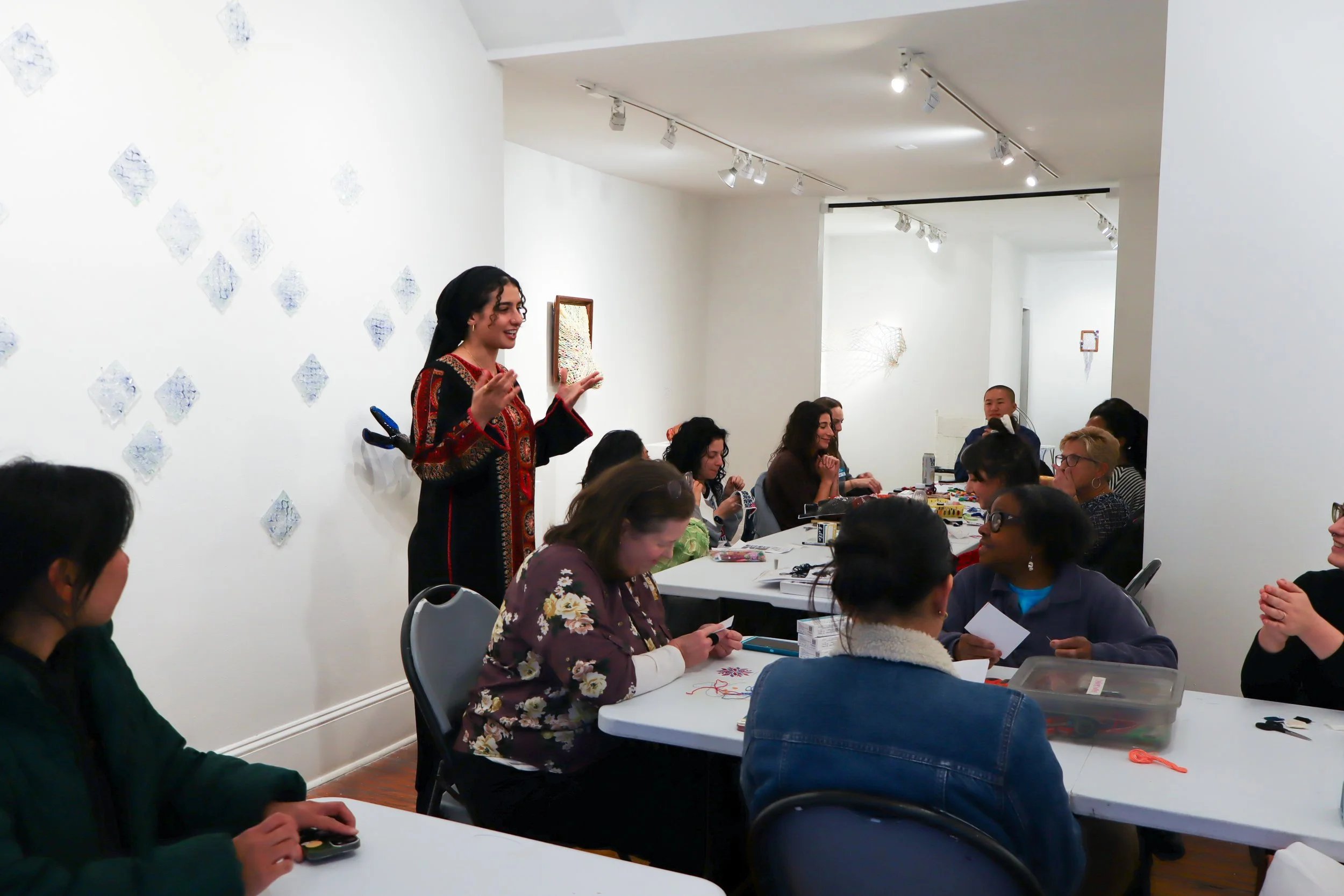
To highlight the restorative possibilities of traditional craftwork, curator Sarah Trad invited Palestinian tatreez artist Samar Dahleh to lead a demo during the run of Khoury’s exhibition. Photo: Batikh Batikh Collective
Lately, Khoury has been considering art as an archival process and the part he wants to play in it. What gives an archive meaning? Who judges the material value of an archive? “I've been thinking a lot about gay artists who lived in New York City and were using photography or writing to capture their lives and existences before they died in the AIDS crisis,” he said. “And I feel a similar instinct to just make and record.”
Given these instincts, it has been a powerful experience for Khoury to connect with others through “To Tie a Knot.” He remembers speaking with Lebanese, Palestinian and other Arab visitors who came to see the show and being struck by the way they could discuss their identity through the lens of what Khoury calls “the material condition of where we’re from.” And indeed, “To Tie a Knot” played a powerful role in exploring how history embeds itself in material we can hold in our hands. Objects offer the possibility of remembering what people themselves can forget. And craft can bear unique witness to routes of migration, extraction and erasure simultaneously.
It’s not lost on Khoury that glass was a medium he first discovered in August 2023. “At that time, I was feeling emotions that I never felt before and did not know how to regulate in a way where I could wake up and go to school without wanting to jump in front of a car, to be explicit,” Khoury said. “But then I had this medium that was encompassing my entire body. It was forcing me to unlearn instincts of fearing fire or extreme heat, or working my body to levels that I hadn't before. That was what made me work with it and fall in love with it.”
As the works in Khoury’s exhibition make clear, fragility can also be a form of endurance. Just as the act of making can be a mode of survival.
***
Lauren Abunassar is a Palestinian-American writer, poet and journalist. Lauren holds an MFA from the Iowa Writers’ Workshop and an MA in journalism from NYU. Her first book, Coriolis, was published in 2023 as winner of the Etel Adnan Poetry Prize. She has been nominated for a National Magazine Award and is a 2025 NEA creative writing fellow.
Al-Bustan News is made possible by Independence Public Media Foundation.