Nasser Al-Rayess’ Philly Stand-Up Show Celebrates Growing up Arab in America
By Elissa Odeh
October 29, 2025
Syrian-American comic Nasser Al-Rayess has described his stand-up shows as Arab gatherings: lively, loud and full of warmth.
“There’s so much going on. You have the hookah on the side, the uncles talking about their blood pressure and the aunties eating sunflower seeds and complaining about their husbands. The kids are playing outside, and food just keeps coming.”
His goal is to bring that same chaotic energy to the stage.
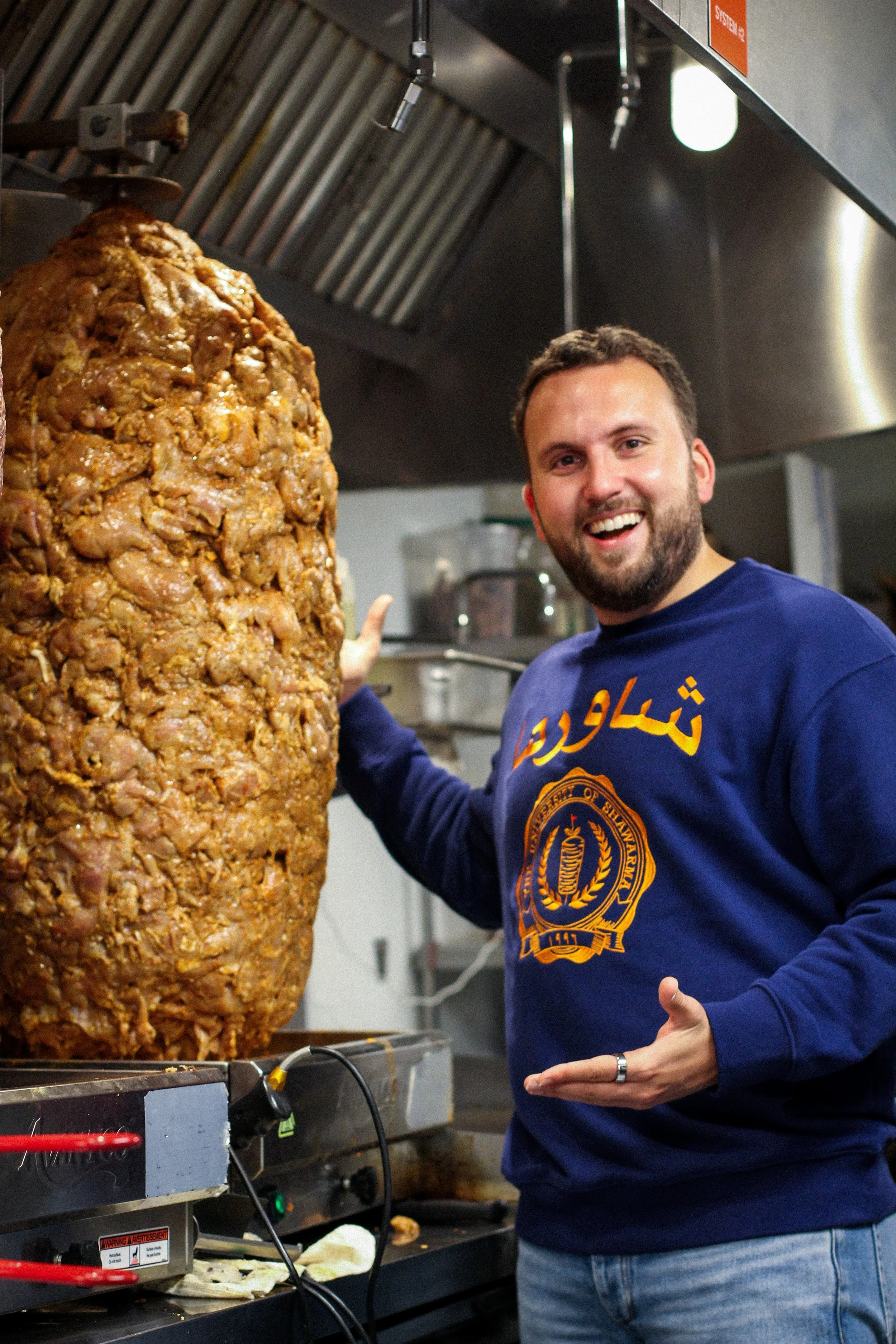
The self-proclaimed ‘Shawarma King,’ Al-Rayess creates videos reviewing shawarma sandwiches around the world. Photo courtesy of Nasser Al-Rayess
On October 23 the California–based comedian and content creator did just that at Philly’s Helium Comedy Club for the second show of his fall tour. Cackles echoed throughout the venue as Al-Rayess told stories of Arab family drama, cultural dilemmas, politics and his lifelong love: the shawarma sandwich.
“I anointed myself as the Shawarma King, and no one is taking that crown yet,” he told Al-Bustan a few days before the show. “I take this honor with responsibility and care, and I will preach to the world about shawarma for as long as I can.”
His self-proclaimed title grew out of videos he made during the COVID-19 pandemic, reviewing shawarma sandwiches around the world and igniting debates among Arabs everywhere on whose shawarma reigns supreme.
Long before he started making videos, Al-Rayess was already hooked on making people laugh. While in high school, he performed in talent shows, taking the stage to do stand-up for the first time as a senior.
For Al-Rayess, comedy is more than a performance — it is a reflection of his daily life, one that resonates with many Arab Americans navigating the diaspora. “There’s nothing more beautiful in life than telling a story. And I take so much pride in being able to tell it with my culture at the forefront,” he said.
At his show, Al-Rayess joked about one of the biggest cultural pressures in Arab culture — getting married. “I’m almost 30, so the questions never stop. Back home I would’ve been married to my cousin by now.”
On October 24, he released a new song titled “3o2balak Habibi,” or “You’re Next, My Dear,” an anthem for all single Arabs who have to smile through relatives asking them when they will tie the knot. Palestinian American George Qadado, who drove from Virginia for Al–Rayess’s show, said he could relate. “Growing up as a first-generation Arab immigrant, it hit home.”
Still, Al-Rayess is looking forward to someday having his own Arab wedding, which he describes as the pinnacle of Arab culture, from the lavish decor and extravagant dresses to, most importantly, the dance floor, which he calls the “fire zone.”
“You will see your uncle who hasn’t worked out since the 1980s, jumping up and down,” he told the crowd. “Your cousin who just got here from the Middle East is leading the dabke line, hoping someone will give him a green card.”
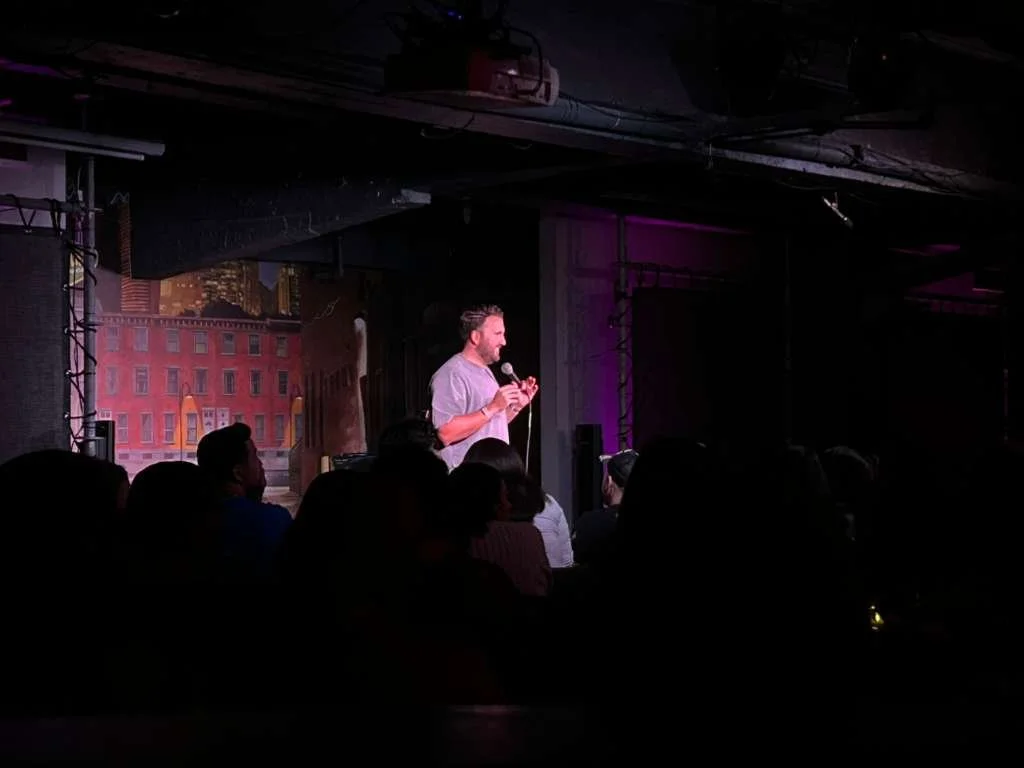
Nasser Al-Rayess performs during his stand-up show at Helium Comedy Club in Philadelphia on October 23. Photo by Elissa Odeh
At the end of his show, Al-Rayess brought the spirit of Arab parties to Philly, inviting four non-Arab audience members onto the stage and teaching them a few classic moves. The room erupted into cheers and singing. “It was so nice to see the Arab community come together and see other non-Arabs appreciate Arab artists,” said Dina Alyelgad, an Egyptian-American attendee from New Jersey.
Such moments of connection are vital for Al-Rayess, who grew up juggling his Arab and American identities. “The diaspora experience is having to create an identity that doesn’t exist,” he said. “You’re constantly trying to figure out who you are; it’s an existence of nonexistence.”
Growing up in the U.S., Al-Rayess felt his heritage was always visible, especially at school when his mother brought trays of hummus for the teachers while other parents brought wine and chocolate, or when his football coach found out he was playing while fasting. “He lost his mind. He didn’t want an Arab Muslim kid dying on a Catholic football field,” Al-Rayess said.
Those experiences later became the foundation of his comedy, which has allowed him to process his upbringing in the diaspora. “Humor helps me cope with the seriousness of my existence,” he said. “There’s so much depth to our experiences as Arabs, and we are always flooded with sad news from our home countries, but comedy allows us to understand each other better.”
This tour marks Al-Rayess’ fourth in the U.S., and he is making plans to announce the dates of his first tour in Europe and Australia. With every show, Al-Rayess said, his Arab pride only grows, and he hopes to encourage others to embrace the chaos of diaspora life.
“I want all Arabs to be unapologetically proud of who they are. Be yourself to the fullest, because the most beautiful, sparkling light that you have is who you are.”
***
Elissa Odeh is a Palestinian journalist and storyteller based in Lansdale, PA covering Arab and SWANA communities in the U.S. She holds a B.A. in media and culture. She has written extensively for Al-Bustan News, exploring themes of identity and cultural pride through profiles and community features.