
At Norristown Farm Park, a Garden Grows Health, Sustainability and Community
By Gawhara Abou-eid
October 20, 2025
On a summer day at the Pennsylvania Horticultural Society’s (PHS) Community Farm at Norristown, Lansana Waritay, a local volunteer, bent over rows of sweet potato greens, not just harvesting food, but reconnecting with memories of growing up on his grandfather's farm in Liberia. Later, he would turn those greens into a traditional West African dish made from the greens and rice and share it with fellow volunteers. That moment of cultural exchange is just one example of how this two-acre teaching and production farm has become a vital hub for community connection, healing and heritage.
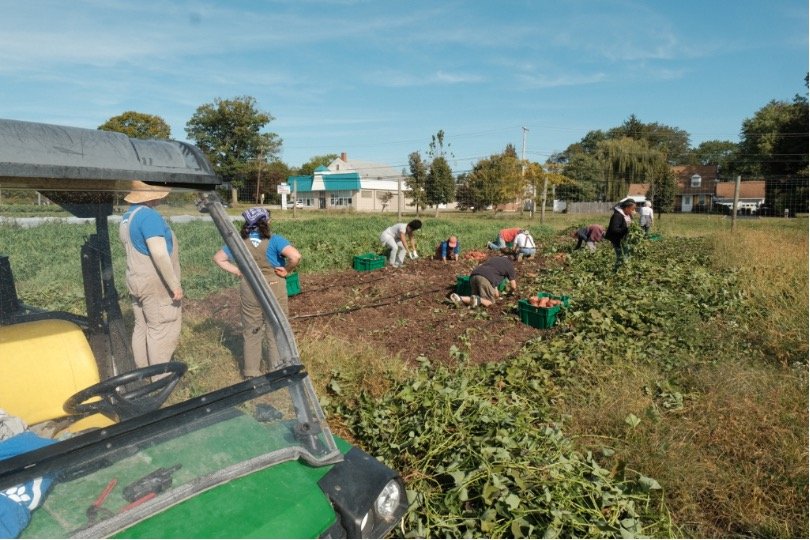
Norristown Farm Park staff and volunteers grow over 20,000 lbs. of food annually for local communities. All photos by Ben Bennett
The community farm was established in 2020 through a partnership between PHS, Montgomery County and the state’s Department of Conservation and Natural Resources. According to U.S. Census Bureau data from 2019 to 2023, Norristown is home to approximately 13,121 households, with about 17.7% of residents being foreign-born. In 2021, the county ranked second in Pennsylvania for total immigrant population. The farm supports immigrant and refugee families, as well as other residents, through hands-on agriculture, nutrition education and culturally relevant crop production.
Marta Lynch, farm manager since March 2021, says the project began when PHS and Montgomery County recognized the need to address food insecurity. She had previously worked at a community farm in North Philadelphia that partnered with PHS and was drawn to bring that experience to the county.
Lynch and field manager Zoe Ganslaw, who joined in February 2023, highlight the farm’s focus on food justice rather than commercial agriculture.
“We’re growing food for folks who didn’t necessarily have access to fresh produce,” Ganslaw says, noting that their prior work on larger farms serving wealthier communities felt disconnected from the needs of lower-income neighborhoods.
Each crop cycle features 40 to 50 different varieties, and high tunnel structures allow for the cultivation of more tropical plants. Crops are selected in consultation with partner organizations and community input to ensure they meet desire and necessity.
“Annually, we produce over 20,000 pounds of food,” Lynch says. “ [It] goes directly into community programs, pantries and participants in Food as Medicine.”
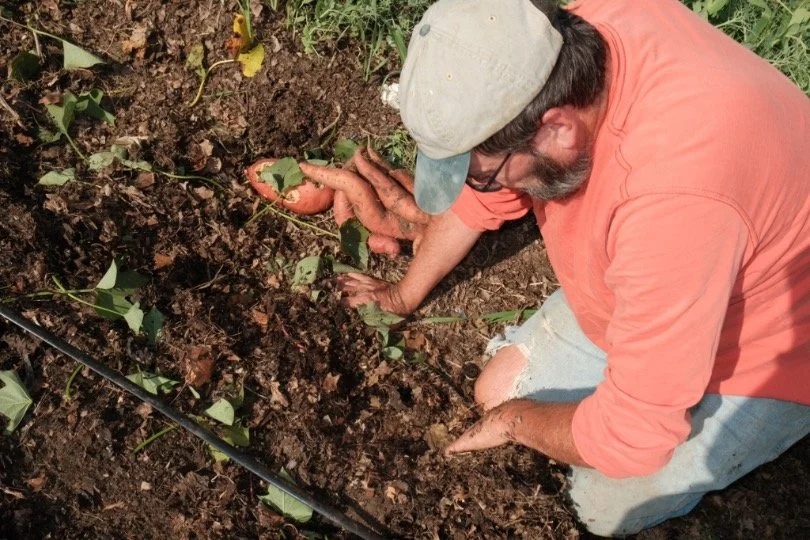
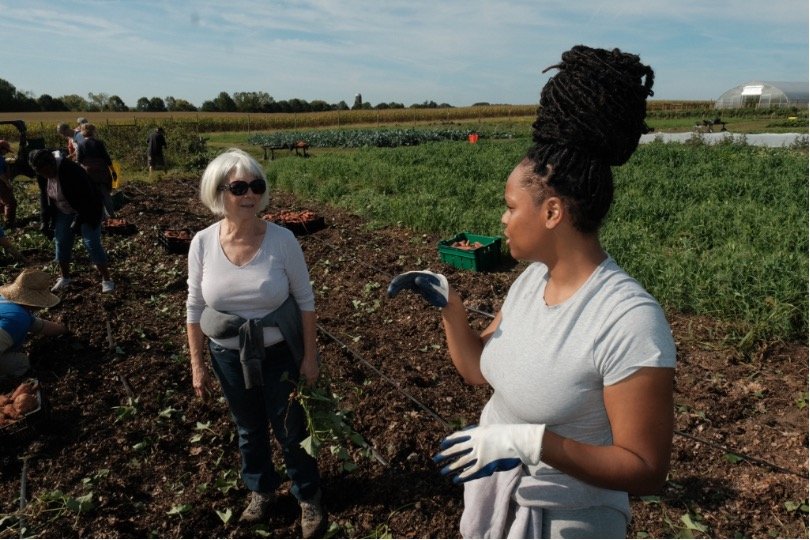
Above: A volunteer digs up sweet potatoes. Below: Sheryl Panka (left), who recently started coming to the farm, talks with Bri Steves (right), a first–time volunteer.
Central to the farm’s impact is its Food as Medicine program, which provides weekly produce boxes to participants referred by clinics in Norristown and Pottstown through Montgomery County’s behavioral health system. In addition to delivering vegetables, the program offers nutrition education and cooking lessons via clinic-based dietitians, nurses and farm educators, an approach rooted in the idea of “prescription vegetables” as an intervention for both physical and mental health.
Hossein Gharavi and his wife Stephanie Smith, both retired social workers, are among those who now dedicate their time to volunteering at the garden. What began as an appreciation for nature and community quickly evolved into something more personal.
Smith, a lifelong Norristown resident and a member of PHS with a love for flowers, began volunteering after receiving an email request for help. Since then, she and Gharavi have returned several times over the summer.
For Gharavi, who was born and raised in Iran and moved to the U.S. in 1977 for college, the experience calls back to the quiet acts of service he witnessed in his youth.
“The way my mother raised me, it was… always looking out for other people,” he says. “She used to pack these [food] packages for people… and would tell me, ‘Go to so-and-so’s house, leave it outside the door, ring the bell and just walk away.’ She never wanted thanks or glory. She was always feeding people.”
For Smith, too, the experience is rooted in heritage.
“My father was from the South and grew up on a farm,” she says. “From the time I was a kid, I knew how to garden. So I think the way you grew up and the values that were instilled, whether you understand it or not at the time, you carry them forward… Maybe that was why I was so interested in becoming a part of the volunteer effort.”
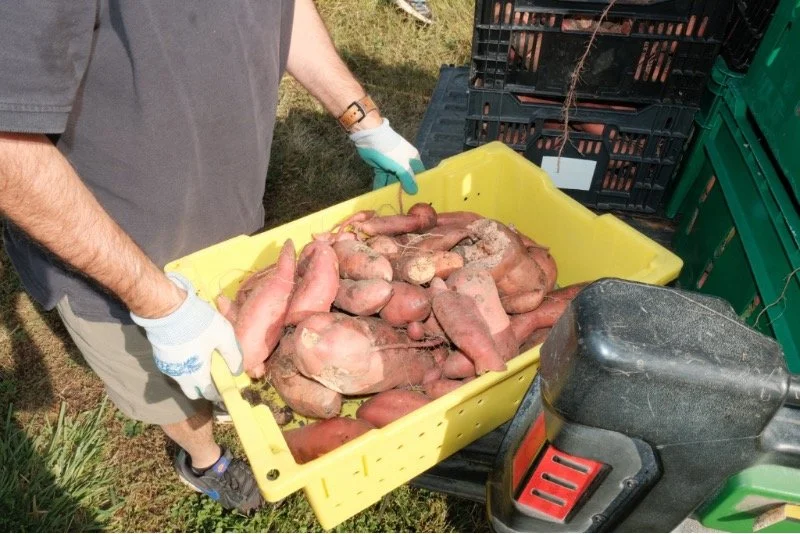
Hossein Gharavi, a retired social worker who grew up in Iran, puts a box of sweet potatoes onto the back of the farm car for transport.
The farm also collaborates with local nonprofit partners. Islamic Circle of North America (ICNA) Relief Pennsylvania, where Waritay works as the food pantry coordinator, is a key recipient of produce. A weekly volunteer, Waritay harvests and distributes produce in the area, Lynch says.
According to Dana Mohamed, ICNA Relief’s area manager, the partnership helps feed between 90 and 120 families each week at a free produce pop-up.
“Getting freshly harvested organic produce is a game changer,” Mohamed says. “Our focus with our hunger prevention program is on fresh produce, more so than non-perishables.”
For Waritay, being at the Norristown farm is more than just giving back, it’s returning home.
“I grew up with farms. So it’s not a chore to me. Living off the land and eating wholesome food, that’s what got me interested,” Waritay says. “And they do not use pesticides. So it is a good addition to what we can give our people, something better.”
Sweet potatoes in particular hold strong meaning for Waritay.
“My grandfather used to farm… and to store them. Sometimes they keep them in the farm for a year and eat them during the rainy season,” he says.
Centro de Cultura Arte Trabajo y Educacion (CCATE), a grassroots organization serving the Latinx community in Norristown, also receives weekly produce boxes and brings youth to the farm for educational field trips. Students from local high schools’ horticulture clubs and elementary school groups also visit the farm for hands-on learning and cooking workshops.
Beyond donations and education, the farm hosts an on‑site community garden used by over 50 families and groups. Gardeners rent beds to grow food for personal or shared use.
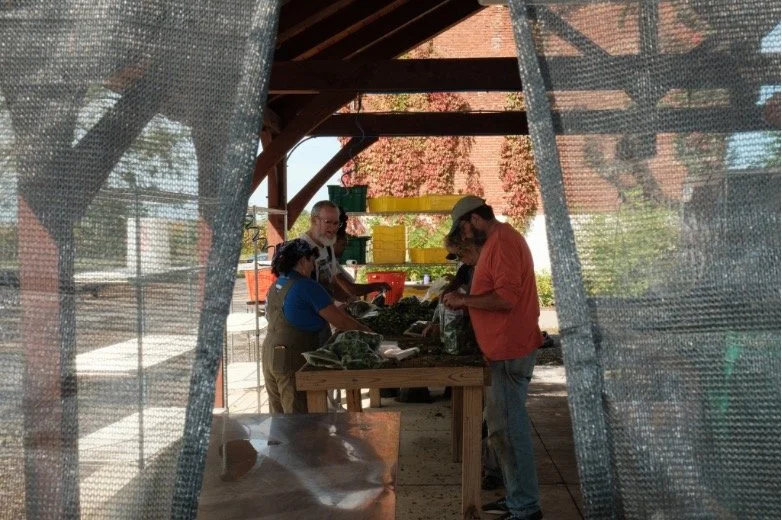
Staff and volunteers bag lettuce grown on the farm.
“On volunteer days, we’re constantly sharing recipes and teaching about farming,” Ganslaw says. “People learn what crops look like as they grow, connecting what they see in grocery stores with how it grows in the field. We usually have potlucks a couple of times a year, sharing recipes and food from what we grow.”
Most of the farm’s funding comes directly from Montgomery County, Lynch says, which initiated and continues to support the project in response to regional food insecurity. Additional support comes from private foundations. However, shifts in the federal funding environment have posed challenges.
Lynch says the team is currently advocating at the county level for sustainable, long-term funding, as the project looks to remain viable amid budget uncertainties. Their goal is to stabilize the program financially to ensure its continued service to the community.
The Norristown farm is one among many PHS projects. Founded in 1827, PHS has long asserted that horticulture can foster health and social change. The organization manages parks and farms across the region, offering community programs and green spaces designed to enhance urban agriculture, biodiversity and equitable access to fresh produce.
At Norristown Farm Park, this mission comes to life. In the soil, between rows of culturally familiar crops, and in shared meals, community voices grow as much as gardens.
“The Norristown Farm Park is like… a heart,” Gharavi says. “Like you're in the middle of town, and all of a sudden you feel like you're in the country. And sometimes you get lost in the nature, which is wonderful. It’s therapeutic.”
***
Gawhara Abou-eid is an Egyptian-American researcher and journalist from Lewisburg, PA and an Al-Bustan News media fellow. They hold a BA in International Relations from The George Washington University, with a concentration in International Security Policy. Gawhara has published research for the League of Arab States in Cairo, and their journalism has appeared in The Standard Journal and The News-Item.
Ben Bennett is a Chinese-American visual journalist based in Philadelphia and an Al-Bustan Media Fellow. He is a recent graduate of American University's journalism program, where his coverage focused on underserved communities and the intersection of politics and popular culture.

Al-Bustan News is made possible by a grant from Independence Public Media Foundation.