
Cinema, Etcetera | How Are We Supposed to Talk About ‘The Voice of Hind Rajab’?
By Joseph Fahim
December 18, 2025
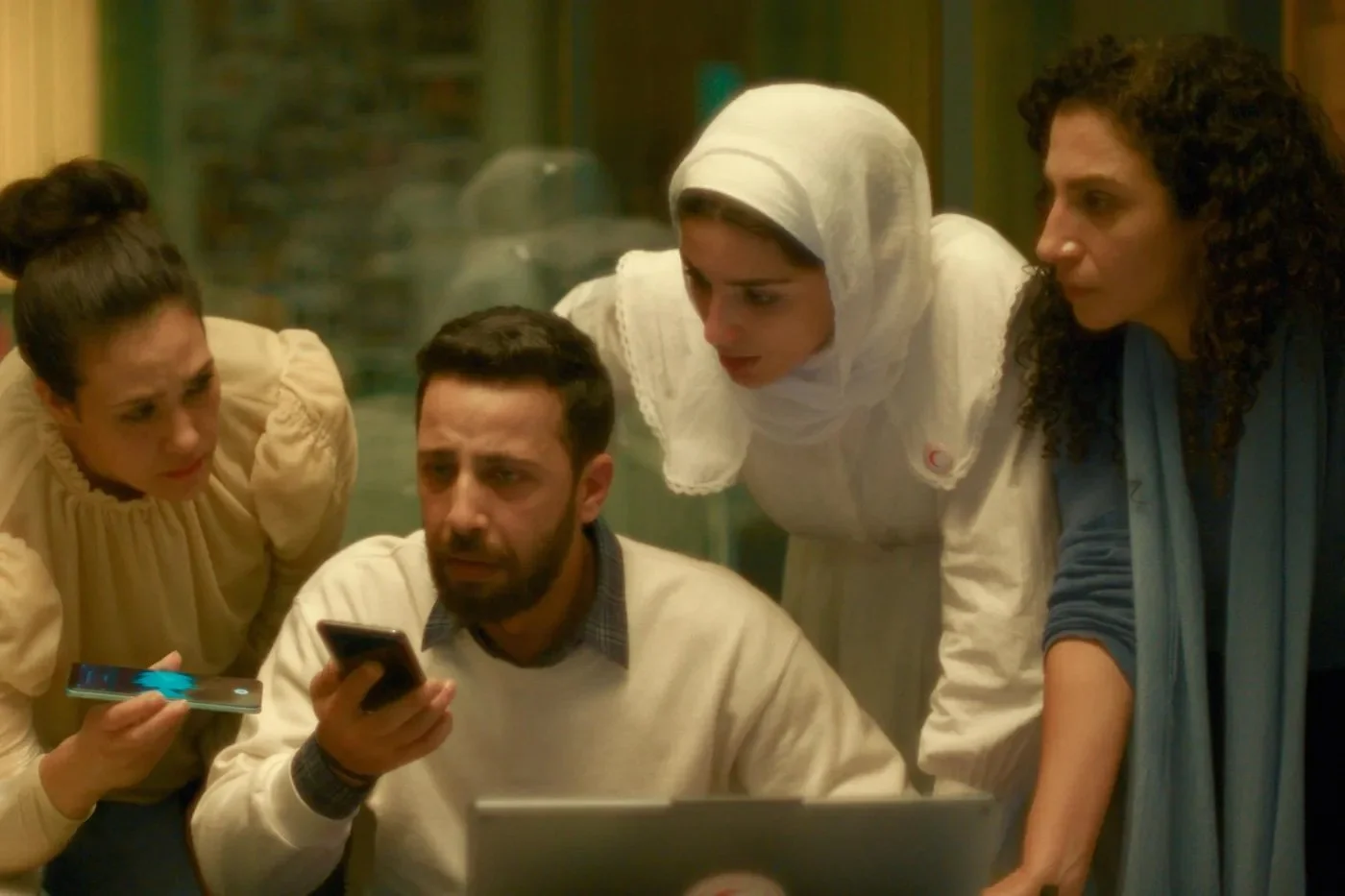
Still from “The Voice of Hind Rajab.” 2025. ©Mime Films, Tanit Films
For the past four months, it has seemed nearly impossible to escape the grip of “The Voice of Hind Rajab,” the most talked–about Arab film of the year. The seventh feature by French–Tunisian filmmaker Kaouther Ben Hania, “Hind Rajab” boasts some of Hollywood’s biggest names as executive producers, including Joaquin Phoenix, Rooney Mara, Brad Pitt, Alfonso Cuarón and Jonathan Glazer. The film received a record–breaking standing ovation at the Venice Film Festival in September, has been nominated for a Golden Globe (a first for a Tunisian film) and has earned a torrent of effusive reviews.
“Hind Rajab” has been positioned as cinema’s cri de coeur for the Palestinian cause: an emotionally devastating work, endowed with the rare power to convert the apathetic and the uninformed.
The docudrama reconstructs the killing of Hind Rajab, the five-year-old Palestinian girl murdered in January 2024 by the Israeli Defence Forces alongside six members of her family and the paramedics who attempted to rescue her. Set entirely inside the dispatch office of the Palestinian Red Crescent Society (PRCS) in the West Bank, the film unfolds over the course of a single day, chronicling the desperate efforts of the PRCS volunteers to rescue Hind while navigating the debilitating bureaucratic red tape imposed by Israeli authorities.
In a recent review for another publication, I praised the film for its political clarity. Ben Hania attributes responsibility for Hind’s death to state violence, calling the Israeli occupation precisely that—an occupation—rather than resorting to the euphemisms favored by Western media. The film underscores the fact that the killing of Hind and the paramedics was a deliberate act of aggression rooted in unchecked brutality and barbarism.
The use of Hind’s voice, however, remains the film’s most troubling element, deployed unfiltered and unmediated. The project’s emotional force derives almost entirely from Hind’s raw pleas, which leave no room for anything but sympathy. Simply put, it is impossible not to be moved by the voice of a five-year-old begging for her life — a voice whose fate haunts every frame of the film.
In interviews, Ben Hania has stated that her aim was to immortalize Hind’s voice and bring it to the widest possible audience. She obtained consent from Hind’s mother, who was trapped in Gaza at the time of her child’s murder. But questions of exploitation and opportunism have surfaced repeatedly, beginning with the Venice Film Festival press conference. Rather than engaging substantively with these ethical concerns, the filmmaker leaned on the Palestinian cause to shut down the conversation.
“I’ve already heard this argument. It’s a key talking point,” Ben Hania said in September. “When you amplify Palestinian voices, you are personally accused of exploitation — it’s another way to silence you. I have nothing to answer to this.”
“The film’s closed form prevents the child’s fullness from emerging, rendering her indistinguishable from the tens of thousands of Palestinian children who have suffered a similar fate.”
Despite being an early supporter of Ben Hania’s work, “Zaineb Hates the Snow” (2016), about a nine-year-old Tunisian girl adjusting to her new life in Canada, was the last of her films that I genuinely admired. Her later films, however technically accomplished and formally ingenious, resemble awards bait, recycling the same themes the West expects from Arab cinema: sexual violence in “Beauty and the Dogs” (2017); illegal immigration and Syria in “The Man Who Sold His Skin” (2020); ISIS in “Four Daughters” (2023); and now Gaza in “Hind Rajab.”
Across her body of work, Ben Hania’s subjects are invariably victims, presented through an authoritative gaze she neither interrogates nor subverts. The power dynamics governing her relationship to her subjects are mere footnotes, allowing her to sidestep thorny ethical questions. The closed forms she favors — allegory, docufiction, reenactment — leave no room to turn the camera inward, insulating the filmmaker from legitimate accusations of exploitation. Of all the creative paths available to her, why this one?
In purely artistic terms, “Hind Rajab” is deeply flawed. Much of the acting is poor, evidenced by the audience’s laughter at the London Palestine Film Festival during Motaz Malhees’ overdramatic performance. And the mise-en-scène — how the actors move within a confined space — is sloppy and uninspired. Yet artistry has largely taken a back seat in discussions of the film.
Perhaps judging a work as politically grave as “Hind Rajab” solely on aesthetic grounds may be deemed insensitive. But one cannot ignore the calculated deployment of Hind’s voice. The first time I saw the film, the child’s voice (if not the thriller–like structure Ben Hania builds around it) left me feeling shattered. A second viewing produced a markedly different reaction. The use of the voice leaves no space for reflection, permitting only a single emotional response: sympathy for the child victim.
Ben Hania claims to immortalize Hind Rajab, but she reduces her to a symbol rather than a fully realized person with a brief, singular life. The inevitability of Hind’s killing is the only element that defines her. The film’s closed form prevents the child’s fullness from emerging, rendering her indistinguishable from the tens of thousands of Palestinian children who have suffered a similar fate. As a result, “The Voice of Hind Rajab” functions more as a spectacle of horror than as a humane — or even enraged — inquiry into loss and injustice.
“Critics write for readers, not for film professionals. ”
Since attending the film’s Venice premiere, I have faced unprecedented pressure from those inside the industry not to criticize it. One person told me that “The Voice of Hind Rajab” represents the Palestinian cause, and we should all support it. Another urged that we must be united and get behind the film. It’s good propaganda, and it’s exactly what we need right now, remarked a third. There are also the critics and filmmakers I’ve spoken with who share my reservations but remain reluctant to voice them publicly, fearing misinterpretation or professional repercussions.
In a year marked by the far–reaching erosion of freedom of expression, such comments felt especially alarming. We live in a moment when both the right and the left demand a single unified voice and opinion. But no single film should bear the burden of representing Palestine, no matter how urgent or popular it may be. Nor does criticizing a film equate to opposing its politics or intentions.
These issues aside, I would still urge my Trump–supporting Arab–American relatives, who are largely agnostic toward the Palestinian cause, to watch “The Voice of Hind Rajab.” Last year, I showed them “The Zone of Interest” (2023), Jonathan Glazer’s chilling Holocaust drama that depicts Auschwitz from the perspective of a German middle–class family residing next to the camps. Glazer never shows the gas chambers, relying instead on sound — a far more haunting strategy. Though initially unsettled, my relatives wanted more by the end.
“Hind Rajab" could have been more explicit or graphic, and some may interpret its reliance on voice as restraint. For this writer, however, the use of a dead child’s voice feels excessive. And yet, it is precisely this tactic that may succeed in converting viewers who have never engaged with Palestinian stories before.
The censorship surrounding this film — direct, indirect and self-imposed — underscores the superficiality of contemporary discourse on Arab cinema and culture. Its perceived necessity in the American context says less about the strength of Ben Hania’s filmmaking than about the limitations of that landscape itself, specifically, a reliance on affective immediacy over critical complexity.
Last week, Saja Kilani, the actress who plays one of the volunteers, appeared in a video posted by Yung magazine, modeling a series of haute couture ensembles while speaking about the importance of amplifying Hind’s voice. Jarring and deeply tone–deaf, the video served as a reminder that commerce is intrinsic to cinema, and that filmmaking is not a virtuous endeavor beyond scrutiny.
And though I encourage people to watch this film, I remain increasingly skeptical of Arab representation in the filmmaker’s work and of her cinematic project, whatever it may ultimately be. Critics write for readers, not for film professionals. And it is the obligation of every free writer to honor the trust of their readers by reflecting on, and challenging, dominant narratives. “The Voice of Hind Rajab” demands a plurality of critical perspectives — and a more nuanced conversation.
***
Joseph Fahim is a film critic, curator and lecturer. Currently Al-Bustan’s film curator, he has curated for and lectured at film festivals, universities and art institutions in the Middle East, Europe and North America. He also works as a script consultant for various film funds and production companies; has co-authored several books on Arab cinema; and has contributed to news outlets, including Middle East Eye, Middle East Institute, Al-Monitor and Al Jazeera. In addition, his writing can be found on such platforms and publications as MUBI’s Notebook, Sight & Sound, The Criterion Collection, British Film Institute and BBC Culture. His writings have been translated into eight different languages.

Al-Bustan News is made possible by a grant from Independence Public Media Foundation.