
‘We Can’t Afford Mistakes’: The Human Toll of the Crisis in Immigration Advocacy
By Lauren Abunassar
December 3, 2025
When Junior Jones Hidalgo first began volunteering with immigrants as a college senior in 2022, he was motivated by academic curiosity. Majoring in international studies with a concentration in political science, government and law, Hidalgo was taking a course on how the global north impacts the migration of the global south when he began researching Philadelphia organizations that provide legal services to immigrants. When he discovered immigrant aid organization HIAS PA, he was eager to begin offering Spanish interpretation services for clients, guidance to culture–shocked asylum seekers and mentorship to young immigrants who needed someone to tell them that America had a space for them — that they belonged.
As Hidalgo grew more enmeshed in advocacy, it started to become a deeply personal endeavor. He first came to the U.S. from the Dominican Republic in 2016 when he was 18 years old, settling in Philadelphia. He finds that when he shares his own story with clients, “it puts them at ease because they see that they are talking to someone who looks like them, has the same background and who understands — which is critical in these times,” Hidalgo said. “But at the end of the day, at this moment, we have situations that put us in an uncomfortable position because we understand how the law should work. It’s just not working that way.”
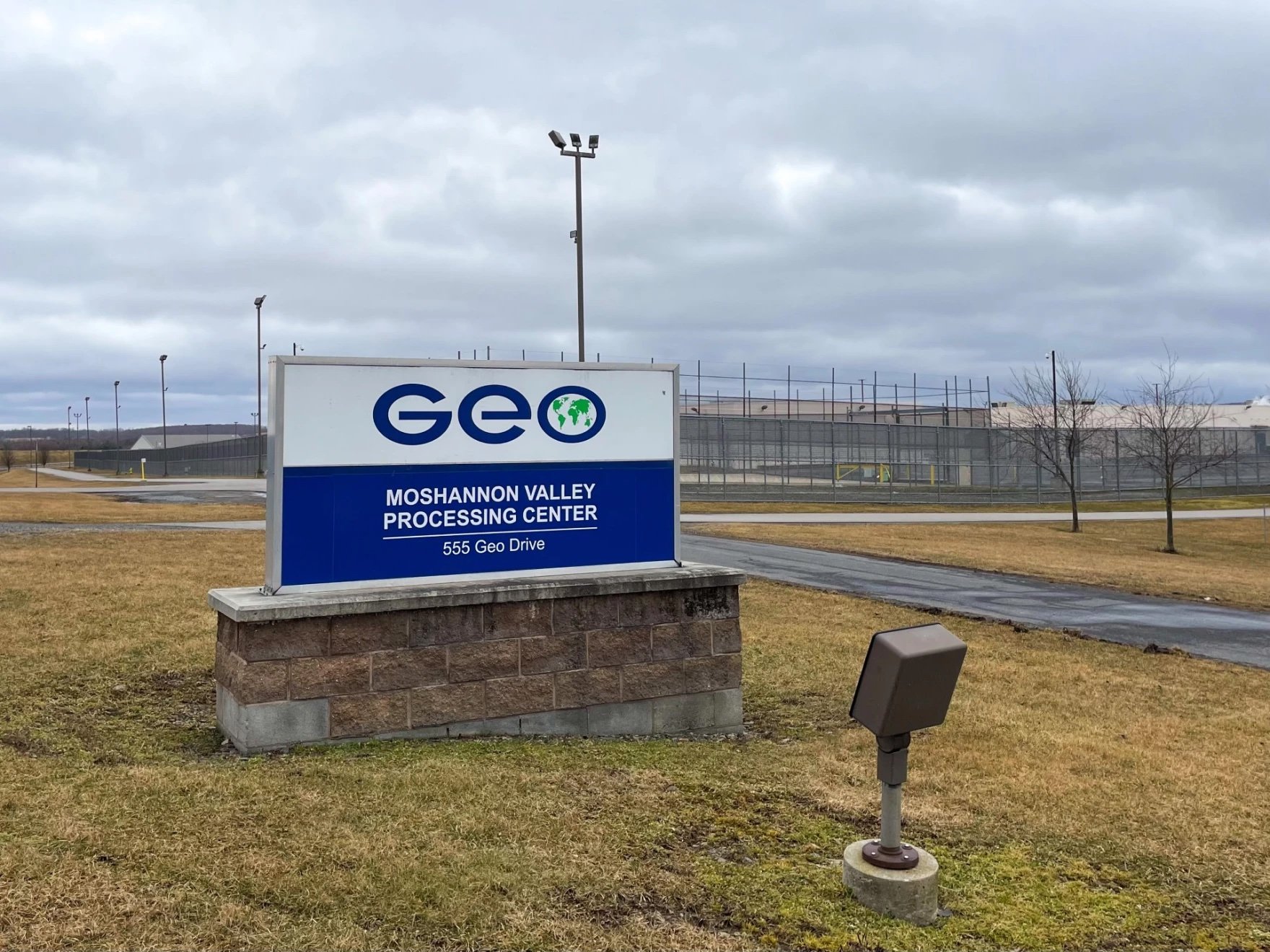
The Moshannon Valley Processing Center, a former prison in Clearfield County, Pa, now serves as the largest ICE detention center in the northeastern United States. Source: Emily Reddy / WPSU
Hidalgo continues to volunteer with HIAS PA, recently receiving a 2025 Volunteer Appreciation Award from the organization. He also works as an immigration law specialist and accredited representative — a Department of Justice certification that allows him to practice immigration law. As the immigration landscape becomes increasingly defined by crisis–level need and shrinking support systems, Hidalgo is no stranger to the emotional fallout that can come with work like his. Rapid improvisation, uncertainty and the moral weight of helping people in crisis — especially as the government systems they are navigating seem designed to fail — have become constant fixtures in immigration work. As a result, today the advocacy landscape is less about idealism and more about triage, grit and the endurance of caring under pressure.
For Hidalgo, the stakes of the work are inseparable from the stakes of his own life. When he first arrived in Philadelphia, he spoke no English, had no access to higher education resources and felt lost in a system that often made it difficult to imagine any kind of future. “We migrate to this country because we believe in the opportunities it can offer,” he said. “But it’s different when you’re in it and you are trying to find a way to survive… You have to do everything in a way that is harder. We have to do everything perfectly because any little mistake can erase the chances of any good future in this country.” That fear of one misstep shadows nearly every case he now touches.
“We’re looking at success not as winning cases. Rather, it’s just offering accompaniment throughout the process, even when the result is devastating.”
During a November panel discussion on how the immigration crisis is unfolding at a local level, Philippe Weisz, co-director of legal services at HIAS PA, was caught between shock and resignation: “The chaos we’re seeing is sort of the MO of this administration on an hourly, not daily, basis,” he said. The panel took the place of HIAS PA’s annual gathering for refugee and immigrant clients celebrating their first Thanksgiving. This year, those clients were too afraid to gather publicly.
Instead, over 100 community members registered to attend and ask panelists about the current immigration landscape. Is entering the country illegally a criminal offense? What one can do to intervene during an ICE raid? And what can be done about the Moshannon Valley Processing Center? The former prison in Clearfield County in central PA now serves as the largest ICE detention center in the Northeast. It is currently close to reaching its 1,878 capacity.
HIAS PA’s managing attorney, Christopher Seltz-Kelly, described Moshannon’s bleak conditions, noting the increasing number of people “self–deporting” as a pervasive feeling of surrender takes root. Every panelist had seen a client detained in front of them, and each had a client whose story felt emblematic of the grim state of the immigration crisis. Seltz–Kelly recently fought for the release of a sole breadwinner who was detained in front of his nine–month–old. “When he was released, other detainees cheered for him, which we may not have seen in a time when bond releases were more common,” Seltz-Kelly said. “Now, the environment is so bleak, a release is a rare cause for celebration.”
Stephanie Lubert, the managing attorney for HIAS PA’s Immigrant Youth Advocacy program, recently helped a young client escape labor trafficking only to see him deported after calling the police when he and his sister were threatened by his sister’s partner during a domestic violence dispute. Lubert’s client was the recipient of a T visa, a type of visa reserved specifically for victims of human trafficking. Because a T visa indicates recipients’ cooperation with law enforcement, past administrations have had a policy of not detaining these victims. The Trump administration has stopped honoring this policy.
Cases like these are nothing short of gut-wrenching for immigration advocates. And though burnout is something all the panelists have contended with in the past, today, the struggle feels all the more treacherous given the unprecedented pace of systemic change. For one thing, in years past the Presidential Determination on Refugee Admissions, the cap a president can put on refugees admitted to the U.S. annually, has typically averaged 120,000 to 180,000. Trump’s limit is set at 7,500.
As a result, the metrics for success have changed for organizations like HIAS PA. “We’re looking at success not as winning cases. Rather, it’s just offering accompaniment throughout the process, even when the result is devastating,” said Lubert. “Any dignity we can bring to this inhumane process is a win.”
For people like Junior Jones Hidalgo, this also means that standards for frontline efforts have become impossibly high. “It forces us to be better, in a sense, because we can't afford mistakes,” Hidalgo said. “Within this administrative process, mistakes you may have made in the past, you were able to fix. Right now, when it comes to court and USCIS, you're not able to make any of those mistakes.”
And the pressure is not just procedural — it is personal. When Hidalgo works with clients whose journeys mirror his own, he feels that proximity acutely. Anything that happens to them, he says, he can imagine happening to him. In the face of such pressure, optimism becomes an act of defiance. He finds himself reminding his clients of that. “At the end of the day, hope is what we have,” Hidalgo tells them. “And we have to hope this is just a dark chapter that, later, will be a part of history.”
“There are times when I feel really fatalistic… But if I wasn’t able to volunteer and take action, I think I’d feel a lot more hopeless.”
If Hidalgo’s perspective is shaped by his own lived experience within the system, fellow HIAS PA volunteer Tracie Van Auken’s is shaped by the time she spent with refugees and asylum seekers in the uncertain and uneasy early days of Trump’s second term. Also a recipient of a 2025 Volunteer Appreciation Award, she has been working with HIAS PA for a year.
At first, Van Auken’s responsibilities were largely administrative. She sorted donated winter coats. She helped source SEPTA key cards for newly arrived immigrants. And then she began working more directly with clients, participating in projects that involved calling new citizens and encouraging them to vote, or helping clients move forward in the process of acquiring green cards.
Van Auken remembers one client in particular who expressed uncertainty about whether she should even move forward with the immigration process. “I didn’t know what to tell her,” she said. “It’s tiring to have conversations with people and not know what to say. It didn’t feel like my place to tell somebody they should or shouldn’t be afraid, that they should or shouldn’t pursue citizenship, or that they should or shouldn’t leave the house. Actually, the truth is, sometimes it’s not even a question. It’s just clients saying ‘I’m not leaving the house.’”
Working with people whose futures hinge on decisions she cannot necessarily advise them on, Van Auken sometimes feels the limits of volunteering closing in. When she was sorting winter coats in her early volunteer days, she never imagined her work being shadowed by political discourse — particularly when all the clients she has worked with so far came to the U.S. legally. “That was probably foolish of me,” she admits. “But they’ve done all the necessary things and followed all of the legal steps. And yet, it has still become a political question.”
But while the emotional tax is high and the administrative fear–mongering feels to Van Auken like it is achieving its desired effect, the prospect of stepping back from her volunteer work is worse. “There are times when I feel really fatalistic… But if I wasn’t able to volunteer and take action, I think I’d feel a lot more hopeless,” she said.
It is the perseverance of her clients and the individual actions Van Auken sees advocates and community members taking that help her keep some hold on hope, however fragile. She thinks often of a green–card client she worked with. “I was so struck by her determination. She was so proactive in texting me and making things happen for her and her family. It made me realize that coming here under any circumstances is not done easily. The people who do so, have had to overcome so many obstacles, and so many barriers.”
In the end, what binds Hidalgo, Van Auken and so many others doing this work is not certainty but commitment — even when the system feels unyielding and cruel, even when the outcomes feel painfully small. Their efforts are a testament to the same flood of community aid that brought guests to HIAS PA’s November panel.
And it was a community’s determination that panel guest Congresswoman Mary Gay Scanlon acknowledged as a force that balances the surreal devastation of the administration’s anti-immigration campaign. For every story of drones hovering over immigrant neighborhoods or ICE agents loitering outside community centers and places of worship, there are stories of mass protests or community interventions, or the vigils held regularly outside the Philadelphia sheriff’s office. The message of community efforts like these is clear, Scanlon said. “This is not a radical fringe. This is the heart and soul of America saying this is wrong.”
***
Lauren Abunassar is a Palestinian-American writer, poet and journalist. Lauren holds an MFA from the Iowa Writers’ Workshop and an MA in journalism from NYU. Her first book, Coriolis, was published in 2023 as winner of the Etel Adnan Poetry Prize. She has been nominated for a National Magazine Award and is a 2025 NEA creative writing fellow.

Al-Bustan News is made possible by Independence Public Media Foundation.