
Coming Soon: The ‘Cinema, Etcetera’ Column
By Joseph Fahim
August 25, 2025
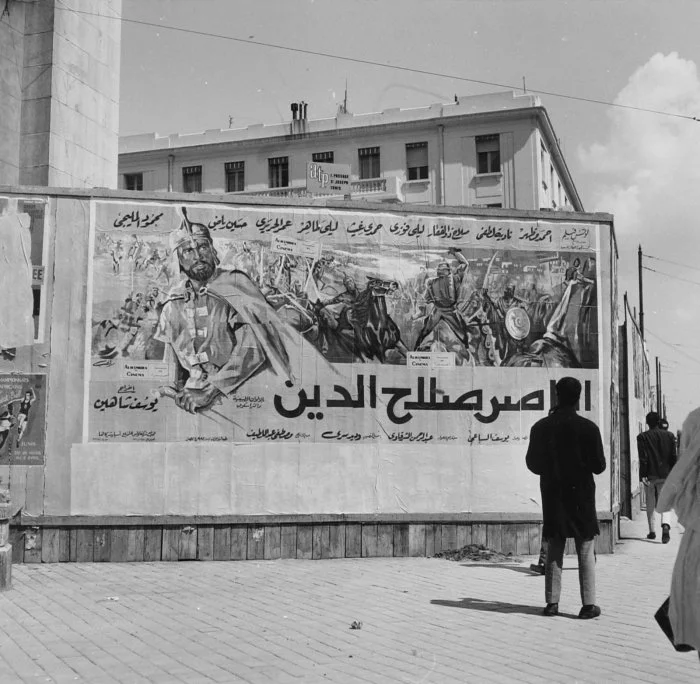
A Tunis street scene from the 1960s featuring an advertisement for the 1963 Egyptian film “Saladin the Victorious,” directed by Youssef Chahine. Image courtesy of http://www.wereldmuseum.nl/
On July 26, Arab culture was struck with the untimely passing of Ziad Rahbani, Lebanon’s preeminent songwriter of the past half-century. Tributes have flooded both traditional and social media, celebrating the boldness, authenticity and bravery of Fairouz’s eldest son, born in 1956. The poignant, heartfelt commemoration has touched upon every facet of Ziad’s life and career: his pioneering of Arab jazz, his championing of the Palestinian cause, his grounding of Fairouz’s persona through poetic, everyday lyrics; his Marxism; his prediction of Lebanon’s 15–year civil war and disdain for the country’s entrenched sectarianism.
But little has been written about what Ziad’s death represents. His brand of unabashedly political art was abrasive for its time and continues to be so today. The fierceness and incisiveness of his poetry, the artistic and political battles he engaged in and lost, the bohemian way he lived his life—all point to a time when politics was inseparable from the art produced in the region. It was a time when the realities of Arab streets drove film, TV, music and visual arts. Ziad’s death marks the long demise of political Arab art.
Ziad never subscribed to the notion of art for art’s sake, or hollow aestheticization in the pursuit of beauty. Even his most seemingly innocuous love songs challenge the status quo and stand in opposition to the governing sentiment of their time. Mainstream art has never been so out of touch with Arab life as it it now. Funding has dried up, markets have shrunk and a lack of state support in most of the region has forced artists to censor themselves to appease financers intolerant of the type of rebellious, probing art that made Ziad an enduring icon.
And yet political Arab art perseveres. It may no longer dictate the cultural dialogue, but the conversations it does inspire remain urgent and revelatory.
This column will celebrate, ponder and criticize the state of Arab art in relation to its past, present and future. Criticism is imperative not only for understanding Arab culture, but for confronting the mediocrity that can arise from silencing critical perspectives. The world needs bold, free, imaginative art; Arab art is no different. This is the art we aim to advocate for. And while the main focus of the column will be film, I will also make the occasional foray into other artforms, including music, television and literature.
As the iconic French filmmaker Jean-Luc Godard once said, “Everything is cinema.”
***
Joseph Fahim is a film critic, curator and lecturer. Currently Al-Bustan’s film curator, he has curated for and lectured at film festivals, universities and art institutions in the Middle East, Europe and North America. He also works as a script consultant for various film funds and production companies; has co-authored several books on Arab cinema; and has contributed to news outlets, including Middle East Eye, Middle East Institute, Al-Monitor and Al Jazeera. In addition, his writing can be found on such platforms and publications as MUBI’s Notebook, Sight & Sound, The Criterion Collection, British Film Institute and BBC Culture. His writings have been translated into eight different languages.