
The Woman-Centered Tradition Behind Zaghrouta’s ‘Viral Coachella Moment’
By Gawhara Abou-eid
June 8, 2026
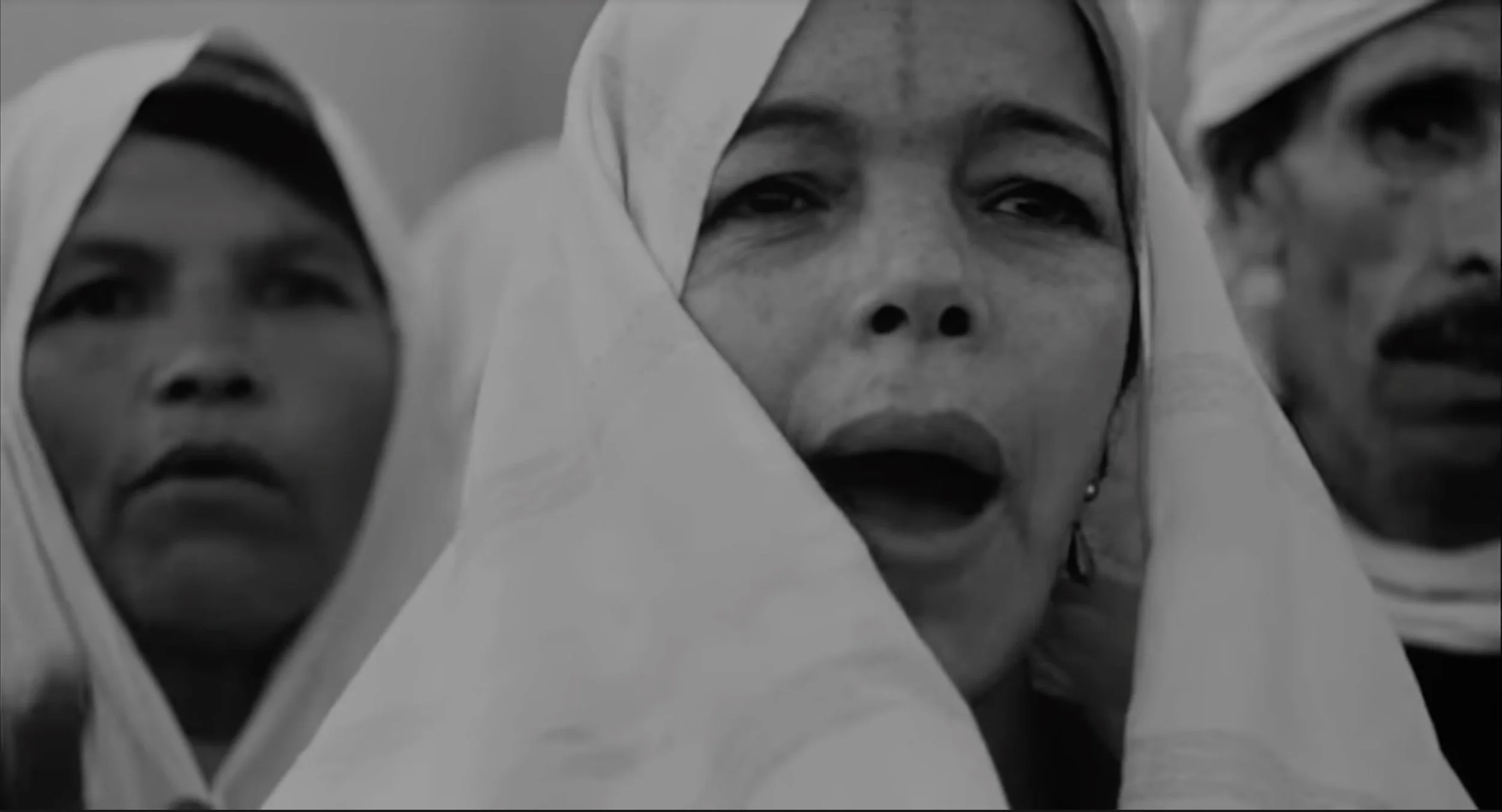
The famous zaghrouta scene from “The Battle of Algiers” (1966)
When pop singer Sabrina Carpenter apologized for mocking a ululating fan at her April 10 Coachella performance, many Arab Americans saw more than a celebrity misunderstanding. The moment ignited a broader conversation about a centuries-old vocal tradition rooted in joy, celebration, womanhood and resistance.
During her headlining set at Coachella, Carpenter paused after hearing a fan perform a zaghrouta, also known as a zaghareet, from the audience. “I think I heard someone yodel. Is that what you’re doing? I don’t like it,” she said onstage. The fan replied, “It’s my culture,” and Carpenter continued: “That’s your culture, is yodeling? Is this Burning Man? What’s going on? This is weird.”
The following day, Carpenter issued a public apology on X, stating her reaction was “pure confusion, sarcasm and not ill-intended.” For many in the Arab diaspora, however, the exchange became a gateway into a broader discussion about a sound deeply woven into everyday life across the Middle East and North Africa.
“It all starts with joy,” says Donia Ismail, a French journalist who has written about Arab diaspora culture and zaghrouta traditions. “Our joy is political.”
Born and raised in Paris to an Algerian mother and Egyptian father, Ismail says the practice of zaghrouta shaped family celebrations throughout her childhood and continues to resonate strongly among younger generations in diaspora communities.
“When something incredible is happening, or it’s your birthday, or when you’ve won an award, or anything, the first reaction is to do zaghrouta,” she says. “It carries this idea of pride, love and joy.”
Known by different names across the region, zaghrouta describes the high-pitched ululation traditionally performed by women during weddings, births, graduations, communal celebrations and funerals. Though styles vary across countries and communities, scholars say the tradition stretches across generations and borders.
A Tradition Preserved Mostly Through Oral History
According to Ismail, formal academic research on zaghrouta remains surprisingly limited, despite its cultural significance. “One expert told me, ‘No one cares about that because it belongs to women,’” she says.
That absence of scholarship, Ismail argues, reflects broader patterns in which women-centered cultural traditions are often overlooked or dismissed as informal domestic practices rather than serious historical subjects. The tradition instead survives through oral transmission from one generation of women to the next, with mothers, grandmothers, aunts and older relatives teaching younger women how to perform the sound.
“Before, many women would come up with these amazing zaghareet one after another,” she says. “Now there’s more of, ‘Who’s going to do it now?’”
Concerns about preservation have intensified as younger generations become further removed from village life and the informal spaces where these traditions were once constantly practiced. Ismail recalls the initial feelings of embarrassment among her diaspora peers when hearing zaghrouta for the first time. She worried then that the tradition would be quietly abandoned.
But in France, Ismail sees women spending years trying to master zaghrouta through family instruction and repetition. Others improvise when they cannot produce the sound themselves. “One woman told me she used an app during weddings because she couldn’t do it herself. But she still felt she was participating in her own way,” she says. Another woman became determined to learn after worrying her grandmother’s famous zaghrouta would disappear with her death.
Sociologist Nada Matta remembers hearing zaghrouta throughout her childhood in the Palestinian village of Mi’ilya in the western Galilee.
“It was part of our life growing up, especially in celebrations,” says Matta, who is the director of Middle East and North Africa Studies at Drexel University and assistant professor in the departments of Sociology and Global Studies and Modern Languages. “Usually in weddings, it’s a reference to the beauty of the bride, to her fertility, to her manners.”
Matta has increasingly noticed moments of hesitation during modern weddings where older traditions once flowed naturally between women.
“Before, many women would come up with these amazing zaghareet one after another,” she says. “Now there’s more of, ‘Who’s going to do it now?’”
Similar losses are happening around mourning rituals and oral lament traditions once led by elder women in Palestinian communities, Matta says. She remembers a woman in her village named Reheb who became renowned for leading such powerful funeral lamentations that recordings of her performances were preserved after her death.
“She was just unbelievable,” says Matta. “There’s not a lot of women who do that nowadays to replace her.”
Looking back at her days in the village, Matta remembers women gathering around the bride before the groom’s family arrived, singing improvised verses praising her appearance, family and future. Other chants mourned her departure from her parents’ home, often moving women in the room to tears.
“There’s a lot of singing with the bride herself and her family members. Some of them are emotional and definitely beautiful to sing along to.”
At the same time, many of these rituals reflected patriarchal structures tied to marriage and family life, Matta says, calling them “very gendered and sexist at the core.”
One of her friends rejected the longstanding custom in which the groom ceremonially arrives to “take” the bride from her family home, choosing instead to meet her husband directly at the wedding venue.
“For her, it was more respectful that he didn’t come to take her,” Matta says.
Even as younger generations reinterpret certain customs through feminist and modern perspectives, Matta believes women’s voices remain central to how celebrations are experienced and remembered.
For Ismail, that gendered dimension remains essential to understanding zaghrouta’s cultural power: “It has to be women. It’s a way for women to assert their presence in spaces.”
“Ismail views the public dimension of zagrouta as a direct challenge to how Arab and Muslim women are often portrayed in Western culture. ”
Joy, Protest and Refusing to Be Silent
Though usually associated with weddings and celebrations, zaghrouta has also carried political meaning across historical moments in the Arab world. According to Ismail, its political significance emerged naturally from domestic and community spaces. “Politics is not only what happens in the street. It is also what happens in the home,” she says.
During the eight-year Algerian War with France, which began in 1954, women used zaghrouta during demonstrations and revolutionary gatherings to express defiance and rally resistance fighters. French colonial authorities viewed the chants as threatening. “It was seen as so dangerous by the French army that it was banned,” Ismail says, pointing to “The Battle of Algiers” as an example. One scene in the landmark 1966 film (starting around the 1 hour 17 minute mark) depicts Algerian women ululating during anti-colonial protests.
More recently, women performed zaghrouta during Egypt’s 2011 Arab Spring revolution in Cairo’s Tahrir Square and, since October 7, at pro-Palestine demonstrations in Europe and North America.
Ismail views the public dimension of zagrouta as a direct challenge to how Arab and Muslim women are often portrayed in Western culture. The Coachella incident, she says, reflected broader misunderstandings about Arab expressions of joy and community in Western spaces. “What was tricky for me was: are you mocking the way we express joy? The fan was trying to support her and show love.”
But the sound’s power comes from how impossible it is to ignore, she says — a way for women to assert their presence in public and private spaces.
“When you hear a woman doing zaghrouta, she’s anything but silent.”
***
Gawhara Abou-eid is an Egyptian-American researcher and journalist from Lewisburg, PA and an Al-Bustan News media fellow. They hold a BA in International Relations from The George Washington University, with a concentration in International Security Policy. Gawhara has published research for the League of Arab States in Cairo, and their journalism has appeared in The Standard Journal and The News-Item.

Al-Bustan News is made possible by the People’s Media Fund.