
Despite Sanctuary City Status, Philadelphia’s Immigrant Communities Are Under Siege
By Ragad Ahmad
January 28, 2026
Immediately following the fatal shooting of 37–year–old American citizen Renée Good by ICE agent Jonathan Ross in Minneapolis on Jan. 7, Philadelphia emerged as a focal point in the national debate over immigration enforcement. On Jan. 8, District Attorney Larry Krasner and Sheriff Rochelle Bilal convened a news conference at Salt & Light Church in Kingsessing, with Krasner declaring that ICE agents who violate the law will face arrest.
"We will put handcuffs on you. We will close those cuffs. We will put you in a cell," he warned. Bilal issued her own challenge to federal agents, telling them to "bring the smoke."
But despite these bold promises, No Ice Philly, an immigrant–led anti–ICE advocacy coalition, has documented more than 100 people detained by ICE at the Philadelphia Criminal Justice Center, where Sheriff Bilal herself oversees security. Compounding the confusion, the Philadelphia Police Department (PPD) released a statement on Jan. 9 clarifying that the city is policed by the PPD, not the Sheriff's office, and that the department will continue informally collaborating with ICE regardless of the positions taken by Bilal and Krasner.
Philadelphia maintains its sanctuary status, meant to offer protection to non–citizens. But the reality on the ground tells a starkly different story.
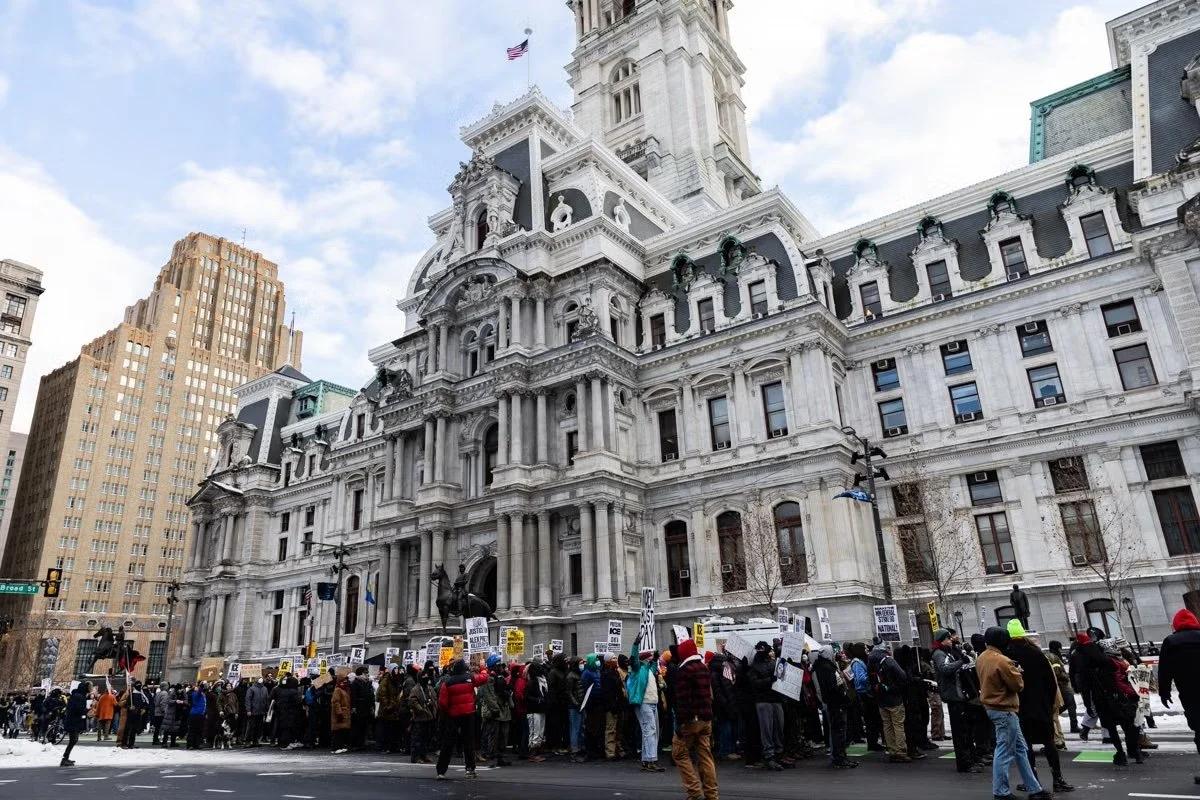
Anti–ICE protesters in Center City, Philadelphia on Jan. 26. (Kimberly Paynter/WHYY)
‘An Uphill Battle for Human Rights’
Jasmine Rivera, executive director of the Pennsylvania Immigration Coalition, has been preparing for this moment since long before Trump took office. Leading up to the 2024 election, her coalition knew that regardless of who won, substantive work around immigration policies would be necessary. "It was always going to be an uphill battle for human rights; the difference would be the steepness of the hill," Rivera said. "There wasn't much guessing that needed to be done, because what we're seeing was clearly outlined in Project 2025.”
The current system of detainment and violence did not begin with the Trump administration. "This is not a Trump or Republican issue," said Ahmet Tekelioglu, director of the Council on American–Islamic Relations (CAIR) Philadelphia. “ICE was doing the same things during the Biden and Obama administrations. This is a structural violence issue, and when we are thinking of solutions we need to keep that in mind."
During Biden’s presidency, Rivera said, “a lot of immigration policies that were put in place under Trump’s first term were never reversed." The Biden administration resumed construction of the wall on the U.S.–Mexico border in 2023 and gutted asylum protections in 2024, making it significantly harder for people to be approved through legal channels.
The Booming Detention Business
Since 2024, Pennsylvania’s detention capacity has increased from three to eight facilities. The Moshannon Valley Processing Center in Clearfield County, which has approximately 1,800 beds, is the largest detention center in the Northeast. ICE also plans to open warehouse facilities to hold more than 5,000 immigrants each, with at least two sites identified in Pennsylvania.
"Holding immigrants is a relatively new thing, and the reason it has become so predominant is because it makes money that local governments and private companies profit from," Rivera said.
But while immigrant detentions have skyrocketed, deportation numbers have increased only seven percent, suggesting that authorities are prioritizing detention over case processing, enriching private companies and local governments while subjecting detainees to dangerous, sometimes deadly conditions, according to Rivera.
The conditions within the centers, including verbal, physical and sexual abuse, medical neglect, and inhumane conditions in general, have been well documented by the Detention Watch Network, a national advocacy and organizing coalition. Three deaths have occurred at Moshannon alone, part of a broader pattern of deadly neglect across the detention system.
‘A Nightmare Come True’
Carlos (a pseudonym), a 19–year–old college student in Philadelphia who requested anonymity due to safety concerns, knows this terror intimately. Carlos and his two siblings are American citizens, born after their parents immigrated from Guatemala in 2006. His mother was pregnant with him when the family made the difficult journey north, fleeing poverty and seeking the opportunities and safety that the U.S. promised. For nearly two decades, his father worked in construction, paid his taxes and contributed to his community.
"Since ICE raids have increased, my family has been very careful," Carlos said. "My dad was terrified of ICE and would only go to work and come back." That terror materialized last November when his father was apprehended by ICE agents while commuting to work in Northeast Philadelphia. "He was usually home no later than 5 p.m., so when 6 p.m. came around and we hadn't heard from him, we assumed the worst," Carlos recalled. The family frantically searched ICE databases but found nothing. It wasn't until the following morning, when his father called from the Moshannaon facility, that they learned what had happened. "It was a nightmare come true," he said.
The impact on the family has been catastrophic. As their primary provider, Carlos’ father's absence created an immediate financial crisis. Carlos abandoned his education to work and help his mother pay rent, but their situation continues to be precarious. "We've had to borrow money from friends and community members to make ends meet and cover my dad's legal fees," he said.
Months later, Carlos’ father remains in detention, with no clear resolution in sight. "My dad is not a criminal," he said. "He is the hardest working person I know. He sacrificed everything to come to America and give my siblings and I a better future than he had growing up in Guatemala. He prioritizes his family and his faith. I can't help but think that the immigrants the administration is targeting, including my father, live up to American principles more than Americans themselves."
Communities Under Siege
Stories like these keep Ahmet Tekelioglu awake at night. Until becoming a U.S. citizen in October, Tekelioglu was a green–card holder and feared for his own safety, particularly as arrests of those vocal about current global issues increased. And through his work with CAIR–Philadelphia, he has witnessed firsthand the fear gripping immigrant communities across the region. Immigration resources are among the main requests CAIR receives these days, and while the organization has been connecting community members with free legal resources, the need far outstrips available resources.
CAIR Philadelphia has been working with local communities to pass protective policies. A recent victory came when the Bucks County Sheriff's Office signed an order ending their collaboration with ICE, thanks to advocacy by community members and organizations like CAIR. While these small victories matter to many, they can feel insignificant against the scale of suffering. While Bucks County has ended its relationship with ICE, Ahmet notes, it maintains its partnership with Israel Defense Forces to train local police and deputies on “advanced anti–terror training”.
The human cost of ICE raids and escalating immigration enforcement has been profound and pervasive. "People are afraid to go about their day–to–day lives," Tekelioglu said. One imam confided in him about a member of his mosque who asked the imam to deliver food to them because they were too afraid to leave their home to purchase groceries. "Community stores are also reporting reduced foot traffic, and there is significant concern around the individuals left behind when someone from their family is deported."
For Tekelioglu and CAIR, coalition–building between organizations has become a crucial part of the effort to protect vulnerable community members.
Working Inside the Chaos
Dounya Ramadan sees the system's failures from the inside — in the legal apparatus itself. She started her job as a paralegal at a Philadelphia–area immigration law firm in July 2023, during the Biden administration, and has watched the landscape shift dramatically since then. Just before Trump took office, the attorneys at Ramadan’s firm briefed employees on what to expect. Staff were warned that it would not be ‘business as usual’, and that attorneys often learned about policy changes through tweets, making a coherent legal strategy very difficult.
"There is a lot of stress and confusion among clients," Ramadan explained. "The form of communication that the administration uses is meant to instill anxiety and fear among our society." Since Trump's inauguration, her firm has been maintaining a blog to track rapid policy changes, a desperate attempt to keep pace with the weaponization of uncertainty.
According to Ramadan, "Attorneys are trying to keep up, just like everyone else." Working in immigration law, she explained, is like working in hospice. Often what's needed most is simply holding someone's hand and comforting them through an agonizing process. Ramadan described clients so despondent that they have considered or attempted self–harm. It is a heavy emotional burden for Ramadan and others who work with immigrants these days. "I feel drained and angry. The world feels like it's falling apart when I am at work."
How Advocates Are Fighting for Change
Ramadan is clear about what is needed on the local level: crowdfunding and community. Legal fees are the biggest barrier for an immigrant navigating an already complex system. She notes the gap in substantive mutual aid efforts and encourages people to look inward to their own communities and recognize that institutional protections have failed.
Among the local organizations leading efforts to protect vulnerable groups is Juntos, a Latine immigrant community organization in South Philadelphia. Juntos hosts Know Your Rights training, accompanies community members to immigration/ICE appointments, and has created an ICE watch hotline.
In addition to resources like these, Jasmine Rivera emphasizes the need to examine root causes and systems to find permanent solutions. "We have to defund ICE — there is no way to reform it," she said, adding that the agency's fundamental structure and mission are incompatible with human rights and constitutional protections. She rejects the notion that the agency is a necessary fixture of American society. “We did not have ICE before 2003."
For those looking to take action, Rivera directs people to the Pennsylvania Immigration Coalition's website to find member organizations in their county that have been doing the necessary work for years. Many of the leaders in these organizations are immigrants themselves. Most important, Rivera said, is putting pressure on elected officials at all levels to ensure positive policy change.
Ramadan wants to see a broader and more sustained community response: "It is not the time to be silent. Everyone needs to join ICE watches, record if they witness an encounter, and be in the streets advocating for immigrant rights."
***
Ragad Ahmad is a Palestinian–American Muslim born and raised in Philadelphia. She currently studies Peace and Conflict Studies at Swarthmore College, where she explores issues of decolonization and climate justice.

Al-Bustan News is made possible by a grant from Independence Public Media Foundation.